








Trees are vital to the environment and our survival on this planet. They absorb CO2, release oxygen, stabilize soil, store carbon, and are home to much of the world's wildlife. They also provide us with food and materials for making tools and shelter. However, because trees are so common, you may often overlook them or consider them boring. If so, here are ten unusual trees that will change your mind. Some are unique species found in nature, while others have acquired their bizarre forms thanks to human intervention. Either way, these ten trees deserve your attention!
1. Rainbow Eucalyptus
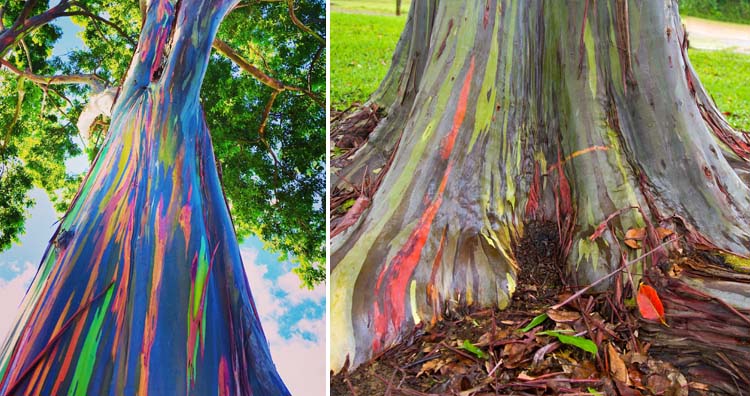
Eucalyptus deglupta, Native to Indonesia, Papua New Guinea, and the Philippines, this stunningly colorful tree has rightfully earned the nickname "Rainbow Eucalyptus." Known for its multicolored bark, the tree resembles a sharpened colored pencil. This unique coloration is due to the way the bark is shed: initially, the inner, bright green bark is exposed. Over time, this part ages and changes color, acquiring various shades of burgundy, orange, purple, and blue. The bark is not shed all at once; different layers fall and age at different times, creating a mesmerizing pattern.
Besides looking like something out of a painting, the rainbow eucalyptus tree, also known as the rainbow gum or Mindanao gum, possesses many other impressive features. For example, this fast-growing tree reaches heights of 197 to 246 feet, with a trunk diameter of up to 94 inches. It is one of only four eucalyptus species native to Australia, where there are over 700 species of this tree. Eucalyptus deglupta is also the only species eucalyptus , growing in tropical forests.
Rainbow eucalyptus is found in botanical gardens worldwide and is also planted as an ornamental tree in places like Southern California, Louisiana, Texas, and Hawaii. The tree has high commercial value and is grown on plantations to produce wood used in the production of white paper. So the next time you pick up a blank sheet of white paper, remember that it may have had a colorful origin. (1, 2)
2. Crooked Forest Griffino

The Crooked Forest, located in the Polish town of Gryfino, is the perfect blend of ecological anomaly and science fiction. This mysterious forest is known for its grove of bizarrely shaped pine trees, planted around 1930. All 400 pines in this grove have an unusual J-shape. All the trees are equally curved sideways, approximately 90 to 2.7 meters at the base, and all straighten out, reaching heights of up to 15 meters. No one knows what caused the trees to grow this way, but countless theories exist, although evidence to support them is scant.
Some have hypothesized that the trees grow with a northward bend due to a strange gravitational pull in the area. However, this theory contradicts the basic scientific fact that gravity acts downward, which could not cause the trees to bend. Others have suggested that heavy snowfall weighed down the trees during their growth, causing their bases to curve. This theory fails to explain why other trees in the area do not exhibit a similar effect.
However, the most common and plausible explanation is that the locals used some kind of tool to deform trees in such a way as to produce curved wood that could be used for building boats or furniture. (1, 2)
3. Canary Islands Dragon Tree
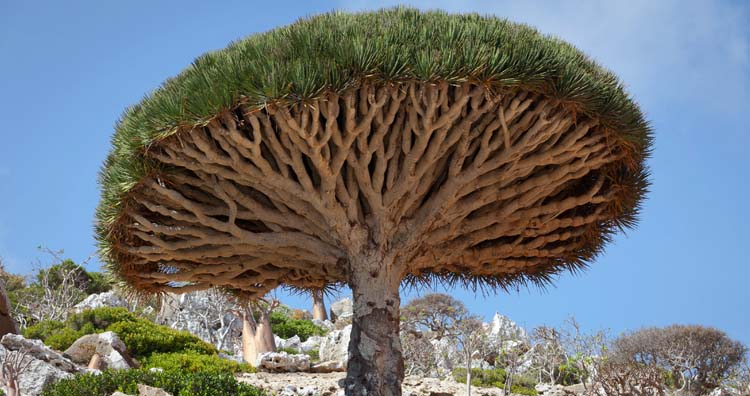
Dracaena draco , commonly known as the "Canary Island dragon tree," is renowned for its umbrella-shaped form. This subtropical tree, native to the Canary Islands, Madeira, and Cape Verde, belongs to the asparagus family. Young plants have a single stem, which ceases growth at approximately 10-15 years. Around this time, the first flower stalk appears, bearing fragrant white flowers and coral-colored berries. After this, a crown of terminal buds forms, and the tree begins to branch. Each branch grows for another 10-15 years until it produces a new branch. This is how mature trees acquire their umbrella-shaped form.
Plants of the genus Dracaena draco They grow slowly and can take up to ten years to reach four feet in height. Being monocots, Canary Island dragon trees lack the growth rings typically found in other trees. Therefore, the age of these trees is determined by the number of branching points reaching the crown. The oldest living specimen, called "El Drago Milenario," or "the thousand-year dragon," is located in Icod de los Vinos on Tenerife. This tree is estimated to be approximately 365 years old.
When cut, the leaves and bark of this tree exude a reddish resin known as "dragon's blood," which has several traditional medicinal uses, and the Guanches used it in the mummification process. In ancient Rome, the red resin was used as a dye, and in Europe, it was used as an antioxidant and varnish.
( 1, 2)
4. La Sabina in Spain

«"La Sabina" is the name of a strangely deformed tree that grows on the island of El Hierro, one of the Canary Islands. View Juniperus Cedrus , The Canary Island juniper, also known as the Canary Island juniper, is a large shrub reaching heights of five to twenty meters. This hardy tree can thrive in the most inhospitable locations. When growing in areas exposed to strong winds, the tree becomes twisted and deformed. Although the trunk remains upright, the branches bend downward, touching the ground, creating its famous, bizarre shape.
Due to a combination of overgrazing by goats and logging cedar juniper (Juniperus cedrus) has become endangered in its native range. This species has been fully protected since 1953, and its population is currently growing very slowly. (1, 2)
5. Wawona Tree

The Wawona Tree, also known as the "Wawona Tunnel Tree," stood in Mariposa Grove in Yosemite National Park until February 1969. This giant sequoia stood 227 feet tall and 26 feet in diameter at the base. In 1881, the Yosemite Stage and Turnpike Company hired two men known as the Scribner Brothers to cut a tunnel through the enormous tree. The site soon became a popular tourist attraction, with people coming to take photos while driving through the tunnel or simply standing beneath it.
The exact origin of the name "Wawona" is unknown, but it is said that Native Americans named it Vavo'na , meaning "owl hoot" or "big tree." The birds are believed to be the spiritual guardians of the redwoods.
In 1969, a massive snowfall on the tree's crown destroyed this gigantic tree. At the time, its age was estimated at 2,300 years. After the tree fell, there was considerable debate about what to do with it, but authorities decided to leave it where it fell for environmental reasons. People still visit the site, now known as the "Fallen Tree Tunnel.". (1, 2)