








The world we live in is made up of a multitude of emotions. While one part of the world was in joy, another could be plunged into the darkness of sadness. We never know what will happen in a moment, but we try to capture the present moment, sometimes in memory, sometimes in photographs. Memories may fade with time, but photographs will always be a constant reminder of the past. Every photograph tells its own story. So, we've compiled ten of the most famous and unknown stories associated with these iconic photographs.
1. View from the window of the Le Gras restaurant
«"View from the Window at Le Gras" is the world's first successful and lasting photograph. It was taken by Nicéphore Niépce in 1826. It took him eight hours to create.
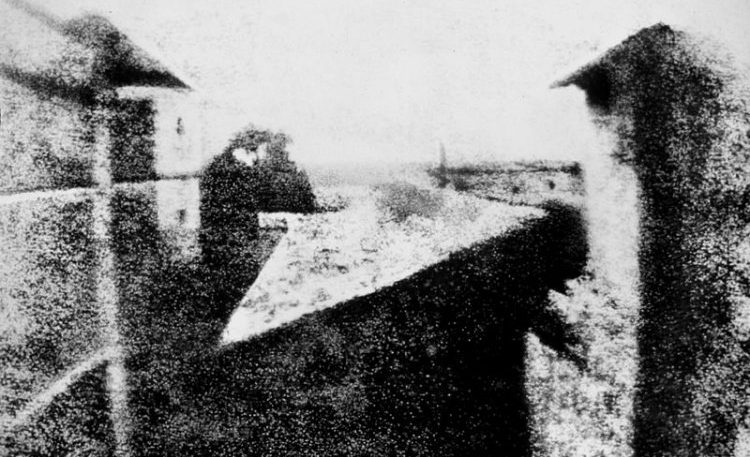
The world's first photograph, "View from the Window at Le Grâce," was taken by the French inventor Joseph Nicéphore Niépce in 1826 from the window of his studio in France. Lithography was a popular method of creating images at the time, and Joseph was fascinated by it. However, he was a poor draftsman and relied on his son to complete the process.
When his son Joseph was drafted into the army, he began searching for alternative methods of creating images. He decided to use a camera obscura. Since he was a poor artist, he considered using a light-sensitive material to allow the light to "etch" the image for him. Through trial and error, he settled on a combination of bitumen from Judea coated on a tin plate.
He left this petroleum-based substance in a camera obscura for eight hours without interruption. The light gradually hardened the bitumen where it hit, creating a primitive photograph. He then washed away the unhardened bitumen with lavender water, creating an image of the roofs and trees visible from his studio window. Thus, Joseph Nicéphore Niépce successfully developed the world's first photograph. (1,2)
2. Lunch at the top of a skyscraper
The photograph "Lunch atop a Skyscraper" was taken during construction of 30 Rockefeller Plaza. It depicts eleven men seated 840 feet above the New York City streets, enjoying lunch. It is believed to be staged.
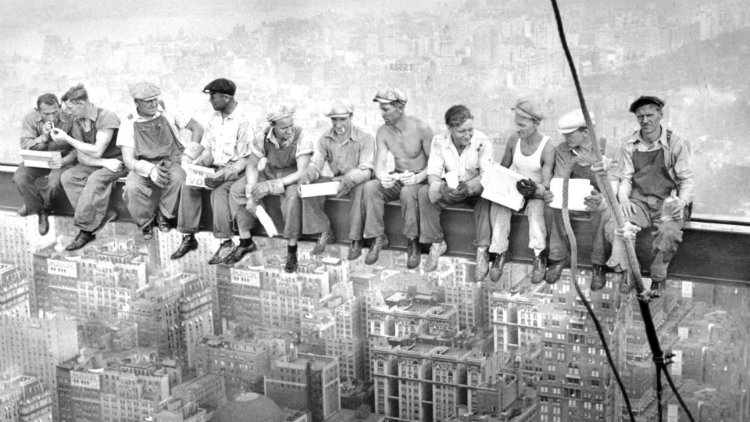
The famous photograph "Lunch atop a Skyscraper," also known as "Workers at Work," is one of the most iconic photographs of all time. It was taken on September 20, 1932, when Rockefeller Center was in its final stages of construction. The photograph depicts eleven men eating lunch on a beam 840 feet above the streets of New York City. According to archivists, the photograph was staged. The men depicted in the picture were real ironworkers, most of them of Irish descent. However, it is believed that the moment was staged by Rockefeller Center to promote its new skyscraper.
This photograph was taken during the Great Depression, when the city was in crisis. Men of that era were willing to take on any job, despite safety concerns, as evidenced by the lack of safety harnesses.
There have been numerous claims regarding the true identities of the men in the photograph, but few have been confirmed. From left to right: number three is Josef Eckner, number four is Michael Breheny, number five is Albin Svensson, and number six, with a cigarette, is John (Jack) Patrick Madden. The first man on the right is a Slovak worker, Gustav (Gusti) Popovic. In 1932, Gusti sent his wife Mariska a postcard with this photograph, writing: "Don't worry, dear Mariska, as you can see, I'm still with the bottle. Your Gusti.". (1,2,3)
3. A Jewish boy surrendered in Warsaw
This 1943 photograph taken in the Warsaw Ghetto shows a frightened and apparently doomed boy with his hands raised, standing with other Warsaw Ghetto Jews under the watchful eye of armed German soldiers.
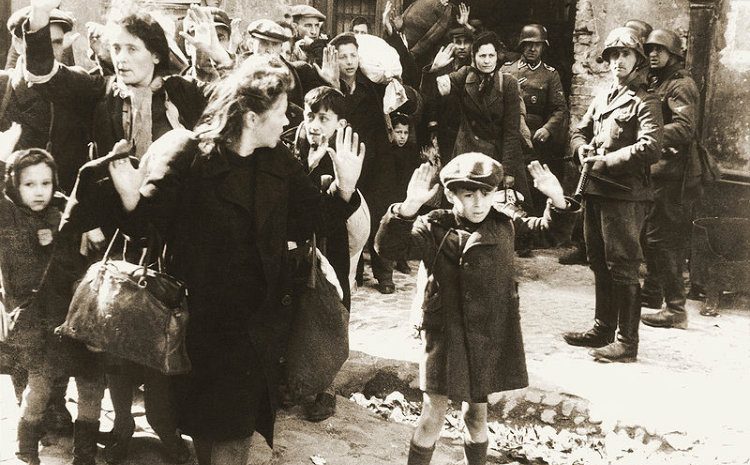
The photograph "Jewish Boy Surrendering in Warsaw" is one of the most iconic photographs of the German Holocaust. It captures the horror engendered by monstrous tyranny: a child wearing a newsboy cap raises his hands in surrender during a roundup of Warsaw's Jews. This was the final roundup of Jews condemned to death during the Warsaw Ghetto Uprising in 1943. The photograph was one of 52 black-and-white images contained in SS General Stroop's report on the liquidation of the ghetto. Originally titled "The Jewish Quarter of Warsaw No More!", the report detailed the operation in April and May 1943 to liberate the Warsaw Ghetto and deport the remaining men, women, and children.
The true identity of the terrified boy is unknown, though many theories have been put forward. The only person in the photograph who has been identified is the German guard pointing a machine gun at the boy. This was SS-Rottenführer Josef Blosche, a feared figure who often teamed up with others to terrorize ghetto inhabitants during hunting expeditions, killing at random anyone he chose.
Upon his arrest, Blosche made the following statement: "In the photograph, I, as a Gestapo officer in the Warsaw Ghetto, am, along with a group of SS men, driving a large number of Jewish citizens out of a house. The group of Jewish citizens consists primarily of children, women, and elderly people, who are driven out of the house through the gate with their hands raised. The Jewish citizens are then taken to the so-called 'Umschlagplatz,' from where they are transported to the Treblinka death camp.". (1,2,3)
4. Dali Atomicus
Inspired by Dalí's painting "Leda Atomic," photographer Philippe Halsman created a complex composition surrounding the artist. It took 26 attempts to achieve the perfect shot.

Before Photoshop, there was a dynamic duo of artist and photographer creating extravagant portraits. The artist was Salvador Dalí, and the photographer was Philippe Halsman. Halsman met Dalí when he was living in Paris in the 1930s. In 1949, Dalí painted "Leda Atomicus," where "atomicus" refers to anything suspended in space.
The painting depicts Leda, the mythological queen of Sparta, with a swan, while various objects float around them, such as a book, a square, two stepladders, and an egg.
Inspired by this painting, Halsman collaborated with Dalí on a photography project. Dalí's initial idea was to use a duck, stuff dynamite up its backside, and then blow it up. But Halsman refused, as it could get them arrested. After some deliberation, they came up with an idea involving three cats and water. They used invisible wire to suspend an easel, a stool, and the painting "Leda Atomicus," while Dalí's wife held the stool.
Halsman counted to four, and after three, the assistants tossed the water and cats into the air, and on the count of four, Dalí jumped. The idea of keeping everything suspended was challenging because it had to be captured in one continuous shot. Dalí and Halsman achieved the magical, gravity-defying shot after 26 attempts. (1,2,3)
5. Babe leaves.
This is a photograph of one of baseball's greatest players, Babe Ruth, standing amid the deafening cheers of 50,000 fans. Photographer Neil Fine captured him humbly accepting the crowd's cheers for the last time in his life.

On June 13, 1948, a young New Yorker named Nat Fine captured one of the greatest photographs of all time—Babe Ruth's final game at Yankee Stadium. The photograph, titled "Babe Goes Out," won the Pulitzer Prize. It was the first sports photograph to win this prestigious award.
Fine was a copy editor at the New York Herald-Tribune, but he also had a keen eye for photography. When the sports photographer fell ill, Fine was sent to Yankee Stadium to capture the 25th anniversary of "The House That Ruth Built." The stadium was to host the retirement ceremony for Babe Ruth's jersey number. Thin and weak from a long illness, Ruth emerged from the dugout to a thunderous ovation from his fans.
Nat Fien captured a rear-facing shot that effectively conveyed the significance of the stadium's anniversary, the retired numbers and uniforms, and the hunched figure of an ailing Babe Ruth. Ruth's identity was unmistakable even without his face. This magnificent photograph is housed in the Smithsonian Institution and the National Baseball Hall of Fame alongside the immortal uniform. (1,2)