








Throughout the evolutionary history of planet Earth, numerous mass extinctions have occurred, wiping out many early species. These mass extinctions were always followed by the birth of new species and the further evolution of the surviving older species. During these geological periods, animals were several times larger than they are today and possessed far more deadly hunting tools. Life as we know it today would likely be very different, not to mention much more complex, if not for these extinctions. So, here are some details about ten such colossal creatures that are now extinct and will not bother us except in science fiction films.
1. Dunkleosteus
This was a fish from the Late Devonian, living 358-382 million years ago. It could reach six meters in length, weigh one ton, and possess a bite force of 7,400 newtons.

Dunkleosteus is an extinct genus of arthrodire placoderm fishes with heavy armored skin and powerful jaws. They were top-of-the-food-chain predators and are believed to have existed for approximately 70 million years. At least ten different species of this genus have been identified, and their fossils have been found across the continents of Europe, Africa, and the Americas.
One of the distinctive features of Dunkleosteus is that instead of teeth, it has two pairs of sharp bony plates, forming a beak-like structure. Although they are slow swimmers, their bite is extremely powerful, reaching an estimated 6,000 newtons at the tip and 7,400 newtons at the blade. It took them about 20 milliseconds to open their mouths and only 50-60 milliseconds for a full snap. With such speed and strength, they could easily pierce the skin of any armored prey. (source)
2. Megalodon
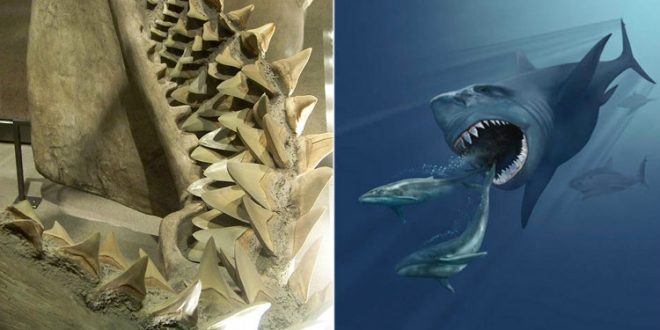
It was an extinct species of shark that was considered one of the largest and most powerful vertebrate predators, reaching lengths of 18 metres (59 feet) and having teeth 7.1 inches long.
Megalodons lived approximately 23 to 2.6 million years ago during the Cenozoic Era. The most common fossils of this species are sets of teeth, which feature large V-shaped structures, the largest of any known shark species, as well as some vertebrae. Megalodons are estimated to have had a bite force of 108,514 newtons, nearly ten times greater than that of the largest great white shark today, which can reach 18,216 newtons. Megalodons were formidable predators due to their enormous size, ability to swim at high speeds, and powerful bite. They are believed to have employed complex hunting strategies and preyed on whales, dolphins, and giant sea turtles. (source)
3. Titanoboa
It was the most massive snake ever to live on Earth, estimated to be 12.8 meters (42 feet) long and weighing approximately 1,135 kilograms (2,500 pounds).
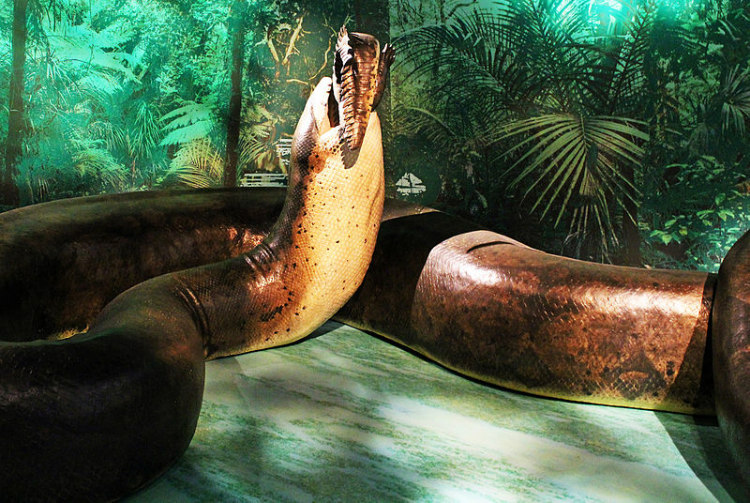
Titanoboa, which existed approximately 58-60 million years ago, was so large that it surpassed the record for largest snake, previously held by Gigantophis. It lived primarily in the tropics, and it is believed that the relatively warm climate allowed it to grow to sizes larger than any modern snake. It fed primarily on the aquatic creatures of its time. (source)
4. Mosasaur
It was an extinct aquatic reptile that grew up to 17 metres (56 feet) in length and weighed around 5,000 kilograms.
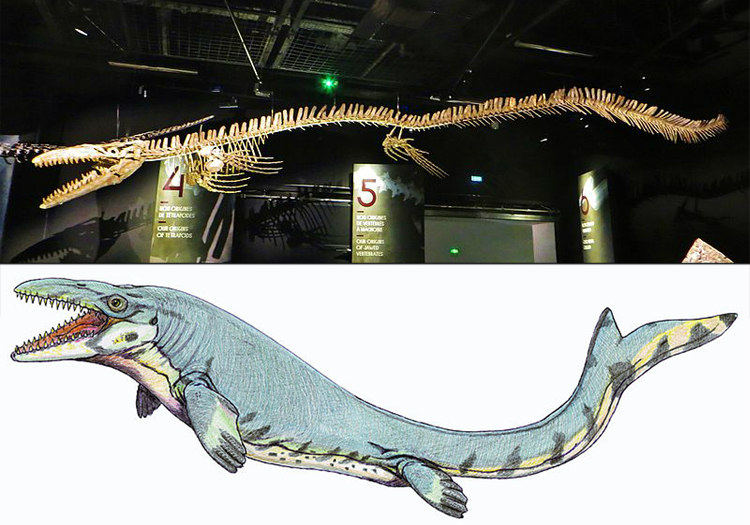
Mosasaurus lived approximately 70–66 million years ago, during the Maastrichtian stage of the late Cretaceous period. Its fossils were first discovered in the 18th century in the Netherlands, and it is considered one of the largest mosasaurs. They were barrel-shaped creatures with a very robust skull, to which the lower jaw was firmly attached. They had large eyes, although with poor binocular vision, and large conical teeth. They had paddle-like limbs, and although they could dive, they did not venture into deep water. They primarily hunted fish, turtles, ammonites, smaller mosasaurs, pterosaurs, and plesiosaurs. (1, 2)
5. Edestus giganteus
Also known as the "scissortooth shark," it can reach 6 meters in length, similar in size to the modern great white shark. Its distinctive feature is a single row of teeth in each jaw, resembling enormous, serrated scissors.
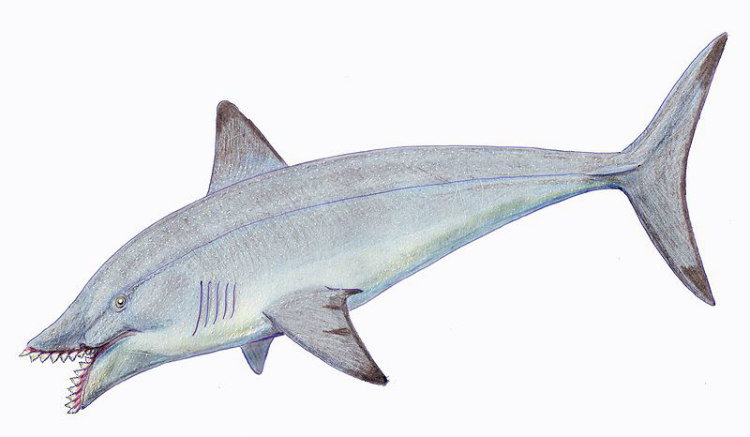
Edestus giganteus lived during the late Carboniferous period, approximately 306–299 million years ago. Despite its relatively smaller size compared to the sharks mentioned above, Edestus were ferocious hunters. Wear marks on their teeth indicate that they often struck their prey vertically, inflicting lacerations to immobilize it, and then swallowed it. Unlike modern sharks, Edestus did not shed their teeth when they wore down or broke. Instead, they grew new teeth at the back of their mouths, pushing out the old ones until they protruded. (source)
6. Pulmonoscorpius
It was a giant species of extinct scorpion, reaching 0.7 meters (28 inches) in length.

The lung scorpion (Pulmonoscorpius) lived during the Visean period of the Carboniferous period, and its fossils were discovered in Scotland in 1994. Its large eyes are thought to have given it excellent vision. Unlike common scorpions, it inhabited swamps, not forests or deserts. It also had small pincers relative to its body size, but a very thick tail. Although the exact potency of its venom is unknown, the venom of scorpions with thick tails and small pincers is generally very potent. Therefore, the lung scorpion could sting its prey to death. Its prey could include arthropods and primitive tetrapods. (1, 2, 3)
7. Carbonemys cofrinii
It was an extinct species of turtle, one of the largest in the world. Its shell was approximately 1.72 meters (5 feet 8 inches) long, and its jaws were massive and strong enough to eat crocodiles.

Carbonemys dates back to the period between 60 and 58 million years ago, beginning five million years after the Earth collided with an asteroid. This impact led to the mass extinction of approximately three-quarters of plant and animal species (the K-T extinction event), ending the Cretaceous Period. Carbonemys was a contemporary of Titanoboa and possessed jaws strong enough to consume crocodilians (crocodiles, alligators, caimans, and gharials). (source)
8. Short-faced bear
It was an extinct North American bear, the largest of which weighed about 957 kilograms (2,110 lb) and stood 3.4 to 3.7 metres (11–12 ft) tall when standing on its hind legs.

The short-faced bear existed during the Pleistocene, from approximately 1.8 million years ago to 11,000 years ago. It was abundant in California and is considered one of the largest known land mammalian carnivores. It is believed to have become extinct due to a global cooling event beginning around 10,900 BC. Walking on all fours, the short-faced bear stood 1.5–1.8 meters (five to six feet) tall and could easily look an adult human in the eye. Given its long legs, it is believed to have run at speeds of 50–70 kilometers per hour, hunting herbivores such as wild horses and saiga antelopes. (source)
9. Helicoprion
It was a long-lived, extinct shark-like fish, about 12 metres (39 feet) long, with a spirally arranged cluster of teeth called a "dentary whorl" that was about 0.6 metres (two feet) long.

Helicoprion lived during the early Permian period, 290 million years ago, and its closest living relatives are chimaeras. As a cartilaginous fish, its body completely disintegrates after death. The only preserved and fossilized parts were teeth, which weren't identified as belonging to Helicoprion until the skull of another related genus was discovered. Helicoprion had no teeth in the upper jaw, and the exact location of the tooth row in the mouth is unknown. Reconstructions depict a tooth row at the tip of the lower jaw and are based on the skulls of its relatives. (source)
10. Fasolasuchus
This extinct predatory archosaur from the Triassic period was estimated to have been between eight and ten meters (26 and 33 feet) long. It is considered the largest land predator to have ever lived, excluding large theropods.
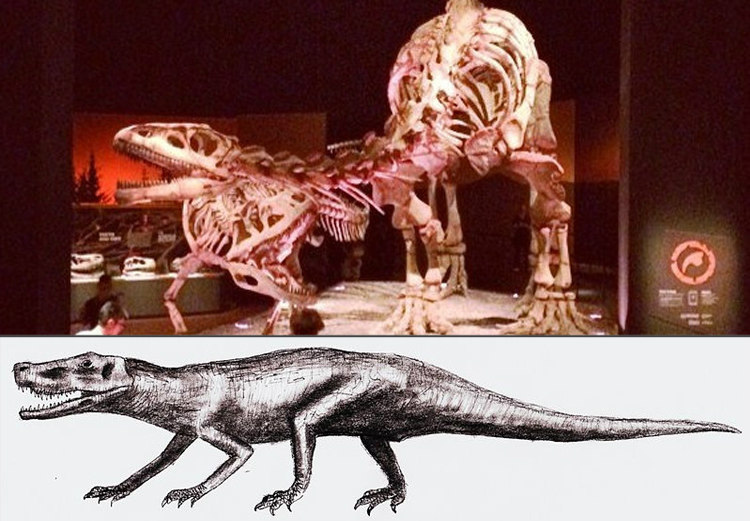
Phasolasuchus belongs to the Rhaetian stage, which existed 208.5–201.3 million years ago, during the Late Triassic, and its fossils have been found primarily in Argentina. Unlike its relatives, which had a denser covering, it had only a single row of osteoderms—bony deposits on the skin in the form of scales, plates, or other structures. Its size gave it a natural advantage over other predatory dinosaurs, making it an apex predator. (1, 2)