






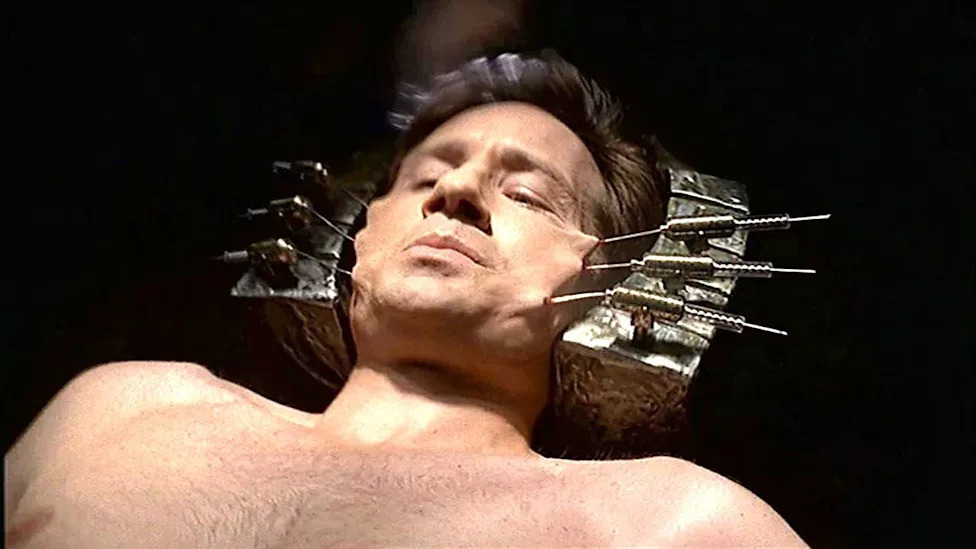
«The X-Files »" have always been known for their penchant for pushing boundaries. This often led to conflicts with censors. Sometimes, this required minor script adjustments. For example, the network rejected the script for the episode "Irresistible" because it described the antagonist Donnie Pfaster as a necrophiliac. Chris Carter reluctantly changed this to "death fetishist" for the episode, a term that is arguably even stranger. Later, the episode "Home" proved so macabre (featuring an incestuous family of murderers from the outback) that it was temporarily banned from reruns by the network.
As irritating as the above examples are, they're understandable. Many families watched the show together in prime time, and Fox likely didn't want parents asking too many questions about necrophilia and incest. However, censorship eventually forced creators of The X-Files« Add one sound effect to an episode, and it was for the dumbest reason. In "Endgame," Scully fights an alien bounty hunter and gets thrown through a table. Standards and Guidelines forced the show's creators to add a wheezing sound effect because they were afraid viewers would think her character had just been killed!
Prepare for battle!
It's no secret that «The X-Files» eventually faded, becoming a long-running show. However, the second season was at its peak, and it was then that we got a gripping story, divided into two episodes: "Colony" and "Endgame." Mulder and Scully take on a case investigating a group of clone scientists, and suddenly Mulder's sister appears. Unfortunately, she turns out to be a clone too, and all these copies are being tracked by a mysterious alien bounty hunter. He ends up in a fight with both Mulder and Scully.
In a subsequent fight, Mulder ends up in critical condition. As for Scully, at the beginning of "Endgame," she's attacked by a bounty hunter, and they have a brief but brutal fight. At one point, the villain (wearing Mulder's mask, incidentally) smashes her table. In the original version, actress Gillian Anderson, who played Scully, didn't make any sounds, but this didn't satisfy Standards and Practices. They forced the addition of a wheezing sound effect to the series so viewers would know Scully was still alive. In the audio commentary for "Endgame," screenwriter Frank Spotnitz described this as a kind of "mysterious, strange logic you have to deal with when you're broadcasting a show on mainstream television.".
Table, One. Scully, Zero.
Spotnitz is right in arguing that the Standards and Practices Department's requirement was absurd. Most viewers «The X-Files» would have guessed that the show wasn't planning on killing off one of its two main characters midway through season two. Furthermore, no matter how brutal the bounty hunter's beating may have been, nothing in that scene suggests Scully actually died. Finally, for those who was stupid enough to think she could die right there on screen, that sound effect doesn't inspire optimism; wouldn't the moans emitted before a violent death be both believable and reasonable?
Fortunately, this strange censorship requirement didn't ruin "Endgame." It remains one of the best episodes. «"The X-Files »", thanks in large part to how badass the alien bounty hunter is. He first appeared when the series was must-see viewing, long before it finally faded away. Eventually, of course, «The X-Files» died, and many of their longtime fans didn't mourn them. We knew the series had been effectively dead for a long time, thanks to repetitive plots, irritating correspondence, and disappointing endings. And, of course, the main reason: no one chuckled to assure us the franchise was still alive!