






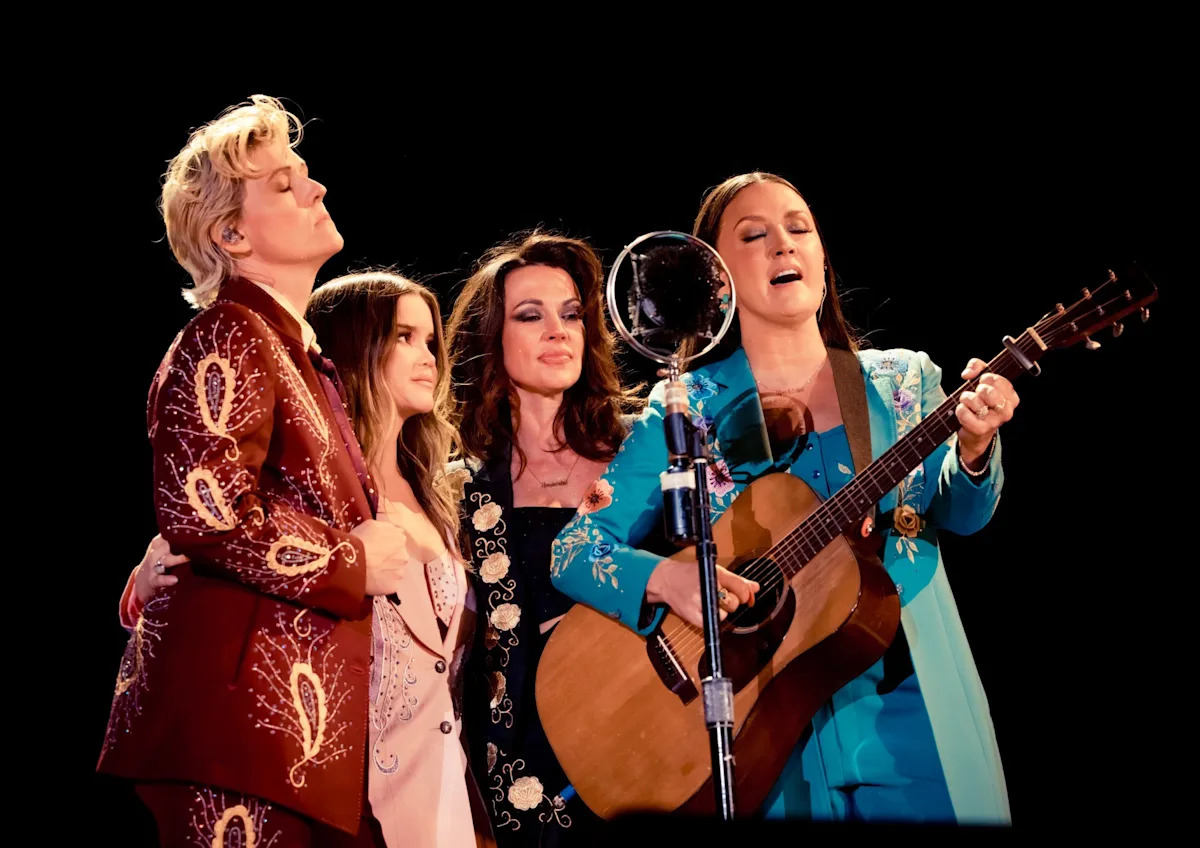
In the seven years since the release of the Highwomen's self-titled debut album, the quartet of Brandi Carlile, Natalie Hemby, Maren Morris, and Amanda Shires has lived enough lives to fill countless classic country songs: they've had children and raised others, filed for and finalized divorces, and survived pandemics. They've won Grammy Awards and released eight solo albums. They've lost loved ones.
«"And a uterus!" jokes Natalie Hemby, sitting in the dressing room between rehearsals with her bandmates. Only a group like Highwomen, made up of female artists who insist on telling women's stories in a genre where country radio playlists are dominated by songs about beer, trucks, and fishing performed by men, could start with a joke about a hysterectomy.
More from Rolling Stone
-
Joan Baez urges pop stars to speak out on politics: 'Just take that one small step.'.
-
Braxton Keith is taking country music back to its roots.
-
Margo Price, Brandi Carlile, Charley Crockett nominated for 2026 Americana Honors.
It's Thursday, the day before Highwomen's performance at Carlile's Echoes Through the Canyon concert series in Gorge, Washington, and the champagne (and pre-rehydration) is already flowing. This is the band's first reunion since their last show at the same venue in 2023, the live album from which they just released digitally. Their Nudie suits are pressed, the kids are with them, and, according to Shires, they'll be playing under a full moon.
«"Shires will be furious," Carlisle says. "I guarantee it." Shires doesn't argue.
Much has changed for the Highwomen, but so has the genre itself. In the years since the group came together to challenge the persistent gender imbalance on country radio, significant progress has been made. Ella Langley broke numerous records with "Choosin' Texas," and Laini Wilson and Megan Moroney dominated awards shows, album sales, and, at times, airplay. Collaboration, not competition—the core tenet of the Highwomen's philosophy—is thriving. Women produce each other's records, write songs together, and compete for space for many when the default is for only one, or even none. Even Miranda Lambert and Kacey Musgraves have reconciled. The Highwomen may not have convinced radio programmers to play their songs, but their mission has permeated listeners' consciousness.
Despite all these successes, the outlook for country radio remains bleak. This week, Mediabase's country music top 20 features only two songs by women. LGBTQ+ voices are rare, and transgender artists and Black women are virtually absent. These days, however, the Highwomen are less concerned about radio and more optimistic about the power of community in country music. When they take the stage a few days later, they'll be joined by a cross-genre and generational group: Bonnie Raitt, Wynonna Judd, Sheryl Crow, Allison Russell, Linda Perry, and Brittney Spencer, and even their own children during a performance of "Only Child." Creating a crowded space is always part of the process.
«"There's no shortage of talent, just opportunities," says Shires, who came up with the idea for the Highwomen after an unsuccessful call to a country radio station asking for more female leads. "Do you want to be in your own little castle or have a group of girlfriends?"»
The Highwomen's next show is July 19 at Red Rocks Amphitheater, where Morris will be joined by the Colorado Symphony Orchestra ("It's going to be crazy," Morris says. "I'll definitely be recording it.") A new album is also in the works. They're discussing summer plans and actively sharing ideas in a group chat.
«"The four of us are the closest thing we have to a superpower," Shires says.
The general reaction to your reunion seems to be:« Thank God, we need this so much now. »"What do you think makes this such a good time for the Highwomen to return? It's been seven years since we met on the tour bus on the set of the video clip "Redesigning Women". Maren Morris: I know why I need this. I'm approaching the end of many important milestones and an album cycle, and I've been through a lot of hardships over the past few years. I'm here for the fans and new fans who just discovered us. Maybe it's my TikTok algorithm, but every other video is from a [2023] concert, and that's refreshing and really necessary right now.
Brandi Carlile: I also love how our friendship is developing now. We met to play in a band—everything was new. It was like a love affair, but we didn't really know each other. We've been through so much over the past seven years that, without any strings attached, we'd call each other and ask, "Hey, how are you? Let's talk about what you've been through." It was like we got married, and then we became partners.
Is it different going on stage because we know each other so well and have been through so much personally? Amanda Shires: More grey hair and clearer boundaries.
Carlisle: I still know no boundaries.
Shires: I think this time we have less to prove and more to enjoy life, not in relation to the world or anything like that, but just as a group.
Morris: The pressure's off. We can just enjoy each other's company, what we've been through, and the solo projects we've had. It's been such a relief to be in a group and not have all the attention on our shoulders. I also think that whenever we're in a crowd that belongs to Brandy, it's a crowd that she and the artists she invites to perform have created. So you can be sure you're in for a truly wonderful, safe, and spiritual weekend.
Shires: She creates an environment where people can be themselves, which is difficult because it takes a lot of trust to feel free.
Morris: Along the way, you lose fans as you build a fan base and become your own artist. You lose some, but then you gain a loyal following.
Carlisle: This is something Maren has certainly experienced many times, we've all experienced it at different times, and it's very difficult to overcome because no one becomes an artist to push people away. But at some point, you have to fight for something, otherwise you can give in to anything. Standing up for your rights and losing people, but at the same time finding those in need—that's very important. I watch Maren perform and am very proud of her.
Morris: It means so much, especially coming from you. You've all been so supportive. When we started, it was a positive way to address the lack of stories being told in the country's mainstream. Of course, that's still true, but I think we had something to prove back then. Almost like a manifesto.
Carlisle: At the time, it was amazing that [Maren] was successful. But I just couldn't believe it. I couldn't believe there were absolutely no women in country music having No. 1 radio hits. I remember Dave Cobb really wanted [Hemby] to write us a hit. She sent me a demo of "Crowded Table," and I was like, "Damn, this is it!" And he said, "Maybe something uptempo." And then, like nothing happened, she released "Redesigning Women." But those two songs, or the beginnings of songs, became the sound of our band because of the way she sang on the demos, and that's how we all sing in unison now.
It's unique that we were able to define the "sound of the band" so early on, especially considering that each of you already have recognizable and developed solo careers. Carlisle: We sound like ourselves. I really noticed that while working on this live album. We realized, "We have a real musical identity." We came together with a purpose, and it became so musical, and now it's personal. Now that all three of those things are aligning, it's really cool. Because, I don't know about you guys, but when I put a Highwomen song on the setlist, the crowd goes crazy.
Shires: When we all do this together, there is something bigger in this matter than ourselves.
Natalie Hemby: I think there is some kind of divine thread between the four of us.
You've always said that Highwomen is not just a group but a movement. Has your vision and approach to inclusivity changed over the years? Shires: Everything's still the same, except now we have more space at the table and a better playlist. I think there's still a lot of work to do, that's what I think.
Carlisle: I think everyone has their own reasons for keeping the Highwomen concept alive. What I love about the movement is that people are empowered en masse, their voices are amplified, whether they're in unison or not—it feels like a door is cracked open to let others in. It's something I've always loved doing in my career and art, and it's so much cooler and more fun to do as a foursome. We're as committed to supporting and advancing women and marginalized groups as we've always been, and we do that by building community with each other and with other people. That's what our shows will be, and that's what our music will be.
Morris: What we stand for, what's important to us, is the people we bring in. I think every show we do is a collaboration with our friends. We call it a kind of musical chairs: whether it's Brittney Spencer, Yola, or Sheryl Crow, we have people who help us improve our songs and support each other.
Putting your personal bandmates aside, is there room for men in Highwomen? Carlisle: We need men to keep this movement going. I'm not a man, but I can tell you that I'm raising daughters, and I don't want them to hear misogynistic and monotonous messages in modern country music. I want them to hear the same messages I heard in '90s country music, you know? I don't have to be a father to know that I want my daughters' anthems to inspire them, not make them sit in shorts in the passenger seat of someone's pickup truck.
Country radio sounds a little different now than it did in 2019. Ella Langley, Megan Moroney, and Laini Wilson have all found success. "Chosin' Texas" is incredibly popular, of course. But it still only accounts for a small percentage of what's played on the radio. Carlisle: These songs are just amazing. I can't get them out of my head. You should listen to them all the time.
Hemby: There are usually only five or six girls in the top 50.
Morris: And girls have to be outstanding. We have to be unique. We have to look different. We have to be eight times better, while getting half the money and half the coverage.
Shires: And the approach to verification is different.
Morris: The songwriting has to be top-notch. We have to do all that to get the attention of the public or a label, but the safest bet is always to find a guy who sounds like eight other guys, and girls are a risk they take. Ella, Lainey, Meg—they all sound completely different. Girls have always sounded that way. Carrie didn't sound like Miranda. Faith didn't sound like Martina.
Carlisle: Tanya [Tucker] always says the same thing. I don't want to be naive, but it's like when Maren was absolutely dominating country music and she didn't need to join a group because, you know, there aren't that many spots, and you've already filled one, and you've managed to break through. It's very tempting not to hold the door or not to join a community or a movement. A couple of weeks ago, I was at an event Billboard Women in Music, and Laney presented Ella with an award, and they're real friends. It's truly inspiring.
Hemby: As Lainey said at that awards ceremony, "You need to stop pitting women against each other." I love seeing that.
Carlisle: And when women say, «Hey, I won’t be the only one still participating in this competition?»
Morris: I don't want to carry the ladder with me. I wonder if Highwomen would have been possible in 2026, when women finally dominate the airwaves.
Shires: I think we were part of a certain cultural trend at the time because we women had the courage to do what we did.
Hemby: Leibs .
I think a song like "Chosin' Texas" can be compared to the Highwomen. Radio programmers may not have played your songs often, if ever, but you helped them get used to both a female perspective and a more country sound with a distinctive "country groove." Brandy, I remember you were very keen to get the group on the air. Carlisle: Maren said, "It will never happen," and I said, "It will!"«
Morris: [Brandy] was so hopeful because she grew up in a completely different environment [of country music], and then when she encountered the system, she realized, if they let you in, you should probably just shut up because you're lucky to be there. But I just realized that this isn't the dream I had when I was singing into a shampoo bottle. I didn't want to ruin anyone's day when I said to Brandy, "Let's do the radio tour interview, but I don't think they'll have the guts to go and try it out.".
Carlisle: Perhaps they don't even have the authority to do so. Perhaps they're too heavily influenced by corporate structures.
Shires: Since the album's release, we've seen more women in positions we didn't have before. There are more female engineers, more female producers. And more women in radio. Maybe we'll continue to move forward, and whatever will be, will be. I'm just trying to stay optimistic.
Carlisle : I just don't need to be called a "country musician.".
Morris: I don't care what people call me. I don't think I'm as cynical or stubborn as I was seven years ago. I don't know if I'm exhausted or wiser, maybe both. Motherhood has changed me. While I can still be a bitch, I'm more gentle about it now. This is one of those projects that I hope will be part of my entire biography, eight chapters long. Every time I listen to these songs, they remind me of the cozy, nostalgic country where I grew up, where I felt safe and at home, even though we express so much activism, humor, pain, and life. My nervous system feels so balanced when I listen to them.
Shires: And I don't think we should force what we're trying to do on everyone. Enough people know what we're trying to do, and that's liberating. I'm looking forward to seeing where this takes us.
Hemby: Now radio isn't really a goal anymore. It seems like the whole world is at our feet.
Carlisle: These criteria have changed too. What does a successful career even mean? We need to rethink that. The music industry is completely new from what we were doing before.
But the band's influence is clear, from the album's longevity to the artists Highwomen has inspired, such as queer country trio The Cowgays . Shires: The domino effect is amazing, but sometimes I think it would be better if the decline was more significant, but I also understand how difficult it is to do that when there are still many people in the way.
Hemby: The Highwomen didn't have what you might call a "big hit" on the radio. But I've seen more and more people, more children's choirs, performing "Crowded Table." Many churches, many sing it at their graduations. That's success, that's what ensures long-term popularity. Yes, I want more women on the radio, but it's not just about that. It has to be good songs. It has to be great music. It has to be the right time.
Carlisle: We didn't come in and say, "Listen to us just because there are four of us." We said, "Try and deny this album." It will stand the test of time, and it's definitely one of the greatest projects I've ever been a part of. It's my kids' favorite album.
Hemby: The album touches on a variety of topics, but it's not preachy. It's based on what we've been through. We've been through the deaths of our fathers. We've been through motherhood, not wanting to get up in the morning and dreaming of going on tour. We've been through a lot. I think that's why it resonates with so many people.
Carlisle: And we have something to say again. My life has really changed. Everyone has become a little more gay.
By the way... Maren, you came out after the album's release. Do you feel like you can sing "If She Ever Leaves Me" a little more freely now? Carlisle: I must say, I always thought of Maren when I sang the line:« After the third sip you will understand that she is mine.".
Morris: Oh, we're revealing something! I'm going to sing it differently this time. Everyone's a little gay [ sings ]. Except Natalie.
Hemby: I am everyone's mother.
Carlisle: You and Joni are the most heterosexual women I know.
Hem : But I know so many straight women who are in love with [Brandi].
Now to the question that's on everyone's mind: how are things going with the new album? Morris: Amanda has already come up with a title for the second album, what is it?
Shires: This is just a temporary replacement: «Saloon Psychosis» . Natalie and I had some ideas the other day.
Carlisle: I see song lyrics in our messages. We all discuss songwriting, how to contribute, and when our schedules allow, but we'll prioritize and get together to write a new set of songs.
Morris: When I finish touring this summer, I'll have nothing for the first time in ten years.
Shires: Let's do this. We've been through a lot. We have many more stories to tell, and we can't be defined by ten songs.
The Best of Rolling Stone
-
«Ben E. King's "Stand by Me": 21 Must-Hear Covers.
-
25 Songs That Are Actually Horrifying
-
All 286 Taylor Swift songs, listed in descending order of popularity.
Subscribe to the RollingStone newsletter. For the latest news, follow us on Facebook, Twitter, and Instagram.