






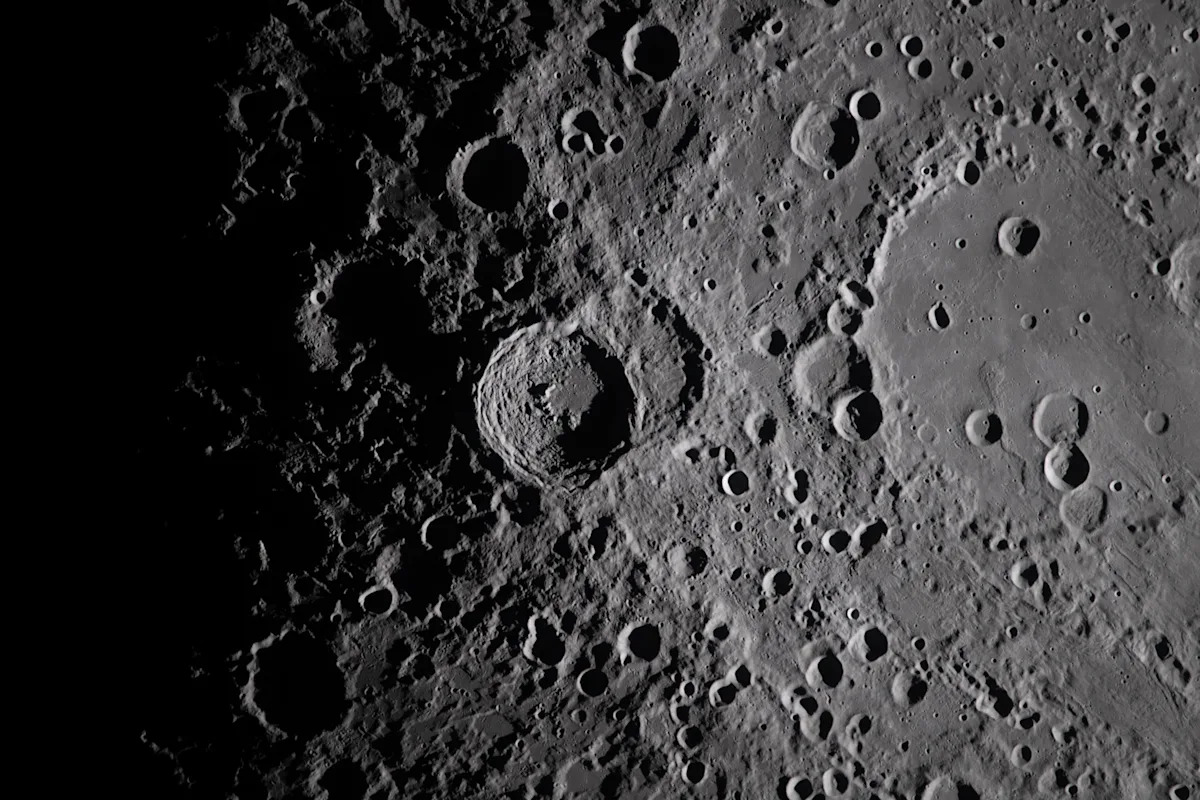
Millions of years ago, an asteroid slammed into the far side of the Moon, the hemisphere of which always faces away from Earth. In the coming years, a robot could land in the crater it left behind and build a radio telescope suitable for the future of astronomy.
This is the basis for an ambitious project called the Lunar Crater Radio Telescope (LCRT), which aims to transform a lunar crater into a telescope using self-assembling robots. The Moon blocks radio interference from Earth, and its far side is dotted with craters that could serve as a telescope dish. This makes it an ideal location for listening to faint radio waves emanating from the so-called cosmic dark ages—the mysterious era between the Big Bang and the birth of the first stars.
Hearing these ancient radio waves will allow scientists to probe the very nature of reality. "We'll find out whether our physics is correct, or whether we need to create new physics," says Saptarshi Bandyopadhyay, a robotics specialist at NASA's Jet Propulsion Laboratory in California and the lead investigator of the LCRT project.
This telescope, located in a lunar crater, is just one of several projects competing to conduct astronomical research on the far side of the Moon. The LCRT is still in development; it has not yet been built, and a launch date has not been set. However, a much smaller prototype telescope is scheduled to launch later this year. And with the recent acceleration of NASA's Artemis program, which promises a higher frequency of lunar missions—both manned and robotic—the idea of placing a radio telescope on the Moon has gained new momentum.
«"This opens a new window on the universe—and there aren't many of those left," says Michael Garrett, an astronomer and director of the Jodrell Bank Centre for Astrophysics in England. "This is the most important event.".
The Moon is pockmarked with impact craters, and NASA scientists behind the Lunar Crater Radio Telescope hope one of these craters could house a telescope large enough to capture ancient signals from the cosmic dark age. NASA
(Watch a rare solar eclipse from the far side of the Moon.)
Ghosts of the Early Universe
From exploding stars to planetary auroras, virtually everything that produces energy in space emits radio waves—the same waves your car radio converts into sound. Unlike visible light, these waves are invisible and inaudible to humans. Unfortunately, for astronomers hoping to hear them all, Earth acts as a megaphone: its ionosphere—the electrified layer of the planet's upper atmosphere—not only creates a loud noise, but all our technology is also unable to stop emitting artificial radio waves.
«"It's a terrifying noise," says Anze Slosar, a researcher at Brookhaven National Laboratory in New York. If you're an astronomer hoping to understand deep space, "it's like looking up from the bottom of a swimming pool." And there's little scientists can do from Earth. "The only way to avoid it is to hide from it," he says.
Luckily, just 240,000 miles away, there's a perfect hiding place. "The Moon is one of the best places for radio astronomy," says Garrett. Standing on the far side of the Moon, your back is turned to Earth, and the Moon acts as a giant geological barrier, blocking out the cacophony of the planets. And if you're taking measurements at night, it also filters out the Sun's own radio interference.
Without all this noise, a lunar telescope could pick up a multitude of signals that are harder for radio telescopes on Earth to detect. "This is also important for the search for extraterrestrial intelligence," says Garrett. One of the biggest obstacles to identifying a radio signal emanating from alien technology is trying to separate it from Earth's own radio interference. On the quiet far side of the Moon, this would be much easier.
Any radio astronomy research conducted on the Moon would be welcome. But detecting a signal from the "cosmic dark ages" is a long-term goal, says Slosar. About 380,000 years after the Big Bang, the universe was a mixture of neutral hydrogen gas. This hydrogen eventually clumps together and ignites, forming the first stars, but back then, all that existed was darkness.
But pure hydrogen emits radio waves of a very specific wavelength. This distant signal would be extremely faint, but if scientists could tune in to it, they could discover how ordinary matter interacts with the mysterious dark matter—the as-yet-undiscovered "glue" that binds the universe together—to shape the cosmos we inhabit today.
There's no guarantee a telescope on the far side of the Moon will be able to hear anything: even if the Earth and Sun are obscured, the hum of the Milky Way galaxy itself is still far louder than these hydrogen whispers. But if it does detect these whispers, our understanding of the universe will change forever. "This is completely uncharted territory," says Garrett.
(There is a huge mysterious spot on the far side of the Moon.)
Radio telescope researcher
First, scientists need to demonstrate the feasibility of conducting radio astronomy research on the Moon. This is the goal of the upcoming Lunar Surface Electromagnetics Experiment-Night (Lu-SEE Night), a collaboration between NASA, the Department of Energy's Brookhaven National Laboratory, and the University of California, Berkeley.
Lu-SEE Night's most important instrument is its sensitive radio receiver, which, theoretically, is capable of detecting a multitude of ancient radio signals emanating from the early universe. It's a simple task, but one that faces significant challenges.
«"No American mission has landed on the far side of the Moon. No private company has landed on the far side of the Moon," says Slosar, the Lu-SEE project manager. And no one has monitored space radio signals from the far side of the Moon.
The biggest threat will be the lunar environment. There's a small risk that a micrometeorite, like a bullet, could fatally injure the robot. And "temperature fluctuations are terrifyingly large," says Slosar, ranging from hundreds of degrees above freezing to hundreds of degrees below freezing from lunar day to lunar night. Lu-SEE Night is equipped with radiators and internal heating systems to try to prevent freezing or overheating. But no one knows for sure whether they'll work.
«"If we survive the first night, we'll survive many more," says Slosar. Ideally, the miniature radio telescope would operate for about 18 months.
Lu-SEE Night is scheduled to launch to the Moon aboard Firefly Aerospace's commercial lander later this year. Radio astronomers around the world will be closely monitoring this project. If it proves successful, the prospect of something even more ambitious will become much more tangible.
(Here's how to turn moon water into rocket fuel.)
Self-Assembling Moon Guardian
Scientists have put forward a number of ideas for lunar radio telescopes. Ultimately, one must be large enough to "hear" these distant radio signals—something the LCRT provides by taking advantage of the Moon's ravine-covered terrain.
The task of constructing the telescope will be entrusted to a family of robots: a lander will deliver a concave wire mesh structure decorated with reflective panels to the center of one of the Moon's many impact craters. These panels will reflect radio waves from the sky to a receiver suspended above the crater floor. Several additional rovers will lift the wire to the crater rim and tighten it, lifting both the mesh and the receiver. The crater will protect the telescope from any radio waves not originating from the sky, including solar radio waves that have managed to pass over the lunar surface.
At least, that was the original idea behind the LCRT. But Bandyopadhyay had some concerns. Using multiple robots to perform this task meant that if one failed, the telescope would be incomplete. Furthermore, it would be a rather slow process, potentially requiring the robots to undergo several dangerous day-night cycles, potentially resulting in their death.
Bandyopadhyay shared revised designs for the telescope with National Geographic. The LCRT team has reduced its fleet of robots to a single drone. A single drone will land in the center of a large impact crater—4,300 feet in diameter, large enough to give the LCRT its impressive size, but not too large to hinder self-assembly—and release anchored tethers in several directions. Once their anchors are secured to the crater rim, thrusters will pull them, lifting the radio receiver above the lander.
During this operation, a 1,150-foot-long radio reflector, designed to concentrate radio waves from the sky onto a receiver, will unfold like a blooming flower into a star-shaped structure. "We borrowed some ideas from origami," says Bandyopadhyay.
This version of the LCRT is not only elegant but also pragmatic. Using a single robot means fewer potential points of failure, reducing the overall cost of the mission. Suspending the telescope in midair also avoids interference from electrically charged lunar dust, which could affect other structures mounted on the lunar surface. Furthermore, using an existing structure (the crater) facilitates rapid assembly and provides protection from unwanted radio wave sources (such as the Sun).
Investing all of its resources in a single LCRT robotic project would still be a somewhat risky step in space exploration. However, it is supported by NASA's Innovative Advanced Concepts Program and the Astrophysics Research and Analysis Program, indicating that management considers it promising.
(Everybody wants a piece of the moon. What could go wrong?)
The LCRT team is currently testing various types of mountings to determine which will prove most effective. Engineers are also using scale models of the telescope to verify whether its origami structure can effectively capture radio waves. Ideally, they want to eventually send some prototype components to the Moon itself to test their performance in ways impossible on Earth.
Perhaps the radio telescope that appears on the far side of the Moon won't be the LCRT, but one of the other mission options. Bandyopadhyay, for one, won't be too upset by this outcome: if someone up there is listening—for extraterrestrial messages and ghostly whispers from the cosmic dark ages—he'll be delighted.
«The main thing is science, which gives humanity access to a part of the Universe that we have never seen before,» he says.