






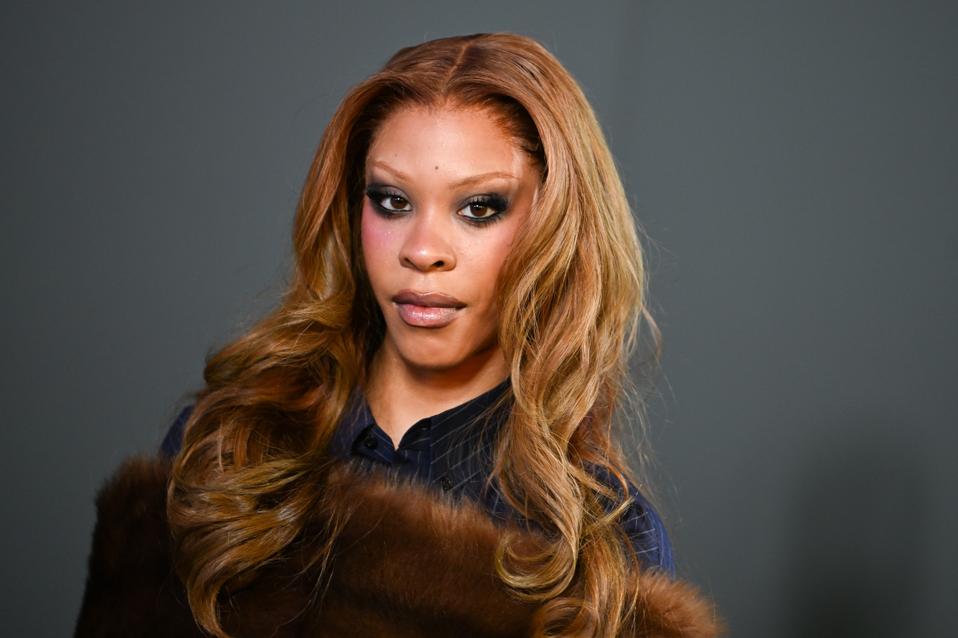
Before stepping onto the set, she transforms—something subtle, almost atmospheric, like the light adjusting to a new space. For Rico Nasty, transformation has always been less a reinvention than an expansion: a way to move between versions of herself without leaving any one behind entirely. This instinct now finds new expression in her acting debut on the series. «"Margot has money problems"» on Apple TV, where acting becomes less about being on stage and more about being in a world that continues to exist long after the cameras roll.
Rico Nasty on his characters, acting, and how he gets on set.
Roark Bailey, Rico's frequent musical collaborator, begins the conversation with a voicemail that feels more like an invitation than a prompt—he asks if the personas and alter egos she's created through music have prepared her for a career in acting. She doesn't look for an answer—she finds one immediately. "Oh my God, yes," she says, connecting the two words without hesitation. "I think every time I've been on a music video set, it's prepared me for acting.".
Looking back, music videos, makeup sessions, and all the subsequent transformations feel more like rehearsals than memories. "Every time I had makeup done, it prepared me for acting," she adds. "Every time I've gone through any kind of transformation… I really live by that principle.".
NEW YORK, NEW YORK – APRIL 08: Rico Nasty attends the premiere of Apple's "Margot Has Money Problems" held at the Regal Union Square Cinemas on April 8, 2026 in New York City. (Photo by Michael Loccisano/Getty Images)
Getty Images
She views identity not as something fixed, but as something worn. "You have to wear your clothes, not let your clothes wear you," she says, almost as a guiding principle. "If I have dark hair, I'll act darker. If I have light hair, I can be a little more playful." It's not a rebirth, she insists, but a permission—permission to change, to bend, to play, without destroying her inner essence. "It's not a complete identity change," she adds, "but I think allowing yourself to transform in a fun, quirky way… helps when you're given a character.".
Rico Nasty talks about costume, color, and character as a language.
This philosophy guided her through her character development, where even costume became a kind of language. After just a few fittings, she found herself rediscovering the visual boldness she'd recently abandoned. "Everyone knows me as a vibrant person," she says, "but I used to wear darker clothes, more muted tones." The role, she explains, brought her back to intensity and risk. "There were moments when I thought, 'I don't necessarily like this outfit, but it suits the character,'" she admits. "So I had to push myself in that regard.".
She recalls one of the most unexpected fittings being a dress made entirely of lace. «I’ve worn lace before, and I thought it was so funny,« she says. »I was like, »Hmm, this isn’t my usual style.«» The moment feels less like discomfort than like a rethink. «It really helped me regain my confidence,» she adds. “It’s like I haven’t lost it—I’ve just become more cautious.” Even the character herself seems defined by contradictions. “She’s a very contradictory girl,” Rico says of Casey, “but in a very effortless way. I love her.”.
In a neon-lit, color-saturated still from Margot Has Money Problems, Rico Nasty enjoys a quiet moment with his co-star, capturing an intimate pause in the show's vibrant world.
(Photo courtesy of Apple TV)
Rico Nasty shares details about relationships on set and rituals off set.
On set, structure often gave way to instinct. Scenes shifted slightly based on chemistry, especially with her co-star Lindsay Normington, who plays Rose. "We were literally dying laughing between takes," she recalls. "We had incredible chemistry from the first time we read the script together." Even scripted moments were unleashed by this energy. "There's a scene where we reach for the pizza—it was scripted, but we kept laughing," she says.
Off-screen, her dressing room rituals are stripped down to the bare essentials—small anchors in an ever-changing environment. «I need a joint,» she says bluntly, then laughs. «I need a Celsius. I need a blanket.» She pauses, almost amused by her own candor. «I totally understand that I come from a rap background,» she adds, «but my rituals are the same, man.» She notes that the food on set seemed almost surreal in its abundance. “There was everything—banana bread, sandwiches—it was crazy. We all talked about it every day.”.
Rico Nasty opens up about the audition process during the "nepotist kid" era in Hollywood.
The audition process is something she thoroughly debunks, dispelling any myths about it being easy. "I didn't get the role just because I'm Rico Nasty," she says immediately. There were readings, re-auditions, and, ultimately, an acting coach who reconsidered everything. "Your job is to champion the character, even if you don't agree with it," she recalls him saying. "You can't think, 'Why did she say that? It should be you. You have to be in the role.'".
In a candid shot from the set of "Margot Has Money Problems," Rico Nasty sits next to his co-star, capturing a surprised reaction amid the show's vibrant and dynamic atmosphere.
(Photo courtesy of Apple TV)
She also dismisses the idea that recognition alone opened doors for her. "It was even weirder," she adds, "because when we showed up on set and I met the writer, she turned out to be a fan and was dressed in literally 2020 gear." While discussions of casting often revolve around issues of access and advantage, industry data analyzing 634 actors under 35 who starred in American films in 2025 shows that approximately 16%—about one in six—have at least one parent in the entertainment industry, highlighting how diverse and uneven the paths to acting are.
By the final round of auditions, she'd stopped putting herself down in front of the audience and instead focused on her presence. "I wore a sweatshirt that said 'ex-bisexual,'" she says with a laugh. "I wanted them to laugh, because that's what the character evoked in me." She describes how the mood in the room shifted afterward. "At some point, you realize: I have to do this really well... because a lot of these people literally make a living doing this." And at that moment, the performance stopped being an adaptation—it became a translation.
This article was originally published on Forbes.com.