








Children's games like house, superheroes and villains, "the floor is lava," and the classic tea party all require imagination. We create stories and worlds with rules and roles.
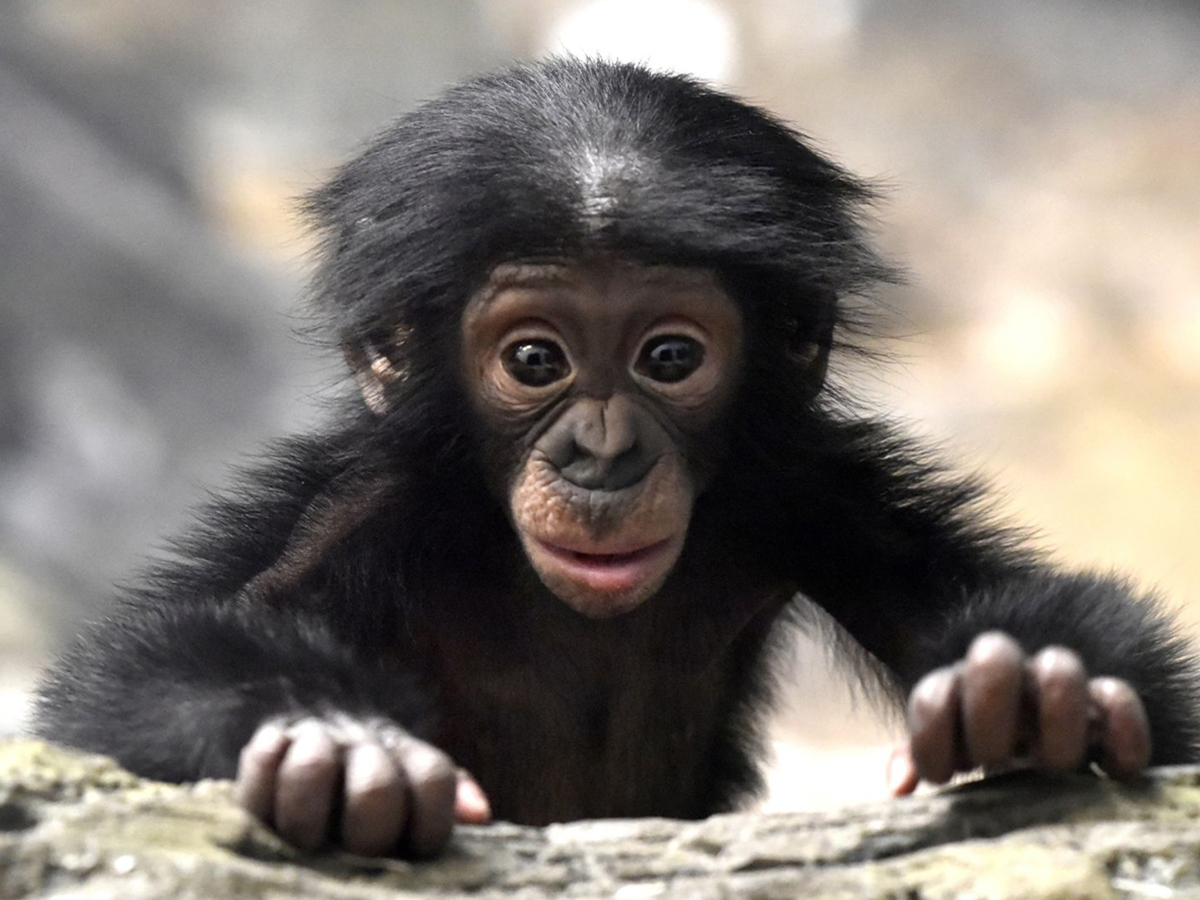
People want to believe that our creativity and artistry make us unique. But a bonobo named Kanzi participated in a study that forced scientists to question just how different we truly are. In three consecutive experiments, Kanzi correctly identified fictional objects, demonstrating that he can understand and participate in imaginary situations.
Kanzi connects words and symbols with Sue Savage-Rumbaugh. Photo by William H. Calvin, Ph.D./Wikimedia Commons (cropped).
Kanzi is having an imaginary tea party.
The researchers designed a simple experimental setup using cups, a pitcher, and actions that began as a real pouring of liquid and gradually transitioned into role-playing. The first experiment used real liquids. The second used a combination of real and simulated liquids. The final scenario omitted the real liquids, leaving the experiment entirely up to the imagination.
Scientists used gestures and fantasy situations to test whether Kanzi's reactions would differ depending on what he was shown. He responded differently in each situation. His reactions showed that he was paying attention not only to the objects but also to how the situation was presented.
Kanzi participates in an indoor test. Photo by William H. Calvin, Ph.D./Wikimedia Commons (cropped)
Animals immersed in fantasy
The experiment showed that animals are able to understand and reproduce imaginary situations.
«"This shows that animals are able to understand pretense in controlled experimental conditions, which has not been done before," she told the publication. The Guardian Dr. Amalia Bastos, first author of the study from the University of St. Andrews.
The scientists involved in the study are cautious in describing its results. They do not view it as proof that bonobos imagine things in the same way as humans. Instead, they suggest that the animals are capable of responding to situations where meaning is implied rather than directly demonstrated.
Why are scientists interested in role-playing games?
Albert Einstein, one of history's greatest scientists, is often credited with the idea that logic gets us from point A to point B, but imagination can take us anywhere. This research suggests that the more we learn about animals, the more we realize the differences between us aren't as great as we once thought.
Developmental research links children's early social and cognitive development to imagining situations that don't physically exist. A 2024 meta-analysis found that imaginary reality isn't just entertainment but also directly linked to social understanding and interpretation of the real world.
Researchers now claim that animal play is far more flexible than previously thought. A 2025 study of ravens found that their play included the manipulation of sticks, stones, and other objects, indicating social awareness and contextual responsiveness, rather than simply instinctive behavior.
Play and imagination may represent multifaceted behaviors no longer considered uniquely human. The broader range of cognitive tools shared by many species suggests that the gap between humans and nonhumans may be narrower than previously thought. What we long considered uniquely human qualities may in fact exist within a spectrum of abilities, manifested in different ways.
The article "Bonobo's tea-drinking imitation forces scientists to rethink whether fantasy is unique to humans" first appeared on Good.is.