






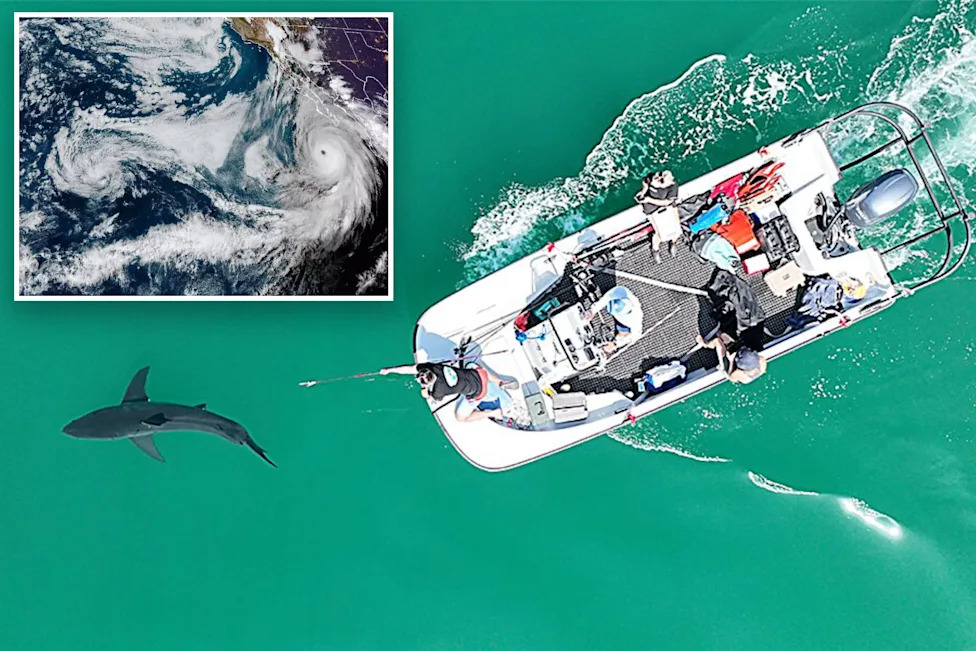
While humans continue to try to mitigate the impact of the elements by preparing for storms, marine animals follow their own extreme weather response protocols.
A recent study examined the behavioral responses of juvenile great white sharks to an approaching storm.
In 2023, scientists from the Scripps Institution of Oceanography at the University of California, San Diego, and the Shark Research Laboratory at California State University, Long Beach (CSULB) monitored the responses of 22 juvenile great white sharks as Storm Hillary approached the California coast.
Satellite imagery shows Hurricane Hillary in August 2023. NOAA
Using acoustic tags, Elstner and his team tracked the movements of top predators before, during, and after a tropical storm.
«"To our knowledge, this is the first study to document the response of white sharks to a storm," study author and graduate student Jack Elstner said in a press release.
Researchers found that more than half of the sharks left their breeding grounds off the coast of Torrey Pines and Del Mar north of San Diego in search of safer, more protected waters, returning only after the coast was cleared of predators.
«"Many of the sharks in this area briefly left the area when the storm started or immediately after," Elstner explained.
Following this mass exodus, many headed to the more sheltered La Jolla Bay, located next to a large underwater canyon, giving the sharks quick access to deeper water.
«"We believe this more protected habitat may have served as an important coastal refuge for some individuals," Elstner said.
One young diver was recorded swimming to a depth of 433 feet, apparently trying to escape the rough sea surface.
Using acoustic tags, Elstner and his team tracked the movements of top predators before, during, and after a tropical storm. CSULB Shark Research Lab
«"The fact that some sharks 'hid' in the less turbulent La Jolla Bay during the storm is an interesting discovery," said co-author Chris Lowe, director of the shark research lab at California State University, Long Island. "We believe some of them were seeking shelter from the storm.".
The research team believes that the change in temperature before the storm may have signaled the sharks it was time to leave.
In one day, the sea surface temperature at the nursery dropped from 68 to 57 degrees.
Experts say juvenile great white sharks are more sensitive to cold than adults, suggesting the young animals sought warmer waters as temperatures dropped.
However, the sharks' behavior during the storm was far from uniform.
«"It makes sense that not all sharks responded the same way, just as humans react differently," says Lowe. "It's a key survival characteristic that appears to be shared by humans.".
Researchers say that as climate change intensifies, understanding how marine species respond to extreme weather will be critical for both their species and our own.
«"Great white sharks and humans are increasingly using the same coastal waters in California," said Bryce Semmens, a marine ecologist at the Scripps Institute and a co-author of the study.
«Research like this helps us understand how sharks respond to rapidly changing ocean conditions and allows us to make more informed decisions that promote both shark conservation and the safe use of the ocean – from surfing and swimming to recreational and commercial fishing.».
Researchers tagged 22 juvenile great white sharks with acoustic tags to track their movements. CSULB Shark Research Lab
Meanwhile, across the country, researchers at the University of Delaware are experimenting with using sharks to predict the intensity of hurricanes on the East Coast.
Fish are fitted with electronic tags that collect data such as ocean temperature and salinity in the Atlantic Ocean, which would otherwise be difficult and expensive to monitor.
This could allow them to learn more about the Mid-Atlantic "cold pool"—a layer of bottom water with temperatures below 50 degrees Fahrenheit that forms in the spring and disappears in the fall—and which can determine how quickly hurricanes intensify.
Scientists who began tagging the creatures in May, when the sharks approach the coast after leaving their winter habitats, found that shortfin mako sharks, blue sharks, smooth hammerhead sharks and juvenile great white sharks were best suited for the experiment.
This is because these species most often float to the surface, allowing their tags to transmit data to satellites.
In another shark-related incident, earlier this week, breathtaking drone footage captured by a documentary filmmaker showed a man swimming in shallow coastal waters between Santa Barbara and Malibu while several young great white sharks moved through the area.
Meanwhile, a 71-year-old lifeguard was dragged six feet underwater by a great white shark in Maine over the weekend after about a dozen sharks were spotted at a popular swimming spot.
California Post News : Facebook, Instagram, TikTok, X, YouTube, WhatsApp, LinkedIn
California Post Sports Facebook, Instagram, TikTok, YouTube, X
Opinion California Post newspapers
Subscribe to the California Post newsletters Here!
California Post App : Download here!
Home delivery : Register here! Page Six Hollywood : Register here!