






Federal prosecutors have charged two foreign nationals working at the National Institutes of Health (NIH) with conspiring to smuggle monkeypox into the United States and making false statements to federal authorities about it, officials said Tuesday.
This case raises new concerns about the handling of dangerous pathogens and biosafety regulations at leading US research centers. The allegations could lead to serious legal consequences for researchers and increased scrutiny of the international transport of infectious materials.
Tuesday evening Newsweek publication emailed the National Institutes of Health (NIH) and the Department of Justice for comment.
Charges against foreign citizens: what you need to know.
The Justice Department said the men allegedly brought more than 100 vials containing virus samples into the country and falsely described their contents to customs officials at the Detroit airport.
The defendants, identified as Dutch citizen Vincent Munster and Cameroonian citizen Claude Que, worked at the National Institutes of Health's Rocky Mountain Laboratories in Montana, a highly secure facility dedicated to the study of emerging infectious diseases. Their research focused on how viruses are transmitted from animals to humans, and this work required strict adherence to federal biosafety regulations.
According to criminal case documents, the men returned to the United States in January after traveling to the Republic of Congo, where a monkeypox outbreak was occurring. Upon arrival at Detroit International Airport, Customs and Border Protection officers inspected their luggage and questioned them about a large shipment of goods.
«"These NIH experts appear to have violated our laws by smuggling viral pathogens on an overcrowded commercial plane from an outbreak zone in the Republic of the Congo. Think about that," U.S. Attorney Jerome F. Gorgon said in a statement.
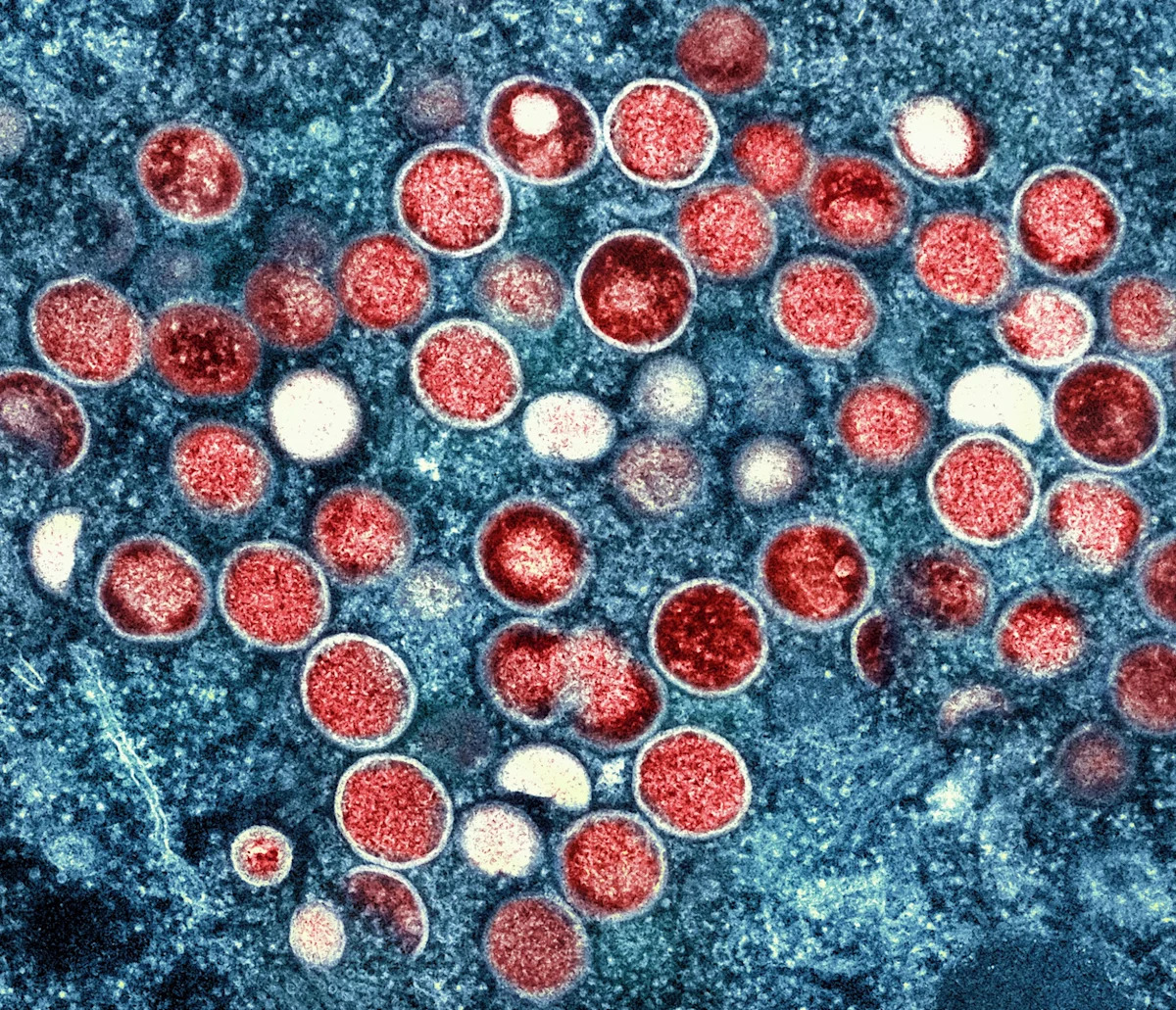
This undated image, provided by the National Institute of Allergy and Infectious Diseases (NIAID), shows a color electron micrograph of monkeypox particles (red) found inside an infected cell (blue) grown in a lab. The image was acquired and processed in color at the NIAID Joint Research Center in Fort Detrick, Maryland. (AP Photo)
According to prosecutors, the researchers told police the container contained diagnostic or testing equipment. A subsequent federal investigation revealed that the container actually contained 113 vials stored in refrigerators—materials suspected of being related to the monkeypox virus. Authorities stated that at the time of the lawsuit, only a portion of the samples had been tested, and the investigation is ongoing.
According to officials, the defendants lacked the necessary authorization and knowingly made false statements to federal agents during an investigation. The charges include conspiracy to smuggle goods into the United States and making false statements, according to prosecutors. Munster and Que face a maximum sentence of five years in prison.
The investigation was announced by the U.S. Attorney's Office for the Eastern District of Michigan, with the participation of the FBI, Customs and Border Protection (CBP), and the Office of Inspector General of the Department of Health and Human Services.
Authorities said the investigation was ongoing, raising broader questions about the controls on high-risk biological research and the international movement of pathogens.
«"We have zero tolerance for any attempt to exploit our research facilities, circumvent our border control procedures, or deceive investigators," Marty K. Raybon, director of field operations for U.S. Customs and Border Protection, said in a statement. "Together with our law enforcement partners, we will remain vigilant in neutralizing biological threats—or any other kind—and will continue to hold accountable those who jeopardize the safety of the American people.".
This photo provided by the National Institutes of Health shows the James H. Shannon Building on the agency's campus in Bethesda, Maryland, in 2015. (Lydia Polimeni/NIH via AP)
What is monkeypox?
Monkeypox, also known as monkeypox, is an infectious disease caused by a virus from the same family as smallpox. This virus, belonging to the genus Orthopoxvirus, can be transmitted from animals to humans, as well as through close contact between people.
Mortality from monkeypox remains relatively low globally: hundreds of cases have been reported since 2022, and the fatality rate is typically below 1 percent. Although most cases are mild, the disease remains a public health concern due to its potential to spread and, in some cases, cause severe illness.
The virus is transmitted primarily through close, direct contact with an infected person, including skin-to-skin contact with lesions, body fluids, or contaminated materials such as clothing or bedding. It can also spread through respiratory secretions during prolonged face-to-face contact and, in some cases, from animals to humans. Health authorities state that transmission typically occurs after the onset of symptoms and continues until lesions heal.
Symptoms often begin with fever, headache, muscle aches, and swollen lymph nodes, followed by a characteristic rash that may develop into fluid-filled lesions before crusting over. The illness typically lasts two to four weeks, and most people recover with supportive care. However, complications can occur, especially in vulnerable groups, such as young children or those with weakened immune systems.
This is breaking news. Further updates will follow.
Related articles
-
Store owner Rick Chow faces a civil lawsuit after shooting a black teenager in the back.
-
Hunger strike detainees at U.S. Immigration and Customs Enforcement say they were pepper-sprayed.
-
Dr. Oz claims Trump gets frequent medical checkups because he "likes the results.".
Start your unlimited trial of Newsweek.