








RedditShareTweetEmailWhatsApp0 Share
Our planet is literally teeming with life. A teaspoon of soil from your garden can contain up to 1 billion bacteria. A square meter of soil can harbor 200,000 insects. The same area can harbor 10 million nematodes. Although only about 1.2 million species have been identified, it is estimated that there are likely 8.75 million species living on Earth.
By some estimates, including microbes, there may be 1 trillion life forms on Earth. But how many life forms live in a single human body? A single human body could contain over 100 trillion bacteria. The entire planet could be home to nonillion bacteria. That's a one followed by 30 zeros. The point is, there's a lot of life on Earth.
Our planet is covered in life, and far more than you might imagine. So how is it that this is the only place where life exists? Many of us entertain the idea that life might exist elsewhere; we just haven't found it yet. But where exactly might this other life reside? We don't need to travel the vast expanses of space to begin to wonder. Why not explore our own solar system and see what it has to offer? The possibilities are far greater than you might imagine.
Our solar system contains eight planets with 293 confirmed moons, as well as five dwarf planets with multiple moons. That's over 300 potential habitats for life!
Clouds of Venus
Remember the first time you saw Cloud City in Star Wars? Didn't it look cool and somehow peaceful? Who wouldn't want to live in the clouds? The idea of living in the clouds on an alien planet isn't so far-fetched, as there are suggestions that life could exist in the clouds of Venus.
The average temperature on Venus is about 870°F (465°C), making it extremely uninhabitable for life as we know it. Furthermore, its atmosphere contains 2,000 times more CO2 than Earth's, and it rains acid. It's unpleasant. But there are clouds.
Although Venus's atmosphere is thick, requiring 243 of our days to complete one day on Venus, there are suggestions that microbial life could exist within its dense cloud cover. The clouds contain small amounts of water and sunlight, and may also contain nutrients, at least those necessary for bacteria. Substances such as carbon, hydrogen, nitrogen, phosphorus, and sulfur are present in trace amounts, but in sufficient quantities to support microbial life. Organisms whose metabolism relies on iron or sulfur could feel quite at home there.
Spectral analysis of Venus's cloud cover reveals unexplained dark spots. It has been theorized that these areas, where sunlight is absorbed more strongly than others, may harbor bacteria that thrive in the light, feeding on these nutrients.
More importantly, scientists discovered phosphine. This gas is produced by living organisms, and while it doesn't prove the existence of life, it is a strong indication that it could exist. It has been suggested that if phosphine were detected on a typical rocky planet, the only reason for its presence would be the presence of life. Researchers studying it on Venus were unable to explain its origin other than as a byproduct of life.
Jupiter's moon Europa
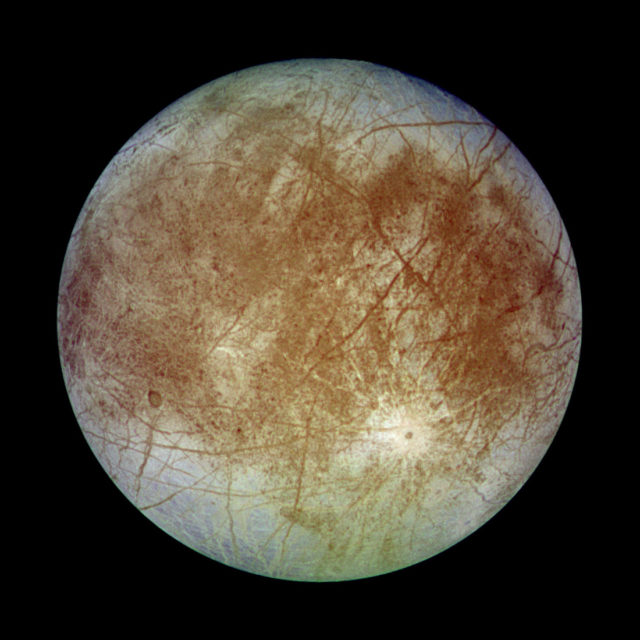
The largest planet in our solar system, Jupiter, has 95 moons, offering a wide range of potential habitats. However, Europa is one of the most likely candidates for life. Perhaps not your life, but some kind of life.
Europa is composed primarily of ice, but beneath it lie oceans. Despite its high salinity, Europa is thought to contain twice as much water as all of Earth's oceans combined. If these Europa oceans have a rocky bottom, they could harbor hydrothermal vents that produce life-sustaining nutrients, similar to the gas clouds on Venus.
Europa's surface is remarkably smooth compared to all other celestial bodies in our solar system. Completely covered in ice about 10-15 miles thick, the geographic topography remains virtually unchanged. However, there are places where cracks, fractures, and other landscape features indicate that warmer ice may have risen from beneath the surface in the past, or that liquid water may have flowed deep beneath the surface.
In 2024, NASA launched the Clipper spacecraft to Europa. It will reach it in 2030, and then we'll have a glimpse of what's happening beneath the icy surface. Clipper's instruments should allow us to determine whether the building blocks of life are present on Europa, and perhaps even detect life itself. Or maybe not. Technically, it's not designed to search for life. We'll have to wait and see what happens!
Saturn's Enceladus

Like Jupiter, Saturn also has oceanic moons. Enceladus is the one we're most interested in in the search for potential life in the universe. This moon is incredibly small, measuring just 314 miles in diameter, compared to Earth's nearly 8,000 miles and Saturn's nearly 75,000 miles. But Enceladus has an icy surface, beneath which lies an ocean that covers the entire moon.
At the moon's south pole, a geyser spews ice and gas into space. The Cassini spacecraft was able to analyze some of the ice and determine that it is salty, like our oceans. It contains elements essential for life, including carbon, hydrogen, phosphorus, nitrogen, and sulfur. It is heated by tidal processes. This means the moon contains water, energy, and chemicals. Enceladus has all three.
One of the chemicals detected by Cassini in the geyser is hydrogen cyanide. While hydrogen cyanide itself is poisonous, it is also a chemical precursor to the formation of amino acids and DNA—the building blocks of life. Compounds such as methane, propylene, ethane, and acetylene—all organic molecules essential for the origin of life—were also detected.
Saturn's Titan

The moon Titan got its name for a reason. Its diameter is approximately 2,500 miles, making it approximately 401 TP3T smaller than Earth and larger than the planet Mercury. It is also the only place in our solar system, other than Earth, where standing liquid exists on the surface in the form of lakes and rivers. Like Earth, and unlike other places, it is the only place where a precipitation cycle exists: lakes and rivers fill with water, then the water evaporates, and rain falls again.
Sure, Titan's rain isn't particularly refreshing and consists mostly of liquid methane, but it's rain nonetheless. The dense nitrogen atmosphere means rain falls about five times slower there than on Earth. Furthermore, at around -179°C, when it finally does fall, it's a freezing rain.
Titan is far less habitable than Earth, but it's possible that some form of life completely different from ours could have evolved there. Life would have to have adapted to methane, not water. Furthermore, if life there requires a lipid cell membrane, then life there would have to exist without the need for cell membranes as we understand them.
Methane and ethane on Titan are organic compounds. When sunlight hits methane, it breaks down into other organic compounds. On Earth, we get new methane from living organisms. As life decays, methane is formed. But Titan is full of methane, raising the question of its origin, since on Earth it forms from living organisms. This doesn't mean we believe there are vast numbers of hidden life forms there, but there's much more going on beneath the surface than we know.
Jupiter's Ganymede
The largest moon in the solar system is Jupiter's Ganymede, approximately two-fifths the size of Earth. Ganymede is known to have an ocean containing more water than all the water on Earth combined, located approximately 100 miles below the surface, and is known to possess its own magnetic field, a feature typically found only on planets.
Deep inside Ganymede lies a molten metallic core, just like Earth's. And because there's water beneath the ice, which may extend all the way to the core or be covered by layers of ice, there's a chance the warm oceans teem with the chemicals needed to support life. So, again, we have water, we have energy, and we have the chemicals for life. Possibly.
Dwarf planet Ceres
Ceres isn't a moon; it's a dwarf planet, one of five in our solar system, along with Pluto, Eris, Haumea, and Makemake. Ceres lies in the asteroid belt between Jupiter and Mars, making it the only dwarf planet in the inner solar system. Furthermore, thanks to the presence of water, it could potentially be a habitable place.
Studying Ceres has led scientists to conclude that the dwarf planet may have once been habitable, even if its surface is now gone. There is evidence that long chains of hydrocarbons capable of converting into fats, called long-chain aliphatic organic compounds, may have bubbled to the surface in the past.
The presence of these compounds led researchers to speculate that oceans may have once existed on the surface of Ceres, lasting for hundreds of millions of years. These compounds persist for only about 10 million years, meaning they formed relatively recently, unlike the now-vanished oceans of Ceres. This suggests that oceans containing organic compounds could lurk beneath the surface of the dwarf planet, potentially enabling the origin of life.
Neptune's Triton

Neptune's moon Triton is a place we haven't studied in much detail. Voyager 2 flew past Triton in 1989 and took a few images, but so far it's the only spacecraft we've sent that far. It's a frigid place, with a surface temperature of -235°C. It's covered in nitrogen ice, but there are also rocky formations, and it's thought to contain rock and metal within.
The Moon also exhibits volcanic activity and has a thin atmosphere composed of nitrogen and methane. Methane, as you may recall, is one of the compounds we look for when searching for life.
Since Triton has active geysers, liquid oceans may exist beneath its icy surface. Volcanic activity implies the presence of energy, and methane implies chemical processes, so, again, we're looking at the ingredients for potential life.
It is hypothesized that the energy needed to sustain Triton's liquid ocean comes from the moon's seasonal cycles. As it orbits above and below Neptune's equator, it faces the Sun and is heated and cooled at the poles, while Neptune's gravity drives changes in the ocean, which is thought to exist beneath the surface. This energy could provide all the conditions necessary for the origin of life.
Mimas of Saturn

Mimas isn't the most well-known moon in the Solar System, but it holds many interesting possibilities. It also bears a striking resemblance to the Death Star, which, while unrelated, is nonetheless intriguing.
For many years, this moon went unnoticed, appearing to be little more than a cratered, dead rock. But now evidence has emerged of an ocean, and possibly a young one. By young, we mean less than 25 million years old, potentially as little as two million years old. This relatively young age may explain why no one previously thought it had an ocean: buried beneath ice, it hasn't had time to reshape the surface the way oceans have on other moons and planets.
More recent data obtained by the Cassini probe have led scientists to suggest that irregularities in Mimas's orbit confirm the presence of a hidden ocean beneath its surface. Based on these data, it is estimated that half of Mimas's volume may be covered by liquid water. And, as with other moons, if there is water, there is a possibility that the organic matter and energy could provide the building blocks for life.
Of course, we haven't yet definitively detected life anywhere in the Solar System, but information about Mimas and all its moons, dwarf planets, and other worlds encourages us to continue exploring, study them more deeply, and send new exploration missions to find out if we really are alone in our own Solar System.
We will probably only find microbial life, seemingly insignificant at first glance, but if we can establish that life arose independently more than once in the same solar system, it could have stunning implications for the galaxy and the Universe as a whole.
Other articles that may interest you