








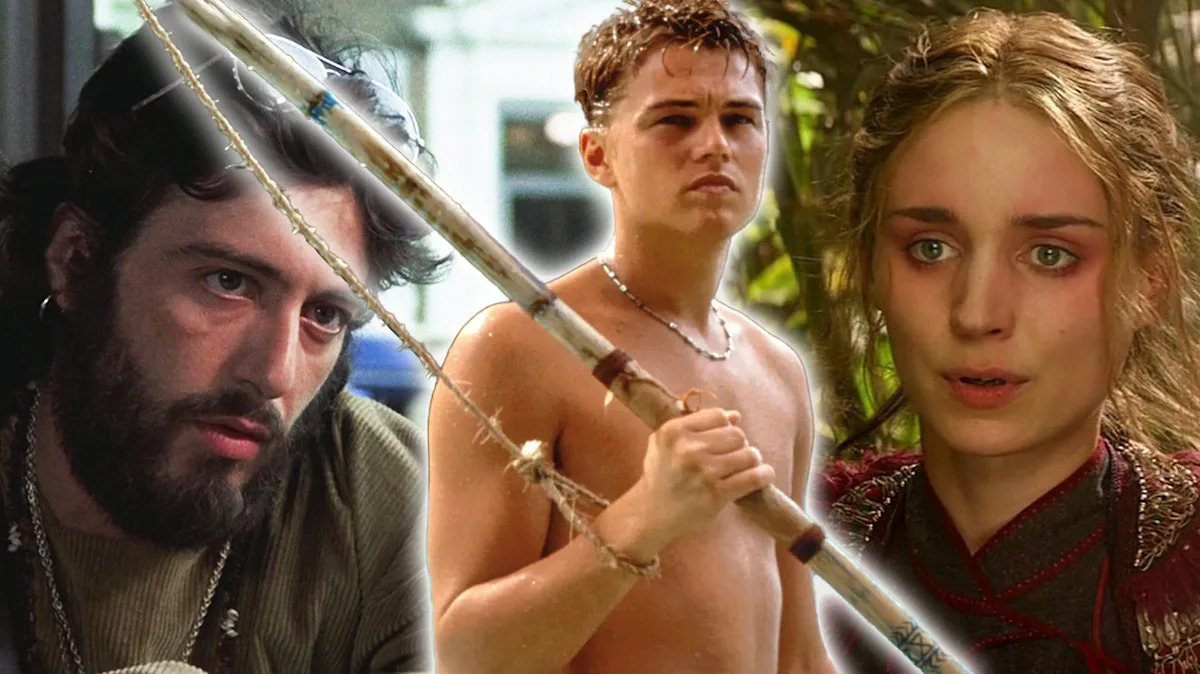
Today, every actor interested in a seven-figure salary is ready to travel to a galaxy far, far away—but in the 1970s, no one in Hollywood had a clue what the hell Star Wars would be. George Lucas, a technical and narrative genius, had a vision as ambitious as it was confusing to those outside his head. Actors had to navigate terms like "Jedi" and "Clone Wars" to understand what Lucas was going for.
Almost every major character in the Star Wars franchise went through numerous current or future A-listers before finding the right actor. Some of these actors immediately turned down lucrative offers and walked away without looking back, while others sincerely regret their short-sighted decisions, despite ultimately achieving incredible success.
From the franchise's inception to the prequels and post-Disney era, here are some actors who turned down Star Wars roles.
Read also: 15 Best Movie Spaceships of All Time, Ranked
Al Pacino turned down the role of Han Solo.
Al Pacino as Bobby Deerfield in the office in "Bobby Deerfield." — Columbia Pictures
In the years immediately preceding the release of the original Star Wars film in 1977, no actor was as popular as Al Pacino. The actor was nominated for four Oscars for Serpico, Dog Day Afternoon, The Godfather, and its sequel. Francis Ford Coppola and George Lucas were already close friends and creative collaborators by then—so naturally, Pacino was Lucas's first choice for the role of Han Solo.
In 1975, while starring in a regional production of Brecht's The Unstoppable Rise of Arturo Ui, Pacino received a Star Wars script from Lucas along with an offer. According to Pacino himself, it included an incredible amount of money—so much so that he found it hard to refuse, despite completely ignoring the script. He even sent the script to his mentor, who was equally perplexed by the space wizards and cyborgs Lucas was trying to sell. Thus, despite the enormous salary, Pacino turned down the role of Solo.
In 1977, the actor starred in Sydney Pollack's Bobby Deerfield, which was a critical and commercial failure by any standard—though even starring in arguably the most popular film of all time could hardly have helped or hurt him.
Harrison Ford, on the other hand, was virtually unknown to anyone except Lucas (who cast him in American Graffiti). Pacino's rejection of the role meant Lucas had to audition other actors, which led to him asking Ford to audition as a narrator. Ford made an unexpected impression, and the rest is history. Decades later, in an interview with Entertainment Weekly, Pacino joked that he was "in the mood to make Harrison Ford's career.".
Burt Reynolds also turned down the role of Han Solo.
Burt Reynolds as Bo "The Bandit" Darville, smiling behind the wheel in "Smokey and the Bandit." — Universal Pictures
However, before George Lucas settled on Harrison Ford, he considered many other options for the role of Han Solo besides Pacino. The least inventive of these potential candidates was Burt Reynolds.
This doesn't mean that Reynolds would have been a bad choice for the role - it's just that by the mid-70s he was already A little had become stale as a Western star. Pulp classics like "Insidious Scheme" and "White Lightning," and especially the thriller "Deliverance," transformed him into the perfect archetype of a Hollywood leading man. He was dangerous and tough, yet also brashly charming, creating a sense of honor even when playing antiheroes. Admittedly, he was Khan Solo before his image was even written into Lucas's script.
After the success of The Longest Yard, Lucas offered Reynolds the role. He declined because, as he later recalled, he had never been a fan of science fiction. Before Star Wars, the genre was largely synonymous with films like Planet of the Apes, Invasion of the Body Snatchers, and The Day the Earth Stood Still. No one expected Lucas's strange vision to resonate so strongly, least of all with traditionalists like Reynolds.
However, in retrospect, while Reynolds didn't seem to have much of a love for science fiction, he still considered turning down Star Wars a missed opportunity (though he did star in Smokey and the Bandit that same year). It was one of several unfortunate rejections in his prolific career, including roles as James Bond during the Pierce Brosnan era and Richard Gere's character in Pretty Woman. Symbolically, this reverse radar came in handy when Reynolds received his first Oscar nomination for Boogie Nights, a film he had turned down seven times.
Kurt Russell could have played Han Solo too.
Kurt Russell as Bob "Snake" Plissken, leaning back in his chair in Escape from New York. — AVCO Embassy Pictures
Kurt Russell was another promising actor considered for the role of Han Solo—though it wasn't the only character he was approached for. While he hadn't quite reached the movie star status he achieved in the 1980s, Russell was a reliable, steadily rising actor with enterprising parents and a strong relationship with the Walt Disney Company. He had enough experience, clout, and confidence to approach Star Wars with a healthy dose of skepticism.
Russell lacked the star status to receive the same instant offers as Al Pacino and Burt Reynolds. Instead, George Lucas invited him to audition for the role of Khan. и Luke Skywalker. Russell is one of the few actors whose unsuccessful auditions for Star Wars roles can be viewed online. He doesn't do what Harrison Ford or Mark Hamill later did with those roles, but he brings the charm that casting directors were hoping to convey to the directors.
In recent years, Russell has remained tight-lipped about his subsequent audition—only that he wasn't offered the role. He's joked in the past that he couldn't turn down anything at that point, especially a role in a feature film. He also said that Lucas's reluctance to confirm his involvement pushed him toward the lead role in the short-lived NBC western series "Looking.".
The series hardly proved the career breakthrough Russell had hoped for. Of course, John Carpenter soon helped him return to science fiction, turning him into one of the genre's greatest actors of all time.
Jodie Foster was considered for the role of Princess Leia.
Jodie Foster as Iris Steensma looks at Travis Bickle in "Taxi Driver." — Columbia Pictures
Even before The Walt Disney Company fully acquired Lucasfilm in the early 2010s, the House of Mouse and a galaxy far, far away worked together harmoniously. However, they once stood between George Lucas and his first choice for Princess Leia, Jodie Foster.
This hypothetical scenario might initially baffle seasoned cinephiles. When Lucas held casting calls for Star Wars, Foster was not yet 12 years old, and her best-known role at the time was in Martin Scorsese's tragicomedy Alice Doesn't Live Here Anymore. As she herself confirmed much later, Lucas was initially looking for the young actress to play Leia—and while she didn't directly reveal how close she was to accepting the offer, Christopher Walken claims to remember her audition for the role of Han Solo (in his own words, Walken himself was no closer to landing the role than the hundreds of other Solo hopefuls who came forward after Al Pacino's rejection).
However, Foster was ultimately forced to turn down the opportunity to play Leia due to Star Wars clashing with her existing Disney contract (presumably for the 1976 film Freaky Friday). The same year Lucas's film was released, she was nominated for an Oscar for her breakout performance in Scorsese's Taxi Driver. Lucas, meanwhile, shifted his focus to auditioning older actors for the role of Leia (having seen a number of future stars, including Farrah Fawcett). Of course, he ultimately chose Carrie Fisher, who at the time had only one film credit to her credit.
Toshiro Mifune was offered the roles of Obi-Wan Kenobi and Darth Vader.
Toshiro Mifune as the sword-wielding Kuroda Jubei in "Red Sun." — Les Films Corona
It's no secret that George Lucas was heavily inspired by the works of Akira Kurosawa when writing and directing Star Wars. Along with the Flash Gordon series and old Westerns, the Japanese director's samurai films had such a profound influence on his vision of this new world that he could hardly imagine it without Kurosawa's leading man, Toshiro Mifune.
Mifune was a major Japanese film star throughout the 1940s and 1950s, particularly remembered for starring in Kurosawa's seminal works, such as Seven Samurai, Yojimbo, and The Hidden Fortress (the last of which was the most influential on Lucas's Star Wars). He made his Hollywood debut in the 1966 film Grand Prix and continued to act in the United States for the rest of his career. It's not hard to imagine what Mifune might have brought to the role of Obi-Wan Kenobi, who was clearly modeled after the stoic samurai heroes he had previously played. Lucas offered him roles as Kenobi. и Darth Vader, but Mifune reportedly didn't want either role.
According to his daughter (who spoke publicly about the proposal in 2015, as reported by The Guardian), Mifune wasn't actually impressed by Lucas's inspiration for his films. "...[He] was concerned about how the film would look and how it would devalue the samurai image on which George Lucas based much of his image and fighting style," she said. Mifune subsequently starred in Steven Spielberg's 1941; Lucas, however, turned to Alec Guinness, who received an Oscar nomination for Best Supporting Actor.
Jim Henson could work on The Empire Strikes Back.
Jim Henson with Dr. Tiff on The Tonight Show Starring Johnny Carson - NBC.
«The Empire Strikes Back is often called the most successful independent film in history. Outside of 20th Century Fox, George Lucas was able to use the profits from Star Wars to create an ambitious sequel. Understandably, he wanted to work only with the best, so when it came to bringing the new alien character, Yoda, to life, Lucas immediately turned to the puppet master himself.
By the 1970s, Jim Henson had revolutionized puppetry with Sesame Street and The Muppet Show. The creation of Empire coincided with a turning point in his career, with the fifth and final season of The Muppet Show looming and The Muppet Movie slated for release in 1979. Lucas, in an interview afterward, said Henson was focused on an unnamed film—if it hadn't been the aforementioned one, it might have been The Great Muppet Heist (1981) or The Dark Crystal (1982), the latter of which was a long-in-development project that could potentially launch his post-Muppet career. In any case, he was too focused on his own work to help Lucas with his—at least not directly.
Henson referred Lucas to Frank Oz, a prolific (though lesser-known at the time) puppeteer who had worked closely with Henson since the early days of The Muppets in the early 1960s. Oz was behind characters like Cookie Monster and Fozzie Bear, both of which are subtly echoed in Oz's performance as Yoda. Quite tangibly, despite his absence, Henson's influence is still felt in Empire.
Yaphet Kotto didn't want to play Lando Calrissian.
Yaphet Kotto as Parker, scowling at the other engineers in "Alien." — 20th Century Studios
The late Yaphet Kotto wasn't thrilled when he was offered a role in Star Wars. The actor, known for Live and Let Die and Alien, met with The Empire Strikes Back director Irvin Kershner on the set of the latter film, where he was offered the role of Lando Calrissian. Whether Kershner knew it at the time or not, Kotto (by his own admission) was still a bit hurt that he'd been offered the role of Han Solo, while George Lucas had cast Harrison Ford. When Kershner offered him the role of Lando, he turned it down immediately, without a second thought.
Kotto's decision to turn down Empire was driven by two factors. First, he had other commitments at the time—Stuart Rosenberg had cast him in a supporting role behind Robert Redford in the 1980 prison drama Brubaker. The opportunity was as enticing as it was affirming of his talent, given that he felt he hadn't received the credit he deserved in Alien. (Indeed, the actor told Nerdist that his low credit placement in Alien and his being passed over for the role of Han Solo were due to racial discrimination.)
As the actor himself admitted, his commitment to Brubaker was more of a convenient excuse than the primary reason for his dislike of Star Wars. Kotto was well aware that Alien was a sci-fi blockbuster that could easily capitalize on the wave Lucas started in 1977: if he appeared in supporting roles in two space films back-to-back, he was certain he would be perceived as an actor who only played sci-fi roles for the rest of his career.
Leonardo DiCaprio could play Anakin Skywalker.
Leonardo DiCaprio as Frank Abagnale Jr., sitting at a table in Catch Me If You Can. — DreamWorks Pictures
The only actor to have robbed Star Wars of the same modern star power as Al Pacino is undoubtedly Leonardo DiCaprio of the 1990s. By the time George Lucas released The Phantom Menace in theaters in 1999, the future Oscar winner had starred in What's Eating Gilbert Grape, The Basketball Diaries, Romeo & Juliet, and James Cameron's Titanic. DiCaprio stood at the dawn of the new millennium as its biggest rising star, the leading man studios coveted for leading roles in potentially lucrative blockbuster franchises—James Cameron nearly engulfed him in webs in Spider-Man.
After The Phantom Menace premiered to mixed reviews, Lucas cast DiCaprio as Anakin Skywalker. It would have been a boon for Star Wars at a time when the world was reeling from his unexpected return to screens. He met with the director during the casting process for Attack of the Clones, and more than a decade later, he stated that he simply didn't feel ready to "take the risk" (according to Shortlist).
The role went to Hayden Christensen, who had previously starred in Sofia Coppola's The Virgin Suicides (produced by her father) in 1999. Christensen's performance was met with mixed reactions and certainly seems the antithesis of what DiCaprio would have done in the role, alternating between antisocial detachment and capricious rage. Whether this was the right choice for the character is still hotly debated among fans—Christensen was praised for his work in 2003's Shattered Glass, but the role of Anakin remains the one that defined his career, for both good and bad.
Given this, DiCaprio might well have been limited by the prequel trilogy's reputation. In 2002, he starred in Martin Scorsese's Gangs of New York and Steven Spielberg's Catch Me If You Can, cementing his status as a prestige film star who remains one of the most famous actresses to almost star in a Star Wars film.
Rooney Mara was too busy filming Rogue One: A Star Wars Story.
Rooney Mara as Therese Belivet wearing a Santa hat in "Carol." — Studio Canal
There are countless stories of actors passing up the opportunity to star in Star Wars because they couldn't imagine what the film would become. Rooney Mara's story is far more intriguing, as she turned down a role in the franchise when it was arguably at the peak of its popularity, potential, and critical acclaim.
Mara rose to prominence in the early 2010s—in the post-prequel era, when the Star Wars franchise still enjoyed a mixed reputation with the general public—thanks to films like The Social Network and The Girl with the Dragon Tattoo. The latter earned Mara her first Oscar nomination. Following this, Star Wars experienced a triumphant cultural resurgence in the lead-up to The Force Awakens. There was arguably no better time for an actress of Mara's generation to take part in this project, and, in retrospect, no better project for an actress of her taste.
In early 2015, Mara met with director Gareth Edwards about the role of Jyn Erso in Rogue One: A Star Wars Story. Although she claims the meeting went well, she said she didn't even read the script because she was too busy working on adult dramas like Lion and Carol (the latter of which earned her her second Oscar nomination). By March, it was announced that fellow Oscar nominee Felicity Jones would play the lead role, and the film will be remembered as the closest the Star Wars franchise has come to adult drama in theaters.
Mikey Madison has turned down Shawn Levy's Star Wars: Starfighter.
Mikey Madison as Anora Mikheeva looks lovingly at Anora. — Neon
Unfortunately, the most recent entry on this list is the one we know the least about, at least at the time of writing. Shortly after winning the Oscar for Best Actress in Sean Baker's drama Anora, it was widely reported that Mikey Madison had been offered the lead role in the yet-to-be-released Star Wars: Starfighter. Shawn Levy, known for Deadpool and Wolverine, had already been attached to direct the standalone spinoff, with rising actor Ryan Gosling set to star.
The plot of the film (scheduled for a 2027 release) has been kept largely under wraps, but Madison's intended character is expected to be an antagonist pursuing Gosling's character, who is reportedly protecting a younger character played by Wednesday actor Flynn Gray. (It would be downright shocking if he turned out to be a Jedi, wouldn't it? Uncharted territory for the franchise, that's for sure.)
Whatever role Madison was offered, it apparently proved unappealing to the young Oscar winner. So it went to Mia Goth, an actress with equal clout in independent film, whose screen presence, given her work in horror films like Pearl and Infinity Pool, is more villainous. Madison will play Facebook whistleblower Frances Haugen in Aaron Sorkin's Social Reckoning, without Jesse Eisenberg as Mark Zuckerberg.
If you're looking for the easiest way to stay up-to-date on all the top film and TV news, why not subscribe to our free newsletter? You can also add us to your list of preferred search sources in Google.
Read the original article on SlashFilm.