








About 56 years ago, the US government conducted a nuclear test in Nevada, creating the largest man-made crater on Earth—Sedan Crater. Although this nuclear explosion was conducted in a controlled manner and for peaceful purposes, it exposed millions of people to harmful radioactive waste. Nevertheless, Sedan Crater is now listed on the National Register of Historic Places, and thousands of tourists visit it every year. Read on to learn more about the fascinating features of Sedan Crater, the largest man-made crater in the world.
After World War II, the world decided to use nuclear energy for peaceful purposes, leading to peaceful nuclear explosions (PNEs). As part of these projects, the United States detonated several nuclear warheads. One of the warheads, nicknamed "Sedan," was detonated in Nevada to determine the feasibility of using a nuclear explosion for excavation work.

From the late 1950s to the 1980s, the world began to develop peaceful uses for nuclear explosions. During this period, numerous nuclear explosion tests were conducted, primarily in the United States and the Soviet Union. In the United States, a series of nuclear explosion tests was conducted as part of the Atomic Energy Commission's (AEC) Project Plow. Project Plow conducted 31 nuclear explosions in 27 separate tests. One such test, conducted in southern Nevada, led to the creation of Project Carter Sedan. Project Sedan was the second and largest nuclear reconnaissance experiment under the Plow program.
The nuclear tests at Sedan were conducted as part of an alluvial excavation experiment. The purpose of the tests was to assess the feasibility of using nuclear explosions in large-scale excavation projects. These tests yielded significant data that helped determine radiological safety, blast wave impacts, and seismic effects.
On July 6, 1962, a 104-kiloton nuclear warhead was detonated beneath Yucca Flats in southern Nevada. The explosion displaced 12 million tons of earth and created the 1,280-by-320-foot Sedan Crater.

As part of Operation Plow, the United States conducted a nuclear test at the Nevada Test Site on July 6, 1962. The thermonuclear device used for the detonation was named "Sedan." "Sedan" was a fission thermonuclear weapon with a fission ratio of less than 30% and a fusion ratio of approximately 70%. Its explosive yield was 104 kilotons, equivalent to approximately eight Hiroshima bombs. The device was 96.5 cm long, 43 cm in diameter, and weighed 212.2 kg.
Before detonation, the Sedan bomb was lowered into a 194-meter-deep shaft. The shaft was drilled into the alluvial deposits of the Yucca Flats Desert, Nevada. The Sedan's detonation displaced over 12 million tons of earth, creating a crater approximately 100 meters deep and 390 meters in diameter. Because the bomb used for this detonation was called "Sedan," the crater became known as the Sedan Crater. Sedan Crater is currently the largest artificial crater in the world.
The nuclear explosion created a radioactive cloud that rose to an altitude of 12,000 feet, exposing more than 13 million people to radiation. The cloud then split into two plumes of radioactive dust and drifted toward the Atlantic Ocean.
The nuclear explosion in Sedan generated seismic waves equivalent to a 4.75-magnitude earthquake on the Richter scale. An hour after the explosion, radiation levels at the crater rim reached 500 roentgens (R) per hour. After 27 days, they dropped to 500 milliroentgens (mR) per hour. Seven months later, radiation levels dropped to 35 mR per hour, and it became safe to walk along the crater floor without protective equipment.
The most serious side effect of the Sedan explosion was the formation of a radioactive cloud. The radioactive cloud split into two plumes. The plumes rose to altitudes of 3 km and 4.9 km, then moved almost parallel to each other, northeast and then east. As they moved toward the Atlantic Ocean, the radioactive plumes shed radioactive fallout along the way. Fallout is radioactive dust and ash emitted into the atmosphere after the explosion. After the explosion, these radioactive materials fall out into the atmosphere.
The Sedan missile tests released 880,000 curies of radioactive iodine-131 into the atmosphere. Radioactive iodine-131 is a causative agent of thyroid disease. Howard, Worth, and Mitchell counties in Iowa, as well as Washabaw County in South Dakota, were hit hardest by the radioactive fallout. The maximum radioactivity level measured in these counties exceeded 6,000 microcuries per square meter. High levels of radioactivity were also detected in five other counties in Iowa and one county each in Nebraska and Illinois.
As a result of the explosion at the Sedan Nuclear Power Plant, the original perennial shrubs that once grew in this region no longer grow there. The main plant species now growing in the crater is Russian thistle.

The explosion in Sedan caused severe damage to local vegetation within a radius of up to 600 meters from the epicenter. The vegetation was completely destroyed by the blast, and approximately 501 TP3T of shrubs were blown away by the wind. Vegetation and soil within 1,500 to 3,000 meters from the epicenter were covered in a thick layer of radioactive dust.
Perennial shrubs in this region did not recover after the explosion. Russian thistle (tumbleweed) now predominates within the crater. Russian thistle is also the dominant plant in the ejecta zone and adjacent areas affected by the explosion. Additionally, several species of grass grow within the crater and in the surrounding area, approximately 450 meters from the crater rim.
Following the Sedan tests, it was concluded that a nuclear explosion, if used for excavation, could cause extensive radioactive fallout. This would have an extremely negative impact on public health and the environment. Ultimately, the concept was abandoned.

According to a 1999 National Cancer Institute report, the Sedan test produced the second-highest amount of radioactive fallout of any nuclear test on the continental United States. Furthermore, it likely irradiated more people than any other U.S. nuclear test. Following the Sedan test, radiologist Dr. Robert K. Pendleton reported detecting radioactive iodine even in milk and vegetation in several U.S. counties. The extensive radioactive fallout raised widespread concern about its negative health effects. Due to health concerns, as well as a lack of political support, similar nuclear tests have not been conducted in the United States since.
The features of Sedan Crater are very similar to the topography of lunar craters. Therefore, 11 of the 12 American astronauts who walked on the Moon trained in this crater before their missions.
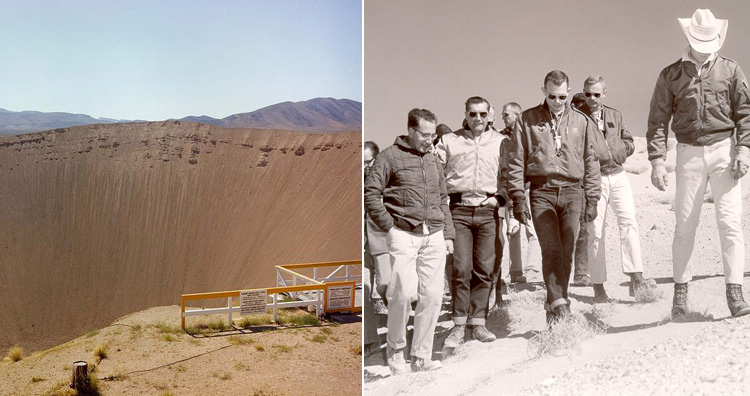
The formation of the Sedan crater unexpectedly served a very useful purpose. While studying the crater, geologists discovered that its topography was somewhat similar to that of craters on the Moon. American astronauts subsequently trained in the crater to gain a rough idea of its topography before actually setting foot on the Moon.
In February 1965, astronaut Neil Armstrong arrived at the Nevada Test Site. He was accompanied by fellow astronauts Buzz Aldrin, Dick Gordon, Rusty Schweickart, and Dave Scott. In preparation for their lunar mission, they explored Sedan Crater. Four years later, Neil Armstrong became the first person to set foot on the Moon. Since then, many other astronauts have trained at Sedan Crater. Some 11 American astronauts who have walked on the Moon trained at this crater.
The appearance of Sedan Crater has remained virtually unchanged since its formation. The U.S. government has taken steps to protect it from vandalism. On March 21, 1994, the crater was listed on the National Register of Historic Places. It is now a popular tourist destination, but public access is restricted.
[source: 1, 2, 3, 4, 5]