








Edward Leedskalnin, a Latvian immigrant, single-handedly created the coral sculpture garden, Coral Castle, over the course of 20 years. Working only at night, he crafted astonishing structures from colossal coral chunks, each weighing several tons. Leedskalnin never revealed his methods, but claimed to have uncovered the secrets of the pyramid builders. Even today, Coral Castle remains one of the world's most bizarre architectural mysteries. Since its creation, it continues to baffle engineers, architects, and scientists. Read on to learn more about Edward Leedskalnin, the sculptor who single-handedly built Coral Castle.
Edward Leedskalnin was born on January 12, 1887, in Latvia. He was a sickly boy and received only a fourth-grade education. As a teenager, his father taught him masonry, which he continued to practice after reaching adulthood.
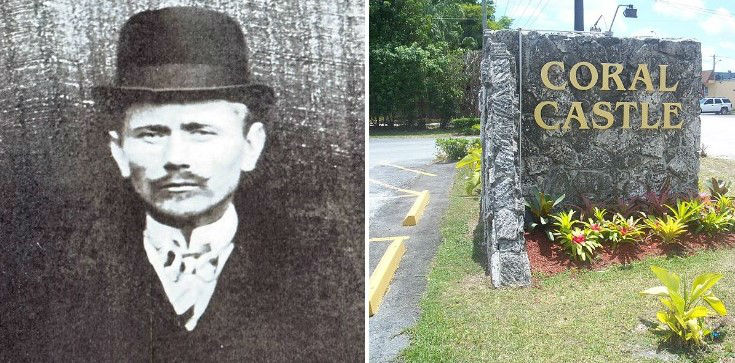
Edward Leedskalnin was born on January 12, 1887, in Latvia. As a child, he was frail and often ill. Therefore, he spent much of his childhood reading, which helped develop his inquisitive mind. Growing up in a poor family, Leedskalnin received the equivalent of a fourth-grade education. As a child, he learned masonry from his father. Later, as an adult, he practiced this craft in Latvia.
At the age of 26, Edward Leedskalnin became engaged to Agnes Skuvst. But his 16-year-old fiancée broke off the engagement just one day before the wedding. Heartbroken, Leedskalnin emigrated to North America in 1912, where he worked in an axe handle factory.

While working as a bricklayer in Latvia, 26-year-old Leedskalnin became engaged to 16-year-old Agnes Skuvst. The day before the wedding, Agnes broke off the engagement. Rejected by his girlfriend, Leedskalnin decided to immigrate to North America. He arrived in New York on April 7, 1912. In North America, Leedskalnin searched for work all along the East Coast. He later moved to the Pacific Northwest. There, he worked in an axe handle factory in Reedsport, Oregon, until 1922.
In the winter of 1922-1923, Edward Leedskalnin contracted tuberculosis and moved to warmer climes in Florida. In Florida City, he purchased land and began constructing complex structures out of oolitic limestone, creating everything from a bedroom to a 9-meter telescope.
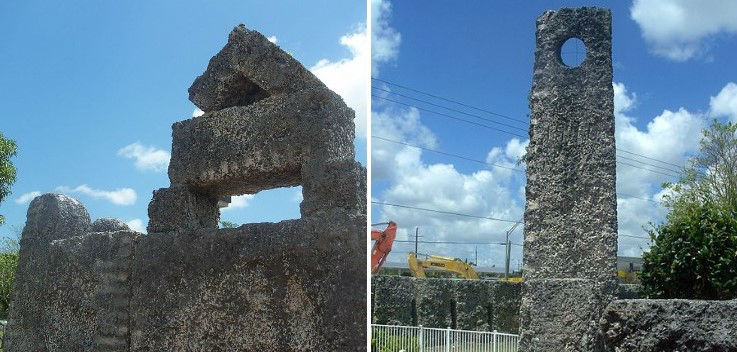
While living in Oregon, the cold weather didn't do Leedskalnin any favors, and he was diagnosed with incurable tuberculosis. To everyone's surprise, he recovered spontaneously. When questioned, he attributed his recovery to magnets, which stimulated his immune system and drove out the disease. After overcoming the disease, he moved to Florida City for the warmer climate. There, he purchased a remote, undeveloped plot of land. At the time, Florida City was sparsely populated and sparsely developed.
On this plot of land, Leedsklanin began his ambitious project, which he called "Stone Gate." He began by quarrying oolitic limestone, processing it, and moving it into place without assistance. Since he worked alone in the dead of night, using only a flashlight as a light source, no one saw the process. With meticulous work, this man, only five feet tall, managed to erect enormous structures from 1,100 tons of stone, some of which weighed nearly 27 tons. These stones were joined seamlessly, without the use of mortar or cement. Using only a few picks, ropes, winches, and pulleys, Leedsklanin created one of the most astonishing engineering marvels in the world.
In 1936, due to the construction of a nearby housing development, Leedsclunin moved the entire structure 10 miles to Homestead, Florida. Over the next three years, he transported the entire building himself by truck. He named the new location "Rock Gate" and dedicated it to his lost love, "Sweet Sixteen.".

Leedsklanin, an extremely private man, chose a secluded plot of land to build "Rock Gate." But in 1936, his privacy was threatened by the construction of a nearby residential complex. Rather than accept the invasion of privacy, he decided to move his massive structure elsewhere. He borrowed a friend's truck and, over the course of three years, transported the entire structure 10 miles to Homestead, Florida. Working alone, he moved everything piece by piece.
After the transfer was completed, he resumed work on the structure. By the time construction was completed, the castle had two stories. It featured a throne room with stone thrones, a 9-meter "Polaris" telescope, a sundial, a 12-meter obelisk, living quarters, a fountain, and even a vast garden filled with stone sculptures. Every structure in this castle is practically perfect. Not a single one of them has gaps between the coral elements, not even a chisel mark.
In Florida City, Edward Leedskalnin opened the gates of his Coral Castle to the public, charging a minimal admission fee. He never revealed the secrets of his construction, which used 1,100 tons of stone, except to a few teenagers. The castle's most famous feature is its 8-foot-tall gate, which can be opened with a child's finger.

Despite being an extremely private man, Leedskalnin opened Coral Castle (then known as Rocky Gate) to the public in Florida City. Initially, he charged ten cents per visitor. But later, he lowered the fee to twenty-five cents, allowing those who couldn't afford it to enter free. He also carved a sign into a stone near the main gate asking for a bell to be rung twice. Each time someone rang the bell, Leedskalnin would descend from his chambers on the second floor of the castle, approach the gate, and give interested visitors a tour.
There are numerous rumors about how Leedsklanin managed to build the Coral Castle. Leedsklanin himself claimed to have used reverse magnetism to create these structures. It is believed that no one except a few teenagers witnessed his method of work. These youths claim to have seen Leedsklanin levitate stones like balloons.
Coral Castle's most popular attraction is its enormous main gate. Standing 8 feet tall (about 2.4 meters), the gate is so perfectly balanced that it can be opened with just a gust of wind or a single finger. In 1986, the gate was dismantled for renovations. It was moved using a 45-ton crane and six workers. The renovations lasted nearly 10 years. It remains a mystery how Leedsklanin managed to install the gates himself and without any modern equipment.
In addition to building Coral Castle, Edward Leedskalnin published numerous pamphlets and booklets on two topics: moral education and magnetism. At the age of 64, he suffered a stroke. Twenty-eight days later, he died of a kidney infection. His creation, Coral Castle, is now listed on the National Register of Historic Places.

In the last years of his life, Leedskalnin published five pamphlets and placed advertisements in a local newspaper. His first and longest pamphlet was a treatise on moral education. It was printed only on the left-hand pages. He also published four pamphlets devoted to the interaction of magnetism, electricity, and the human body. In these pamphlets, he included a series of simple experiments to support his theory. Leedskalnin's thesis on electromagnetism contradicts the standard model of electromagnetism.
Edward Leedskalnin led a very ascetic lifestyle. His diet consisted only of cookies, milk, eggs, and sardines. He grew fruits and vegetables in a small garden. At the age of 64, he fell ill and went to a Miami hospital. A few days later, he suffered a mild stroke. He died 28 days later from pyelonephritis (a kidney infection). After his death, Coral Castle passed to the ownership of his closest relative, a nephew named Harry. The nephew sold the castle in 1953. The new owners renamed it Rock Gate Park. In 1984, it was listed on the National Register of Historic Places.
In 1992, Hurricane Andrew caused massive destruction in Homestead. Remarkably, none of the structures in Rock Gate Park were damaged. In 2011, the park's name was changed from Rock Gate Park to Coral Castle Park. It is now a well-known Florida tourist attraction.
[source:1,2,3,4,5]