








The human mind has always been fascinated by the mysteries of the unknown. Even a simple object's value increases a thousandfold if it's associated with a mysterious past, an event, or even a curse. We may not enjoy owning such objects, but their history always intrigues. In this article, we've compiled the stories behind ten such historical objects believed to be cursed.
1. Hope Diamond
The Hope Diamond is believed to be cursed, bringing misfortune and tragedy to those who own or wear it. But after the Smithsonian Museum acquired the diamond, "the curse appears to have subsided.".

The Hope Diamond is one of the most famous gemstones in the world, with a history of ownership spanning nearly four centuries. This 45.52-carat diamond is believed to have been mined in India. It is said that the diamond was originally set into a statue of the goddess Sita, the wife of the god Rama. The Hope Diamond formed one of her eyes in the idol. It was stolen, and the temple priest placed a curse on whoever came into possession of the missing stone.
This story fuels the belief that misfortune befalls those who own the diamond. The fall of Madame Athénée de Montespan during the reign of Louis XIV, the beheading of Louis XVI and Marie Antoinette, the rape and mutilation of the Princess de Lamballe during the French Revolution, and many other incidents are linked to misfortunes brought on by the Hope Diamond. Even jewelers who may have handled the Hope Diamond are said to have been ruined by it. For example, the madness and suicide of Jacques Colot and the financial ruin of jeweler Simon Frankel are linked to the stone.
The Hope Diamond is currently in the collection of the Smithsonian Museum. But, surprisingly, ownership of the diamond has brought the nonprofit national museum "nothing but good fortune.". (1,2)
2. Björketorp Runestone
The Björketorp Runestone in Sweden is inscribed with a curse. According to the curse, anyone who breaks the monument will be afflicted with evil and doomed to death.

The Björketorp Runestone in Blekinge, Sweden, is part of a burial field. At 4.2 meters tall, it is one of the tallest runestones in the world. It forms a stone circle with two single menhirs, also known as standing stones or orthostats. Of the three, only the Björketorp Runestone bears an inscription, written on both sides. One of the inscriptions states that anyone who destroys the structure will suffer a cruel death. Most scholars date the inscription to the seventh century. It is believed that the curse is intended to protect the runestone. (source)
3. Maori warrior mask
According to Maori tradition, warriors carve and paint masks before battle, and it is said that if they die, their spirit lives on in the mask.

The Maori are the indigenous people of New Zealand. The warrior mask is an important part of their tradition. The masks are quite ornate, featuring intricate details, and are crafted by the Maori before being sent off to war. According to Maori belief, each mask contains the spirit of its owner.
According to Maori traditions, a woman during menstruation is tapu , or taboo, and masks are also taboo. Therefore, if they touch each other, it will cause a curse. Furthermore, pregnant women are considered sacred. Therefore, it is recommended to keep pregnant women away from these masks to protect them. In 2010, the National Museum of New Zealand even caused a wave of outrage when it urged pregnant women to refrain from visiting a museum containing sacred Maori artifacts. (source)
4. China's Terracotta Army
The curse of the Chinese Terracotta Army manifested itself when three of the seven peasants who discovered the sculptures died painfully. The remaining peasants and most of the village are on the brink of financial ruin.
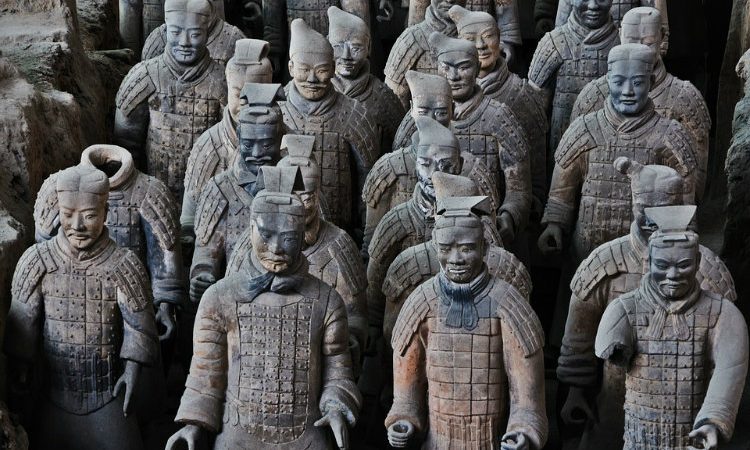
In 1974, a group of seven workers in the village of Yan were digging a well on their communal farm. While digging, one of the farmers, Zhifa, struck something about 15 meters down. At first, they saw the top of a head, but as they dug further, the entire head became visible. Thinking he had found a bronze relic he could sell, Zhifa hammered it off. But when he brought it back to the village, the villagers were afraid to touch it, mistaking it for a temple statue.
As rumors spread, officials and archaeologists flocked to the village, beginning excavations of the tomb. Over the next few years, the land came under state control. Villagers' homes were demolished to make way for exhibition halls and souvenir shops. Of the seven workers who discovered the Terracotta Army, Wang Puji committed suicide, while Yang Wenhai and Yang Yanxin died without work or means of support. The destruction of the village, the suffering of the villagers, and the deaths of the three workers gave rise to the notion that the Terracotta Army was cursed. (source)
5. Black Orlov
Rumor has it that the Black Orlov diamond was stolen from a statue of a Hindu god and is considered cursed. Most of its owners have either died or committed suicide.

The Black Orlov Diamond, also known as the "Eye of Brahma," weighs 67.50 carats and is believed to bring misfortune to its owner. It is said to have been discovered in the early 19th century in India, where it was depicted as one of the eyes on a statue of the Hindu god Brahma. It was then stolen by a monk and cursed.
The first known death associated with this diamond was that of diamond dealer J.W. Paris. He brought the diamond to the United States in 1932 but soon committed suicide by jumping from a skyscraper in New York City. Two more owners, Princess Nadya Vygin-Orlova and Princess Leonila Galitsina-Bariatskaya, also later committed suicide. In 2004, the diamond was acquired by diamond dealer Dennis Petimezas. He once said, "I've spent the last year trying to learn everything I can about the melodramatic history of this stone, and I'm almost certain the curse has been broken.". (1,2,3)
6. The Iceman
In 1991, a completely frozen skeleton of a 5,000-year-old human was discovered in the European Alps. Since then, seven people connected to its discovery have died under mysterious circumstances, and many associate their deaths with the "curse of the Iceman.".

In September 1991, two German tourists were hiking in the peaks of Italy's Ötztal Alps. While enjoying the scenic beauty, they suddenly saw a frozen human corpse. The terrified couple immediately alerted authorities, believing it to be the body of the missing climber. The mysterious body was completely mummified in ice and removed from the scene on September 22. They named it Ötzi, the Ice Man.
But soon after his discovery, people connected to the case began to die. The first to die was forensic pathologist Rainer Henn, one of the first scientists to work with the Iceman. He died in a car accident on his way to a lecture about his discoveries regarding the mummy. Next to die was mountain guide Kurt Fritz, one of the first to discover the mummified body. He died in an avalanche. Then, the American filmmaker who filmed the Iceman's recovery from the ice died of a brain tumor. Next came the hiker who first discovered the Iceman's body, followed by the scientist, one of the first to examine the Iceman. Then came the man leading the search party that found the hiker.
The latest casualty was the death of an archaeologist who played a key role in uncovering information about the Iceman. Some believe all these deaths are just a coincidence, but others believe it is the "curse of the Iceman.". (1,2,3)
7. Glavendrup Stone
The Glavendrup Stone, erected during the Viking Age, contains the longest runic inscription in Denmark and ends with a curse that is said to befall anyone who dares to desecrate the stone.

Erected in the early 10th century, the Glavendrup Stone is a runestone on the island of Funen in Denmark. It was erected by Ragnhild and her sons in memory of her husband, Ali. This runestone is famous for containing the longest runic inscription in Denmark. However, the inscription ends with a curse. According to the curse, anyone who damages or removes it will become a sorcerer. At the time, the word "sorcerer" was used to describe someone considered unnatural and a social outcast. (1,2)
8. Busby Porch Chair
When murderer Thomas Busby was sentenced to death, rumors circulated that the execution site, including the chair he used for the last time, was cursed. Belief in the curse grew stronger in the 1970s, when several fatal accidents were linked to the chair.

In 1702, a man named Busby quarreled with his father-in-law, Otie, over Otie's daughter, Elizabeth. As a result of this dispute, Busby murdered Otie, was arrested, tried, and sentenced to death. On his way to the gallows, Busby's last wish was to stop at a tavern and drink one last glass of ale. His favorite chair, now known as "Busby's Chair," stood in the tavern. It is said that while visiting the tavern, Busby exclaimed, "May sudden death befall anyone who dares to sit in my chair!"«
After Busby's execution, the chair remained in the pub, and patrons were encouraged to sit on it. In 1894, a chimney sweep sat in it and was found hanging from a pole the next morning. During World War II, Canadian airmen frequented the inn, and it is said that those who sat in the chair never returned from their missions. In 1967, two Royal Air Force pilots, returning from the pub, sat in the chair and crashed into a tree, dying. The death toll continued until the pub owner became concerned. In 1978, he donated the chair to the Thirsk Museum on one condition: it be hung from the ceiling, preventing anyone from sitting in it again. (1,2)
9. Tomb of Tutankhamun
Shortly after Howard Carter's excavations of Tutankhamun's tomb, some members of his team and other prominent researchers died, thus giving rise to the belief in Tutankhamun's "curse.".

Until October 1922, the young King Tutankhamun rested peacefully in his tomb, unknown and untouched. But in November 1922, archaeologist Howard Carter and his sponsor, Lord Carnarvon, discovered a chamber in Egypt's Valley of the Kings. Suddenly, they became famous as the world's attention turned to the forgotten young king.
But then Lord Carnarvon was bitten on the cheek by a mosquito, accidentally aggravating the wound while shaving, and died of fever in a delirium. Arthur Conan Doyle, creator of Sherlock Holmes, said this must be the mummy's "curse." Suddenly, newspapers began publishing reports that death was certain for anyone who disturbed the young pharaoh. Belief in the curse grew stronger as more deaths followed. Lord Carnarvon's poultry was eaten by a snake, and his dog died. Later, the radiologist who performed X-rays on the mummy died of a mysterious illness. A wealthy American died of pneumonia after visiting the tomb, and a member of Carter's excavation team is said to have died of arsenic poisoning. But Howard Carter, the man who actually discovered Tutankhamun's tomb, lived until 1939. People still wonder: if Tutankhamun's curse exists, why didn't it affect Carter? (source)
10. Painting "The Crying Boy"«
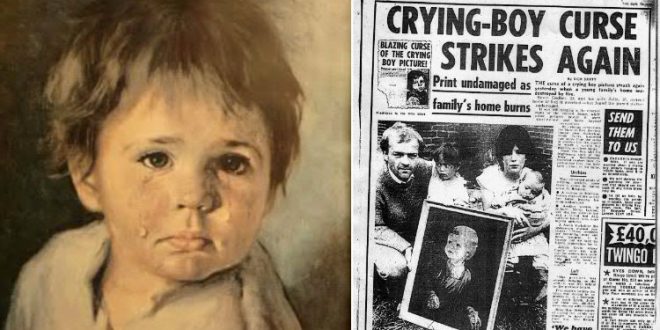
The curse associated with the painting "The Crying Boy" began with reports that many houses that contained a copy of the painting caught fire, but the painting itself was always found intact among the burned ruins.

The painting "The Crying Boy" was painted by the Italian artist Giovanni Bragolin. It was a popular painting, and people loved to display it in their homes. Copies of it were widely circulated beginning in the 1950s. But opinions about the painting changed after a prominent newspaper published a statement from an Essex firefighter. The Essex firefighter claimed to have found copies of the painting in a number of houses destroyed by fire. Amazingly, none of the paintings were damaged, although nearby objects were completely destroyed. He also stated that no firefighter would allow a copy of the painting in their own home.
The news spread quickly, and people began removing the painting from their homes, believing it was cursed. To dispel the curse, Steve Punt, a British writer and comedian, examined the painting in a program called «Punt, Private Detective» . The program tested the painting at the Construction Research Institute. It was discovered that the prints had been treated with a varnish containing a fire retardant. In the event of a fire, the rope holding the painting to the wall would have failed first. As a result, the painting fell face down on the floor, thus protecting it. But the program couldn't explain why no other painting was found undamaged. (source)