








With every technological advancement, the world moves forward, and we gain access to products that people of the past could only dream of. Li-Fi is one such new technology that has the potential to take our communication to a whole new level. Until now, we've been using radio waves for communication, and we're now reaching a point where this is no longer sufficient to meet our information needs. To solve this problem, researchers have decided to use completely different waves—light waves—which are ubiquitous and part of our everyday lives.
The term "Li-Fi" was coined by Professor Harald Haas of the University of Edinburgh and co-founder of PureLiFi. He presented the idea of Li-Fi in 2011 at a global TED Talk, dedicated to a technology that harnesses the same visible light energy we use for everyday lighting.
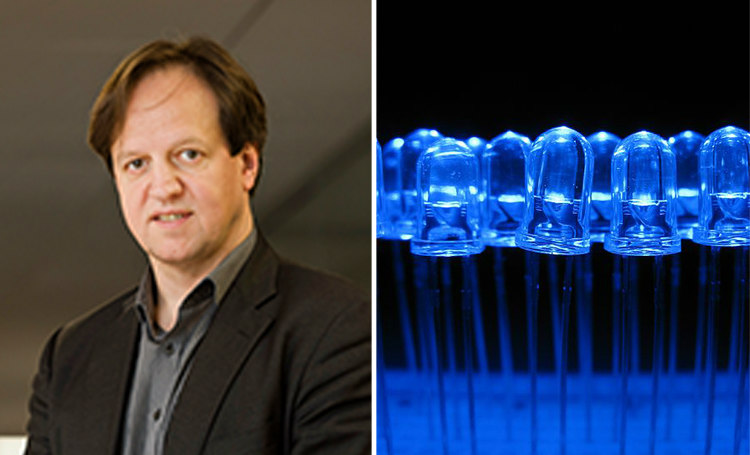
Harald Haas, a professor of mobile communications at the University of Edinburgh in Scotland, began researching Li-Fi in January 2010 and later founded his own company, PureLiFi. By October 2011, several other companies and industry groups had joined him, forming the Li-Fi Consortium to exploit the potential and overcome the limitations of radio-based wireless spectrum.
Li-Fi is a bidirectional, high-speed, and fully networked data transmission using light. It is a form of visible light communication (VLC) and a subset of optical wireless communication (OWC) that can be used in addition to conventional Wi-Fi or replace it entirely. It is also considered an excellent alternative for use in areas sensitive to electromagnetic radiation, such as airplane cabins, hospitals, or nuclear power plants, as it does not cause any interference.
Li-Fi's frequency spectrum is 10,000 times wider than radio frequencies, and lab tests have achieved speeds of 224 gigabits per second.

Before Li-Fi, other VLC systems existed that provided only one-way communication. As research progressed, Li-Fi's speed increased. By August 2013, researchers succeeded in increasing the speed to 1.6 gigabits per second using a single-color LED. In April 2014, the Russian company Stins Coman increased the speed to 1.25 gigabytes per second, hoping to reach five gigabytes per second. Later that year, the Mexican company Sisoft increased the data transfer speed to 10 gigabytes per second. Ultimately, the speed rose to 224 gigabits per second (28 gigabytes per second).
Li-Fi technology works by switching LEDs on and off at a very high rate, too fast for the human eye to detect. The modulated light is then received by a photosensitive detector and demodulated into electronic form.
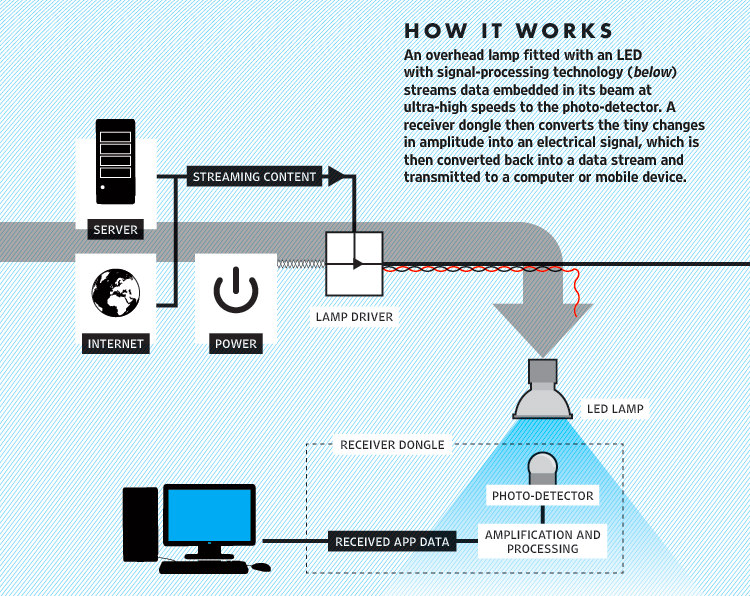
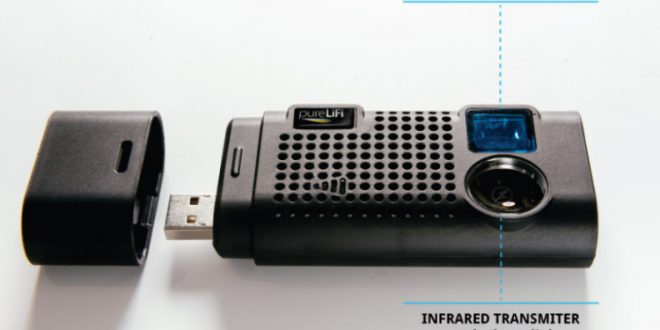
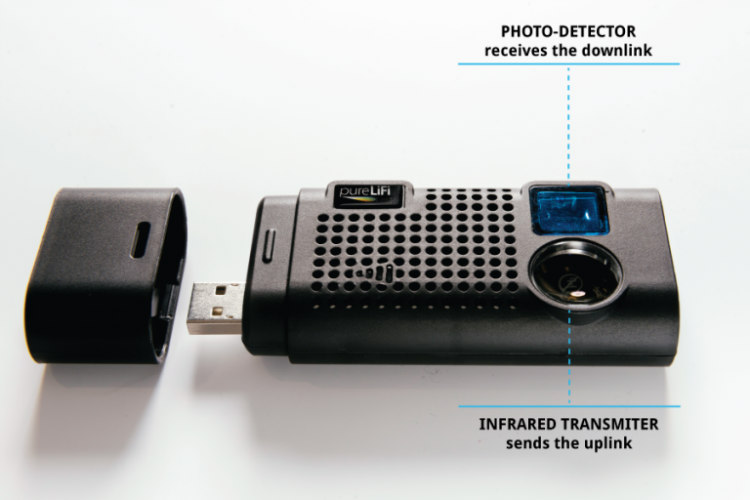
Since LEDs are semiconductor devices, their brightness can change extremely quickly. For comparison, the lowest light modulation frequency is 1 MHz, which is still 10,000 times higher than the refresh rate of our computer monitors. A Li-Fi adapter contains both a transmitter and a sensor to enable two-way communication. Unlike Wi-Fi, it uses direct modulation methods similar to those used in remote controls.
Li-Fi technology operates seamlessly in sunlight at 77,000 lux. Although the human eye can't perceive it, the light can be dimmed at night. Unlike remote controls, Li-Fi doesn't require direct line of sight. In fact, even light reflecting off walls can achieve data transfer rates of up to 70 megabits per second.
Li-Fi technology still faces some challenges, but its potential is enormous. First, it has a short range, as visible light cannot penetrate walls. However, it offers much greater security than Wi-Fi, as it cannot be accessed or hacked from the outside.
One potentially interesting application of Li-Fi is remotely operated underwater vehicles (ROVs). ROVs typically use cables to receive commands and transmit signals, limiting the vehicle's ability to transmit signals over distances greater than the cable's length. Using Li-Fi in hospitals also provides a more efficient information transmission system, and the light waves have minimal impact on medical equipment or the human body. Home and building automation are also being considered as another potential application. Since waves cannot penetrate walls, buildings cannot be hacked remotely.
Many companies such as PureLiFi, OLEDComm, Qualcomm, Panasonic, Samsung and Philips are working on developing this technology to make it easily accessible to everyone.
[Sources: Wikipedia, ScienceAlert, PureLiFi]