









We hear a lot about scientists and their outlandish ideas, but in reality, it's engineers who bring these ideas to life for real-world applications. At its core, engineering is the science of creating things, such as machines, to apply theoretical scientific principles to real-world situations. For example, a theoretical timekeeping system, no matter how complex or accurate, is useless without a working clock.
Of course, the greatest engineering marvels of modern times are a bit more advanced and complex than watches. Over the past few years, engineers around the world have built many things that were once considered impossible or at least relegated to the realm of the distant future.
10. Parker Solar Probe

Despite its apparent proximity to Earth, we know very little about what happens to our Sun, especially on its surface. It appears to be colder than its atmosphere or crown , where all the sun's heat actually comes from. It doesn't make any sense—it's like feeling hotter the further you move from the fire.
This is just one of many things we don't know about the Sun, and until recently, reaching its corona to take measurements was considered an impossible futuristic task. Probe NASA «Parker» broke that barrier on April 28, 2021, when it became the first man-made object to touch the Sun's atmosphere. This was Parker's eighth flyby, and it gave us some important insights into how solar radiation is generated. winds .
The probe is still in orbit around the Sun and is expected to make another close flyby sometime in 2025.
9. Mind-controlled prosthetics
Modern prosthetics are in themselves one of the greatest feats of engineering achievements Of all times. For most of our history, amputees had to either live without limbs altogether or make do with rudimentary, uncomfortable models made of leather, wood, and other basic materials. Only now have prosthetics begun to look and even almost feel like real limbs. However, they are far from reality, as it is impossible to recreate the neural connection between a living organ and the brain using a machine.
Mind-controlled prosthetics are a new class of prosthetics that can be controlled by the mind, although they are still in their early stages. One prototype developed Swedish Scientists have developed a device that connects with the patient's nerves, muscles, and skeleton, allowing them to have much greater control of their fingers and wrists than previously thought possible. It is currently being actively used by three Swedish patients and requires no additional care or monitoring by a healthcare professional, unlike most prosthetics currently available.
According to the researchers, the technology could be available to patients outside of Sweden within this year. While it's still not the same as a real limb, it does offer a glimpse into what the future of prosthetics might look like.
8. Burj Khalifa

Sometimes engineering is about pushing the boundaries of not only engineering but also other fields of study, which contributes to our overall understanding of the world. However, this is not necessary, as good engineering can also be about building really a tall and beautiful building.
Currently, the tallest building in the world is the Burj Khalifa, which is 2,717 feet tall. It unusually high - about 500 feet higher , than its closest competitor, making you wonder how it even stays upright.
The Burj Khalifa, built by Chicago firm Skidmore, Owings & Merrill, took more than six years to complete and first opened to the public in January 2010. years . it also absorbs strong wind.
There are a total of 163 floors, each built differently to reduce the effects of wind as you go higher. Besides residential buildings and shopping areas, the building has several observation decks , including the two-story At The Top on the 124th and 125th floors, as well as luxury restaurants, corporate spaces and a three-story lounge.
7. Floating cities
Rising sea levels pose a huge challenge for the Netherlands, as more than a third of the country's territory is already below sea level. current sea level. To counter the worst effects, a Dutch architecture firm developed Schoonschip: a conceptual residential project in Amsterdam that combines architecture and sustainable design to create a completely new way of living.
The entire neighborhood is built on floating arks in the Johan van Hasseltkade Canal and currently houses about 100 people in 46 residential buildings. It's an alternative to all the land-based models we currently have, though it's not new—many indigenous communities around the world still live in floating settlements.
However, Schoonschip is more than just a trendy floating home. Every aspect of its design is intended to be sustainable and reusable, with all decision-making placed in the hands of the residents. For example, all energy generated within the complex is produced using renewable energy sources and distributed to residents via blockchain .
6. Nanorobots
Nanorobots—or microscopic robots that can perform any function you want—have appeared in science fiction in various forms. However, until recently, creating something similar was virtually impossible. Thanks to advances in theoretical science and nanotechnology over the past few years, we already have the first prototypes of future nanorobots.
As you might expect, these tiny machines have quite a few applications in medicine. Group Researchers from the University of California, San Diego have developed nanobots that can cleanse blood of toxins and pathogens. . Another from the University of New South Wales found a way to teach these bots to repair themselves using DNA , blurring the line between living organs and artificial robots.
5. Invisibility cloak
When we think of an invisibility cloak, we think of a hypothetical material that could make us truly invisible. (Or, just as likely, we think of Harry Potter. Naturally.) Numerous prototypes have been tried, though almost all of them either relied on cheap tricks of light or were too bulky to be of any real use.
The only material that comes close to invisibility in real life is Quantum Stealth , developed by a Canadian corporation known as Hyperstealth Biotechnology Corp. you are invisible.
From the videos released by the company, it's clear that the material is designed to effectively reflect light around any object, including large vehicles. However, we don't know exactly how it works, as this information is still classified due to possible military applications in the near future.
4. Mind reading

It's one thing to scan the brain for electrical and neurological signals, and another to read and record what's going on in our heads as we perceive it. The former can be achieved with many machines found in your local hospital. The latter, however, represents a barrier we never thought machines could overcome, as consciousness is much more than just electrical waves coursing through the brain.
As it turns out, this is not true. We already have machines that can identify song, playing in your head, with the help of AI, as it studies the connections between brain signals and specific fragments of music using machine learning. Or even recreate image, that you think of, albeit with a lesser degree of precision than the songs (but still high enough to be creepy).
3. 4D objects
We've all heard of 3D printing, which allows you to create anything you want, given the basic ingredients and a plan. It's a revolutionary concept in itself, successfully used in a wide variety of applications. Someday, it may even allow us to print living organs or even living creatures.
4D simply builds on this concept, except that printed objects can now respond to various conditions in real time. Quite a few 4D materials, also called "smart materials," have been developed in the past few years, including self-healing plastics that can eliminate wear and tear and make plastic items infinitely reusable, fabrics that can change their molecular structure depending on weather conditions . , and shoes that can completely repair themselves with the help of additional gel, among other things.
2. Artificial intelligence

Artificial intelligence isn't exactly a new concept. First coined in 1956, the term has come to refer to any type of machine or algorithm that can mimic human intelligence. Early experiments involved rudimentary, mildly intelligent automatic machines , such as the Johns Hopkins beast, although the technology was still held back by a lack of processing power and other computational limitations to make a real impact.
Fast forward to today, and artificial intelligence is one of the most revolutionary developments of the past few years, thanks to the proliferation of powerful graphics processing units (GPUs), machine learning, and the emergence of big data. Neural networks, as one example of their many implementations, are capable of thinking and computing just like the human brain, including the ability to learn from mistakes.
AI has revolutionized many fields, including medicine , logistics, space exploration, marketing and almost anything related to analyzing large amounts of data. This also, unfortunately, includes military action, as militaries around the world develop their own technologies based on AI, that will be used on the automated battlefields of the future.
1. Large Hadron Collider
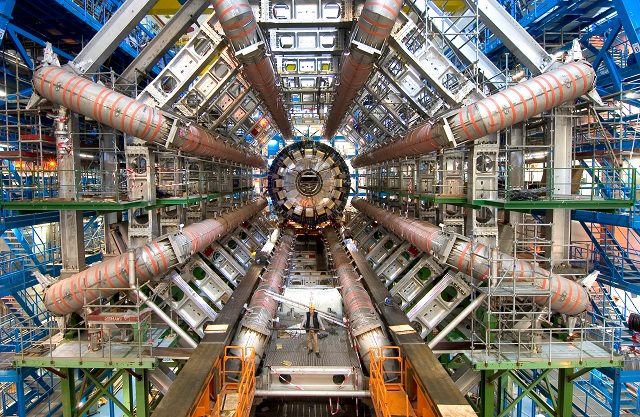
The Large Hadron Collider is perhaps one of the most important engineering feats ever undertaken. underground tunnel 17 miles long , located on the border between France and Switzerland, whose main purpose is to collide different types of particles at very high speeds in order to understand the true nature of reality.
First launched in 2008, it was a massive project not only in scope but also in the scale of its goal. Organized by CERN—or the European Organization for Nuclear Research—it was designed and built by more than 10 000 scientists, engineers, and other specialists from around the world. At over $10 billion, it's the most expensive machine ever built, and we can now say it was worth it. Since its first launch, the LHC has made many important fundamental contributions to theoretical physics, including the widely publicized discovery of the Higgs boson in In 2012 .