








The 1990s witnessed dramatic changes, driven by new technological and cultural advances across the globe. Those who grew up in the '90s are familiar with the decade's defining achievements, such as the advent of the World Wide Web and a host of innovative gadgets. Beyond technological advances, the 1990s also gave the world iconic figures, games, toys, food, movies, TV shows, and fashion trends. The transition from the 20th to the 21st century was seamless, and the fascination with some things that existed in the '90s has gradually begun to fade. To transport you back in time and fill you with nostalgia, we've compiled a list of ten things from the 1990s that are now almost extinct.
1. Videocassettes appeared in the 1970s and revolutionized the television and film industries. However, with the advent of DVDs, the VHS market began to decline. The last known VHS equipment manufacturer, Funai in Japan, officially ceased production in 2016.

VHS is a widely used standard for video recording on cassette tapes, known as VCRs. The technology was invented by the Japanese company Victor and commercially launched in the 1970s. This technology revolutionized the home entertainment industry. Two widely used standards, VHS and Betamax, achieved widespread adoption, with the former dominating the market. But its popularity was overshadowed by the introduction of the optical disc format known as DVD in 1997. This new technology offered increased storage capacity and higher video quality than its counterpart.

The VHS market began to gradually decline, and in 2018, it was completely replaced by DVDs, which had taken over the television and film industries. The last known VHS equipment manufacturer, Funai, based in Japan, officially ceased production in 2016, marking the end of the technology. (source)
2. Handheld game consoles like the Brick Game and Game Boy were incredibly popular in the 1990s. These portable consoles featured a built-in screen, controls, and speakers. With the advent of newer handheld game consoles, monochrome game consoles have given way to more modern versions.

The first handheld game console was introduced in 1979 by Mattel, and several other companies followed suit. However, Nintendo is considered the pioneer of the handheld gaming industry with the release of the Game Boy in 1989. This handheld game console featured games running on an 8-bit processor with a 2-bit color palette.
In the 1990s, this device was incredibly popular among children and teenagers and cost $89.99. Over the next 14 years, the company set a record, selling over 118 million units worldwide. As mobile phones gained popularity thanks to improved processors and better graphics, sales of monochrome handheld devices began to decline. However, in the 2000s, Sony revived the gaming industry by integrating smartphone technology with portable consoles, particularly with the Sony PlayStation. (source)
3. In 1996, Nintendo released its third gaming console, the Nintendo 64, which featured a 64-bit processor. The home gaming console included the popular game Super Mario in 3D. After the advent of more advanced gaming consoles, Nintendo discontinued production of its classic console.

The classic video game console, codenamed "Project Reality," was originally released in Japan in June 1996 and entered the American market in September 1996. It was marketed as the last video game console to use a cartridge as its primary storage medium and released two games: Super Mario 64 и Pilotwings 64. The console was priced at $199.99, and the company sold over 32.93 million units worldwide.
The gaming console provided serious competition to the Sony PlayStation and other well-known gaming devices released during the decade. Thanks to its immense popularity Time magazine named it "Machine of the Year." However, after Nintendo released the GameCube in 2001, the company finally discontinued its classic gaming console in 2002. . (source)
4. Tazos were circular discs distributed as part of promotions with Frito-Lay products and those of its subsidiaries worldwide. Looney Tunes Tazos became popular among children and teenagers because they featured famous cartoon characters such as Bugs Bunny, the Tasmanian Devil, Tweety, and others, along with point values.

The world's first Tazo character set Looney Tunes was released in Australia in 1995. Tazo has been released in a variety of formats and forms covering a variety of topics such as «The Simpsons» , «"Star wars"» и «Marvel Heroes» . These Tazo were used in Japanese game Pog , where the player with the higher score would take the Tazo from the opponent with the lower score. They were also used to create objects by joining multiple Tazo together using cuts along the edges.
In various countries, these Tazos were commonly included in bags of chips such as Lays Chips, Doritos, Uncle Chips, Twisties, Cheese Balls, etc. Over the years, due to the popularity of trading cards, the popularity of Tazos has declined, and they are now a rare collector's item. (source)
5. In the 1990s, the floppy disk was considered the most versatile and widely used data storage medium. However, the advent of CDs, DVDs, and other storage media made floppy disks obsolete.

In 1967, IBM created the floppy disk, commonly referred to as a "floppy disk," a storage medium for storing computer files. The disk drive consisted of a thin, flexible magnetic strip of data, enclosed in a plastic casing. CDs were developed as an alternative to expensive and bulky storage media such as hard drives.
In the 1990s, floppy disks were incredibly popular among techies for installation and file backup, so much so that the save function in computer programs is immortalized with a floppy disk icon. However, in the late 1990s, the advent of advanced storage devices such as USB flash drives, expandable hard drives, DVDs, and network attached storage devices rendered them obsolete.
Additionally, most computers designed after 2000 were released without a floppy disk drive, making them obsolete. (source)
6. AOL Instant Messenger, a computer program for instant messaging created by AOL , dominated the online chat industry in North America in the late 1990s, allowing users to communicate in real time. Due to the emergence of social apps, its popularity began to decline, and the company discontinued its chat service in 2017.

Since its launch in 1997, AIM ( AOL Instant Messenger has become an integral part of the online community. This instant messaging computer program was created as an extension of desktop software. AOL . The desktop client allows registered users to communicate in real time using the OSCAR and TOC instant messaging protocols.
The main competitor AOL There was a Microsoft Windows messaging application, MSN Messenger. AIM dominated the online community for a long time until Gmail , which offered a built-in messenger, Google Chat. Since 2011, AIM's popularity has declined sharply due to the emergence of social apps such as Facebook и WhatsApp . The company ceased providing its services on December 15, 2017. (source)
7. A pager, commonly known as a "beeper," was a small wireless telecommunications device that received and displayed alarms and short messages. They were widely used in the 1990s, but the ubiquity of cell phones and smartphones has significantly reduced the use of this iconic device.
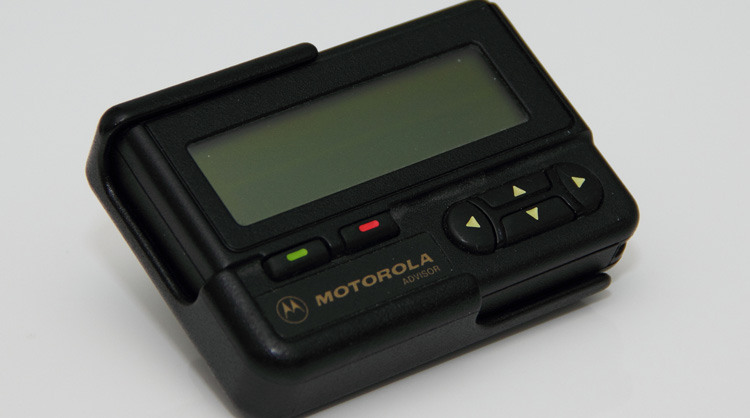
The pager was invented by Alfred J. Gross in 1949 and was initially used to alert doctors in New York City, who purchased the device for a $12 monthly subscription. Roughly the size of a pocket calculator, the pager featured a built-in miniature keyboard and a display capable of displaying several lines of text. With the advent of new technologies, the pager was later used to transmit audible alerts, voice or text messages, numeric and alphanumeric characters, and to provide two-way communication.
In 2003, the American paging industry's revenue was $6.2 billion, but in 2008 it plummeted to $2.1 billion. In the 21st century, the number of paging subscribers has declined due to the proliferation of mobile phones. However, this device remains the preferred means of emergency communication. (source)
8. Walkman is a series of portable music players that allowed people to listen to music on the go. Sony's first portable CD player, the "Discman," was released in 1984, but was renamed the "CD-Walkman" in 1999.

In 1963, the Dutch electronics company Philips created the first magnetic cassette technology, intended exclusively for secretaries and journalists, allowing voice recording and playback later. Sony capitalized on this technology, releasing the Sony Walkman TPS-L2 portable cassette player on July 1, 1979. The original version was a compact cassette player with large buttons and headphones in a leather case.
To improve its bulky design and efficiency, Sony released its first portable CD player, the "Discman," in November 1984, priced at $350. Public interest in music CDs grew rapidly, and the music industry followed suit. However, in the late 1990s, Sony renamed its iconic device the "CD-Walkman," and it became Sony's most successful product ever, selling over 400 million units. As technology advanced, demand for portable CD players declined, and classic players were replaced by MiniDiscs, iPods, and smartphones. (source)
9. «Goosebumps» — is a series of children's horror novels written by renowned American author R.L. Stine. The stories follow children who find themselves in terrifying situations, encountering monsters and other supernatural creatures.

R.L. Stine is often called "the Stephen King of children's literature." From 1992 to 1997, the author published sixty-two books in the "« Goosebumps »"These horror novels were extremely popular with teenagers and inspired numerous television series, merchandise, and feature films.
Since its launch, the series has sold over 400 million copies worldwide, published in 32 languages, making it the best-selling book series ever. «Harry Potter» . The books have repeatedly appeared on various bestseller lists, including the bestseller list New York Times . Scholastic Corporation has discontinued most of the books in the series, except for the most well-known ones. (source)
10. AltaVista , a search engine that existed before Google , was considered a pioneer in the field of search technology. Initially, AltaVista was a test sample provided to the AlphaServer 8400 TurboLaser supercomputer, which is capable of quickly searching large databases. The search engine was acquired Yahoo in 2003 and ceased operations in 2013.
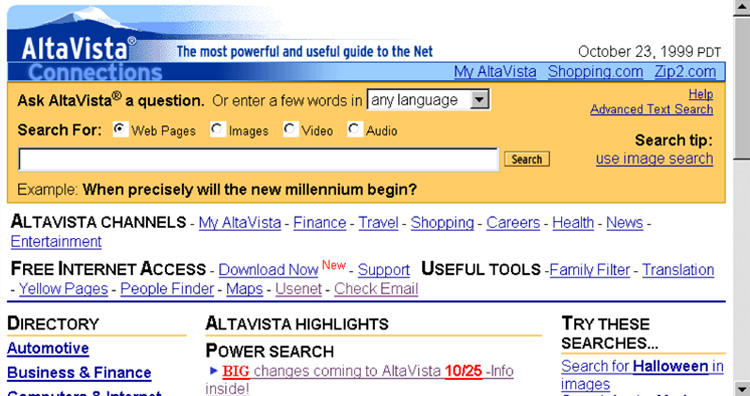
Computer scientist Louis Mauney created the first web crawling tool, "Scooter," launched in December 1995, and Michael Burrows developed the indexer. The researchers coined the term "AltaVista" in honor of Palo Alto, California, where the lab was located. The search engine became incredibly popular among internet users, indexing ten times more websites than other search engines. At its peak, it could handle 80 million visitors per day.
Moreover, AltaVista was the first search engine that allowed users to search for content in their natural language and provided multilingual search. It also allowed searching for audio, images, and video. In 1996, the search engine was acquired by Yahoo and included search portal queries Yahoo , and was later transformed into a sophisticated web portal by Compaq. Users who liked the simple interface abandoned it. AltaVista and preferred Google , which led to its gradual closure in 2013. (source)