








Protests, violent or non-violent, have always been a way for ordinary people to express their voices when those in power remained deaf to their views. Some protests have led to profound changes and advanced humanity. The earliest recorded protests occurred in the 13th century and led to the writing of the Magna Carta, which granted legal protection to barons in the monarchy.
But not all protests were motivated by righteous causes. Some were foolish, some were incredible, and some were downright insane.
Here are some of the craziest protest stories you can find around the world.
1. To protest the amount of air in potato chip bags, Korean students made a raft out of them and floated across a river on it.
In 2014, a group of four South Korean students constructed a raft out of 160 unopened potato chip bags to protest the amount of nitrogen contained in the bags, which significantly exceeded the amount of food. The raft was created to prove that the bags contained enough gas to float. Two of the four students boarded the raft and floated it 1.3 kilometers across the Han River in front of over 200 people.
Potato chip manufacturers claim that nitrogen injection is necessary to protect the package contents, but Korea has a law requiring packages to contain at least 65% of food products. Before the protest, Korean students made a video in which one joked, "I bought nitrogen, and they gave me free snacks.".
The students stated that their goal was not to provoke a boycott, but to encourage chip makers to listen to South Korean consumers. They succeeded, and Orion, the country's chip maker, promised to increase the quantity of product in its packages. (source)
2. The London Black Taxi Drivers' Union protested against Uber, causing a traffic jam in central London. Instead of damaging Uber, the strike increased app downloads by 850% and accelerated the decline of London taxis.

Since the launch of the taxi aggregator Uber, several taxi unions around the world have protested against it. In June 2014, black taxi unions in London decided to protest Uber over fares and licensing. Around 12,000 drivers participated in the demonstration, causing a traffic jam. Taxi drivers honked their horns in unison on the roads surrounding Trafalgar Square, holding signs and shouting slogans. Their complaint was that the government required four to seven years of training to obtain a taxi driver's license, while Uber drivers were not subject to the same regulations.
However, the strike backfired. The protest that paralyzed London led to even more people downloading the Uber app. Over the course of a week, the number of Uber app downloads increased by 8,50%, and Uber claimed that London had sided with them. (source)
3. When the price of a candy bar rose from five cents to eight cents, 200 children marched on the Capitol building in Canada, paralyzing government work for an entire day in 1947. This event became known as the "Candy Bar Strike.".
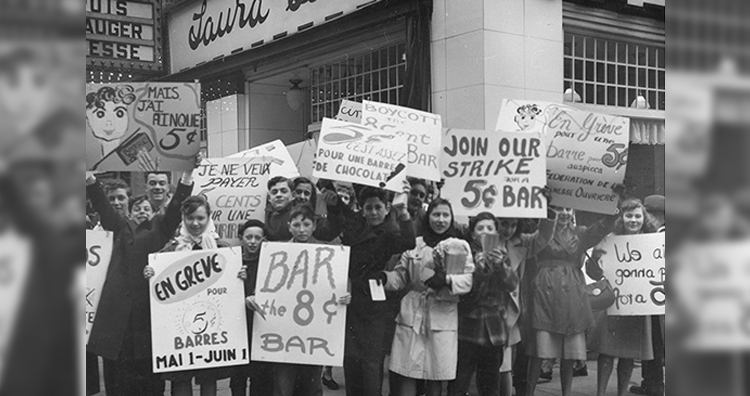
Immediately after World War II, every country was recovering, as were companies that had operated with low profitability during two major wars. They raised prices on almost everything, from fruit to automobiles, and this hit people hard, causing inflation. The price of a three-ounce candy bar increased by 60%—from five cents to eight cents—on April 25, 1947.
The children who consumed the most candy decided to protest. They drew posters and began walking around the city, singing a song they made up on the fly:
«"We want a 5-cent candy bar.".
Eight cents is too much.
We want a chocolate bar for 5 cents.
Oh, we want a 5-cent bar…"»
Subsequently, on April 30, 1947, 200 children marched to the steps of the British Columbia Capitol building, paralyzing government work for an entire day. The protest spread across Canada, and 3,000 children refused to eat candy until the price was lowered. Within days, candy prices dropped by $801. (source)
4. A motorcyclist participating in a 550-strong protest against mandatory helmet wearing in New York City lost control of his motorcycle and struck his head on the pavement, resulting in his death. Medical experts say he would have survived if he had been wearing a helmet.
In 2012, 550 motorcyclists from the Onondaga chapter of American Bikers Aimed Towards Education (ABATE) gathered in western New York, near Syracuse, to protest a law mandating helmets. One of the protesters was a 55-year-old man named Philip Contos from Parish, New York. Riding without a helmet, he lost control of his 1983 Harley Davidson motorcycle on Route 11 in Onondaga, New York, and struck his head on the pavement.
He was pronounced dead at Upstate University Hospital in Syracuse. A doctor at the hospital said he suffered a skull fracture when he attempted to brake and was thrown over the handlebars. His death could have been prevented if he had been wearing a helmet. Kontos was an experienced motorcyclist, not a novice, so his death was not due to carelessness or inexperience, but to a lack of safety precautions. This incident weakened the protest organized by ABATE. (1,2)
5. The second largest petition in Australian history was against the 2000 beer price hike. By the time it was submitted to Parliament, it had garnered 792,985 signatures.
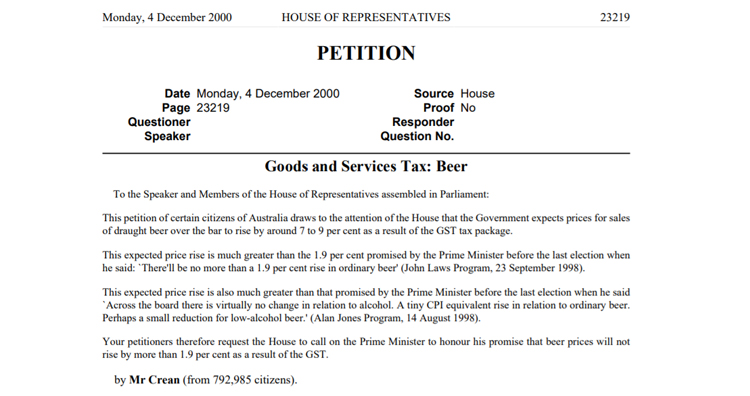
On December 4, 2000, Australians signed a petition to lower beer prices. In a country where 121 petitions are submitted annually, it became the second-largest petition submitted to the Australian Parliament, garnering 792,985 signatures. The largest petition concerned funding for community pharmacies, garnering 1,210,471 signatures.
Draught beer prices in Australia were expected to rise due to the increase in the Goods and Services Tax from seven to nine percent. The price increase was significantly greater than the Prime Minister's announcement before the country's last election. The Prime Minister had stated that the price increase would not exceed 1.9 percent. Regarding non-draught beer, he had mentioned a possible price reduction. People protested by petitioning the Australian Parliament, which ultimately failed, as beer prices in Australia remain high.
A research firm has found that Sydney, Australia, is one of the most expensive cities in the world for a pint of beer. In Australia, a pint of beer currently costs an average of AUD$7.87. The country consumes nearly 1.7 billion liters of beer annually, equivalent to 670 Olympic-sized swimming pools. (1,2,3)
6. In a protest against consumerism, one company sent out 30,000 boxes full of feces on Black Friday and made $180,000.

The creators of the hilarious card game Cards Against Humanity literally filled boxes with "stuff" on Black Friday. Black Friday is celebrated in the United States on November 23rd each year, when many people begin shopping for Christmas. The company was unhappy with the high prices of everything on Black Friday, so they took a stand against consumerism. They pulled the game, which typically retailed for $5 more than the average Black Friday price, and replaced it with a box full of "stuff." Here's the message they posted:
«"To help you maximize your savings on Cards Against Humanity this Black Friday, we've removed the game from our store, making it unavailable for purchase.".
Instead, we offer a unique opportunity to purchase another pile of junk.".
And 30,000 people bought the box, which retailed for about $6. The company made $180,000 on the feces-filled boxes and donated all proceeds to charity. Some fans thought they'd get an extra card from the game by purchasing the box, despite explicit tweets from game co-founder Max Temkin warning them about the feces in the box. (source)
7. In 1917, when 1,300 miners in Arizona went on strike, a mining company hired 2,200 men to be forced at gunpoint into freight cars for a 16-hour journey in scorching heat without food and abandoned in New Mexico.

In early July 1917, 1,300 miners went on strike against their employer, the Phelps Dodge Corporation, to protest poor working conditions in Bisbee, Arizona. The Industrial Workers of the World (IWW) union put forward a number of demands, including an end to medical examinations of workers at the end of each shift and an end to blasting mines while workers were inside. When the company refused to comply, 3,000 miners (85% miners from three companies in Bisbee) went on strike on June 26, 1917.
On July 11, 1917, Phelps Dodge's corporation recruited 2,200 men from Bisbee and the nearby town of Douglas, then arrested about 2,000 striking miners from a list they were given, warning that if they returned to work, they would avoid arrest and deportation. Seven hundred men agreed to the terms, but the remaining 1,300 were loaded at gunpoint into 23 freight cars. The bottoms of many of the cars were covered with a three-inch layer of cow manure.
It wasn't until midday that day that the men arrested at dawn were given water. When they reached Hermanas, New Mexico, and stopped at three o'clock the next morning, they were fed at President Wilson's insistence. (source)
8. In 1973, the crew of the space station «Skylab 4» went on strike. It became the only strike ever to occur in space, in orbit. Due to complaints of fatigue, they cut off communications with NASA and spent the day resting.

In 1973, the longest space mission ever, lasting 84 days, saw three astronauts aboard the Skylab space station grow weary of the demanding schedule NASA expected of them. NASA expected them to work a total of 6,051 hours, conduct several scientific and medical experiments, observe the Sun, Earth, and Comet Kohoutek, conduct four spacewalks, and load and unload equipment. This meant working 24 hours a day.
They decided to go on strike, taking the day off, cutting off all communications with NASA, and spending the day observing the Earth from space and relaxing. This day became known as the "day of silence.".
As a result of this protest, NASA's ground crew reached a compromise with them, allowing them to perform tasks at their own convenience and reducing their workload in exchange for completing the mission on schedule. Mission «Skylab 4» was successfully completed, but the three astronauts—Gerald Carr, William Pogue, and Edward Gibson—never flew in space again. (source)
9. At a garment factory in Bangladesh, thousands of workers went on strike not because of low wages or poor working conditions, but because they wanted to get rid of a ghost that haunted the bathroom.

In June 2013, thousands of workers in Bangladesh went on strike and rioted because they believed they were being attacked by a ghost haunting a building housing a toilet. Fearing the ghost, three thousand workers protested at a factory in Gazipur, Bangladesh. They began vandalizing the factory and only stopped when police used tear gas to disperse the crowd.
Mass hysteria over ghosts is common in several factories in Bangladesh, where workers experience unexplained health problems. A large portion of the Bangladeshi population believes in evil spirits and ghosts. That same year, workers at another factory in Bangladesh began to fall ill, but no diagnosis was made. Doctors then concluded that it was a case of mass hysteria.
A woman working at a factory in Gazipur complained of illness after being attacked by a female ghost in the women's restroom. Unexplained health problems are usually caused by factors invisible to the human eye, such as gas leaks or toxic substances in the air. The factory owners were forced to perform a "ritual exorcism" and close the plant for several days to calm the situation. (source)
10. Farmers in Brussels protested against falling milk prices by spraying milk from cows' udders at police officers.

Outraged by the drop in milk prices in Brussels, over 2,500 farmers resorted to an unusual protest. They blocked off the area in front of the European Union headquarters and, when the police were called, began pelting them with bottles. They also threw chickens at them and sprayed cow's milk straight from the cows' udders. Their protests continued for several weeks.
Farmers brought their tractors to block highways leading to Brussels, causing chaos that affected thousands of commuters in the city. Despite all this, their demand to raise milk prices by limiting production through quotas was not met, as European officials sought to create freer markets. Millions of gallons of milk were spilled onto the streets during the protest. Cows brought by farmers to spray milk at police officers were frightened by firecrackers. One of the panicked cows chased a man down the street. (source)