








Japan is an archipelagic nation consisting of 6,852 islands. Its name, translated in kanji, literally means "origin of the sun," and it is often called the "Land of the Rising Sun." Despite being one of the smallest countries, Japan is the tenth-most populous in the world, has the highest life expectancy, and the third-lowest infant mortality rate. Japan is also a country with one foot in the past and one in the future, boasting one of the richest cultures and traditions in the world and making significant contributions to modern technology. Here are some surprising facts about Japan you might not know.
1. Hiroshima is one of the few places outside the United States that celebrates Martin Luther King Jr. Day because, a few months before his death, King wrote a letter to the people of Japan expressing his desire to visit the country and spread a message of peace.

In addition to being an activist, spokesman, and leader in the civil rights movement, King was also an opponent of nuclear weapons. He spoke out against the nuclear weapons that destroyed Hiroshima and Nagasaki in 1945, saying that any continued use of them would turn the world into "a hell not even Dante could imagine.".
In 1967, King wrote a letter to the people of Japan, stating, "Japan knows the horrors of war and has suffered, like no other country, under the threat of nuclear holocaust. Certainly, Japan can stand firm for world peace." He also expressed hope that his schedule would allow him to visit Japan, but, sadly, he was assassinated on April 4, 1968.
Former Hiroshima Mayor Tadatoshi Akiba is hosting a special banquet at City Hall on Martin Luther King Jr. Day, which also coincides with Japan's Coming of Age Day. Akiba is also a peace activist, a supporter of nuclear disarmament, and the president of Mayors for Peace, an organization of city leaders from around the world advocating for the abolition of nuclear weapons. (source)
2. Japan is home to the world's oldest continuously operating company, the construction company Kongō Gumi, founded in 578 AD.

Kongō Gumi Co., Ltd., headquartered in Osaka, was founded by an experienced Korean immigrant who, after coming to Japan to build a Buddhist temple, decided to start his own construction company. The company also participated in the construction of Osaka Castle, one of Japan's most famous landmarks, which played a vital role in the unification of the country in the 16th century.
The names of all 40 generations of people who inherited the business were inscribed on a three-meter-long scroll from the 17th century, including sons-in-law who joined the clan and adopted the famous family name. However, in 2006, the company fell on hard times and was forced to become a subsidiary of the Takamatsu construction group.
Besides Kongō Gumi, Japan is also home to the second, third, fourth, and fifth oldest companies: Nishiyama Onsen Keiunkan, a hot spring hotel in Hayakawa, Yamanashi Prefecture, founded in 705 CE; Koman, a traditional inn founded in 717 CE; Hōshi Ryokan, another traditional inn in Ishikawa Prefecture, founded in 718 CE; and Genda Shigyō, a ceremonial papercraft company founded in 771 CE. (1, 2)
3. In Japan, Kit Kat is so popular that it's sold in high-end department stores, specialty Kit Kat shops, and post offices. There are over 300 seasonal and regional Kit Kat flavors.

The Kit Kat chocolate bar first appeared in 1973, and by 2014, it had begun to compete with Meiji Chocolate, Japan's best-selling confectionery company. One reason for Kit Kat's popularity in Japan is an accidental false cognate—a word that sounds similar but has a different meaning in another language. The phrase kitto katsu In Japanese it means "you will definitely win.".
Another reason for Kit Kat's popularity is marketing campaigns that emphasized its association with good luck. Nestlé partnered with Japan Post to sell Kit Kats at 20,000 post offices, where people could send the bars to university students as good luck charms.
Nestlé discovered that Japanese convenience stores frequently change flavors and product selections. So they adopted a business model that focused on offering more regional flavors to capitalize on this tradition. omiyage — the custom of bringing regional delicacies home to family, friends, and colleagues when people travel.
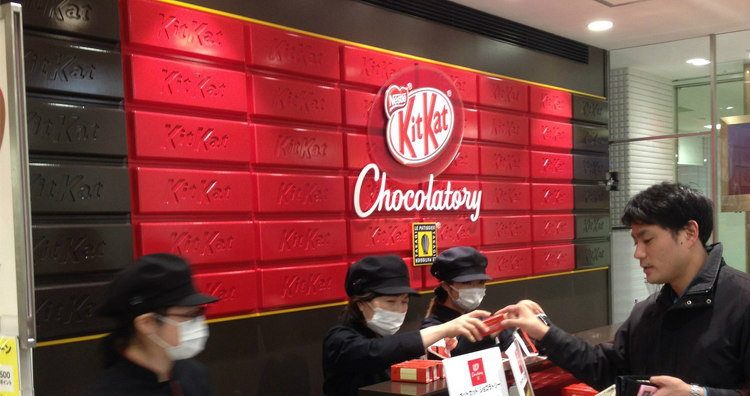
In 2004, Nestlé introduced a green tea flavor, followed by 300 seasonal and regional flavors. Special limited-edition seasonal models, such as the 500 gold-wrapped Kit Kats sold in high-end stores in 2015, helped create a sense of "scarcity and rarity" for consumers. Famous Kit Kat flavors include: adzuki (red beans), match , soy sauce and beni imo (purple sweet potato). Kit Kat is also used in various cafes to make desserts. (source)
4. Despite having one of the highest population densities, Japan has one of the highest percentages (68,55%) of forest land.

In the 16th century, Japan faced declining forest cover due to increased logging and population growth. But by 1670, the situation began to change, as rulers and villagers began to contribute to forest management. The development of forestry and plantations also led to a significant increase in knowledge about trees and seeds.
Over 731,000 square kilometers of Japan's land area is covered by mountains, unsuitable for agriculture, industry, and housing. This has forced most of the population to move to coastal areas, resulting in extremely high population density. All these mountains are also covered by dense forests, covering over 68,551,000 square kilometers of the country's land area, comparable to the forest cover of Finland and Sweden.
However, after World War II, the demand for timber increased to support restoration efforts, leading to the expansion of the logging industry and rapid deforestation. In 1973, under the new forest management system, large-scale reforestation began, which continues to this day, carried out by both public and private organizations. Today, Japan relies primarily on imported timber, which reduces the volume of deforestation and allows forests time to regrow. (1, 2, 3)
5. Cleaning the school is part of the educational process in Japan. The Japanese education system believes that this teaches students respect, responsibility, and emphasizes equality.

In most Japanese schools, a cleaning cloth is included in the list of required supplies for every student. While not mandatory, traditionally, cleaning is part of the Japanese education system to instill character and respect for public spaces. Each class is responsible for cleaning its own classroom and two other rooms.
Younger students are often assigned to groups of older students to help with cleaning. This also helps foster interaction between older and younger students, as most children don't have siblings. Some schools also clean their neighborhoods three times a year and typically keep small brooms and dustpans for this purpose.
This attention to public cleanliness can also be seen at stadiums after any sporting event. Japanese fans stay after the game and walk around their side of the stadium with trash bags to pick up litter. (1, 2)