








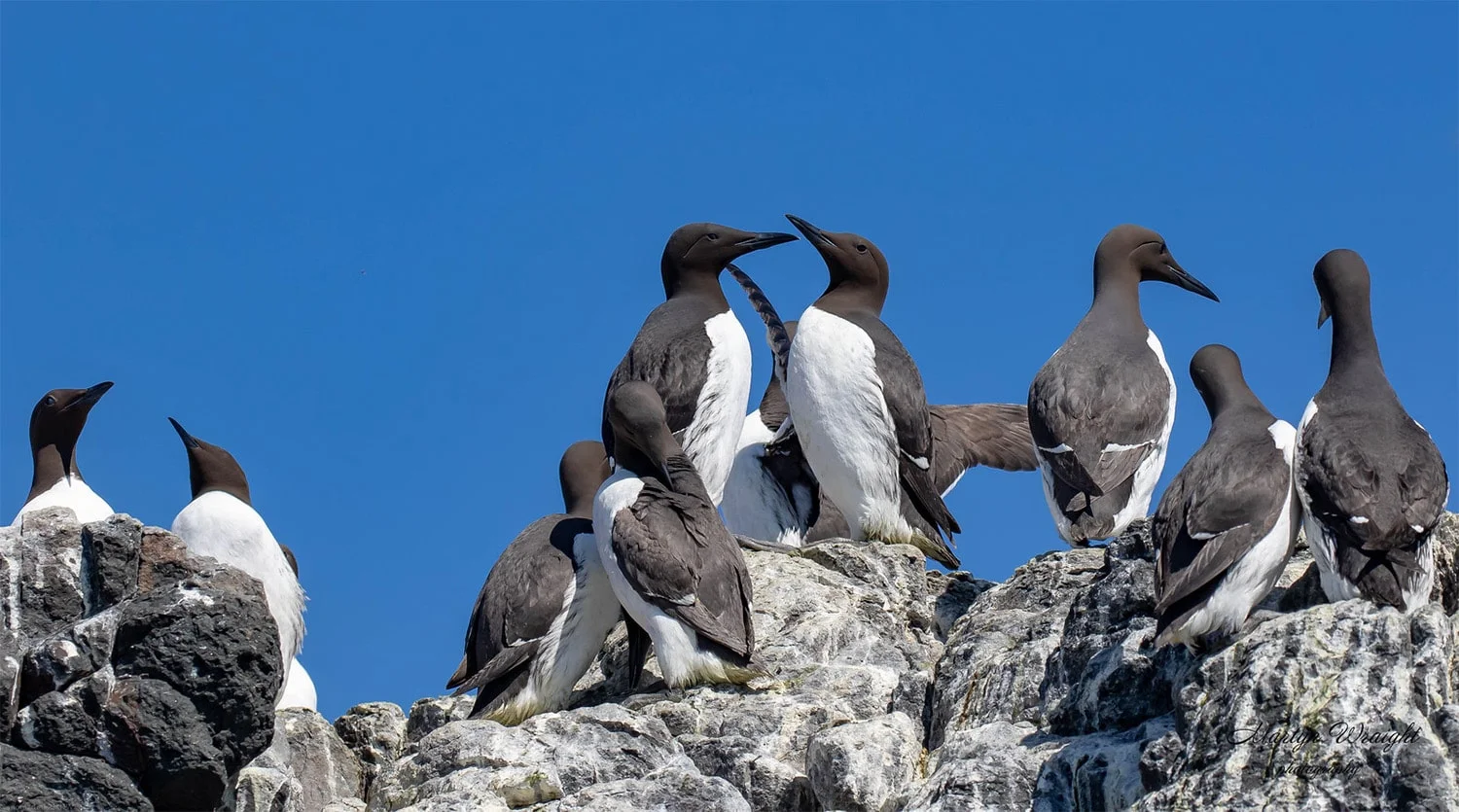
Guillemots are a fascinating group of seabirds closely related to puffins and murres. These birds are well adapted to life in a marine environment, spending much of their lives at sea and coming ashore only to breed on rocky shores. Guillemots are known for their elegant black-and-white plumage and incredible diving ability, allowing them to hunt fish at great depths. Their endurance and unique behavior intrigue ornithologists and birdwatchers. Let's delve into the world of guillemots and discover some fascinating aspects of their lives and habits.
- Guillemots belong to the auk family, scientifically known as Alcidae.
- There are two main species of murre: the common murre (Uria aalge) and the black murre (Cepphus grylle).
- Guillemots inhabit the cold coastal waters of the North Atlantic and Arctic Ocean.
- Unlike many birds, murres do not have a brood patch; they incubate their eggs using their feet.
- Guillemots lay their eggs directly on bare rock ledges without building a traditional nest.
- Their eggs have a unique pear-shaped form to prevent them from rolling off rocks.
- Murres' diet consists mainly of fish, but they also eat crustaceans and marine worms.
- Murres are excellent divers, capable of diving to depths of over 180 metres (590 feet) in search of food.
- They use both wings and legs to move underwater.
- The common murre's plumage changes with the seasons, being a combination of black and white in winter and a more chocolate-brown hue in summer.
- Black murres retain their characteristic black body colour and white wing patches all year round.
- Guillemots nest colonially, often forming large, tightly packed groups on cliffs.
- The survival of murre chicks depends largely on the availability of food and the absence of predators.
- Guillemots are highly attached to their nesting sites, returning there year after year.
- In the wild, murres can live up to 20 years.
- During the breeding season, male murres perform complex mating rituals to attract females, including spreading their wings and making calls.
- Murre chicks are precocial, meaning they are relatively mature and active from the moment they hatch.
- The chicks leave the nest and head out to sea just a few weeks after hatching, long before they can fly.
- The common murre, or ringed form, has a white ring around the eye and a stripe behind the eye, which is found in a small percentage of the population.
- Murres are vulnerable to oil spills and pollution, which can damage their insulating feathers and lead to hypothermia.
- They are also affected by climate change, which impacts prey availability and reproductive success.
- Murre vocalizations include a variety of different sounds used to communicate over the noise of nesting colonies.
- Murres are preyed upon by larger birds such as eagles and large gulls, particularly for their chicks and eggs.
- Research on murres has provided important information on the health of marine ecosystems.
- They are often used as indicator species for marine conservation.
- Murres have a high wing loading (the ratio of body mass to wing area), making them better suited to diving than to flight.
- In winter, murres disperse widely along the coast and in the open ocean, often appearing singly or in small groups.
- In the past, hunting and egg collection significantly reduced the guillemot population.
- Conservation efforts have helped restore some guillemot colonies, although they remain sensitive to environmental changes.
- In the folklore and mythology of coastal communities, guillemots appear as a symbol of good luck and a connection with the sea.
Murres are amazing birds, demonstrating the incredible adaptability and resilience of seabirds. Their marine life, remarkable diving skills, and social nature make them a source of endless fascination and study. Understanding murres helps us appreciate the complexity of marine ecosystems and the importance of their conservation. As indicators of ocean health, protecting murres and their habitats is crucial to maintaining biodiversity and the ecological balance of our oceans. Their continued survival depends on our commitment to marine conservation and our actions to combat environmental threats such as pollution and climate change.