








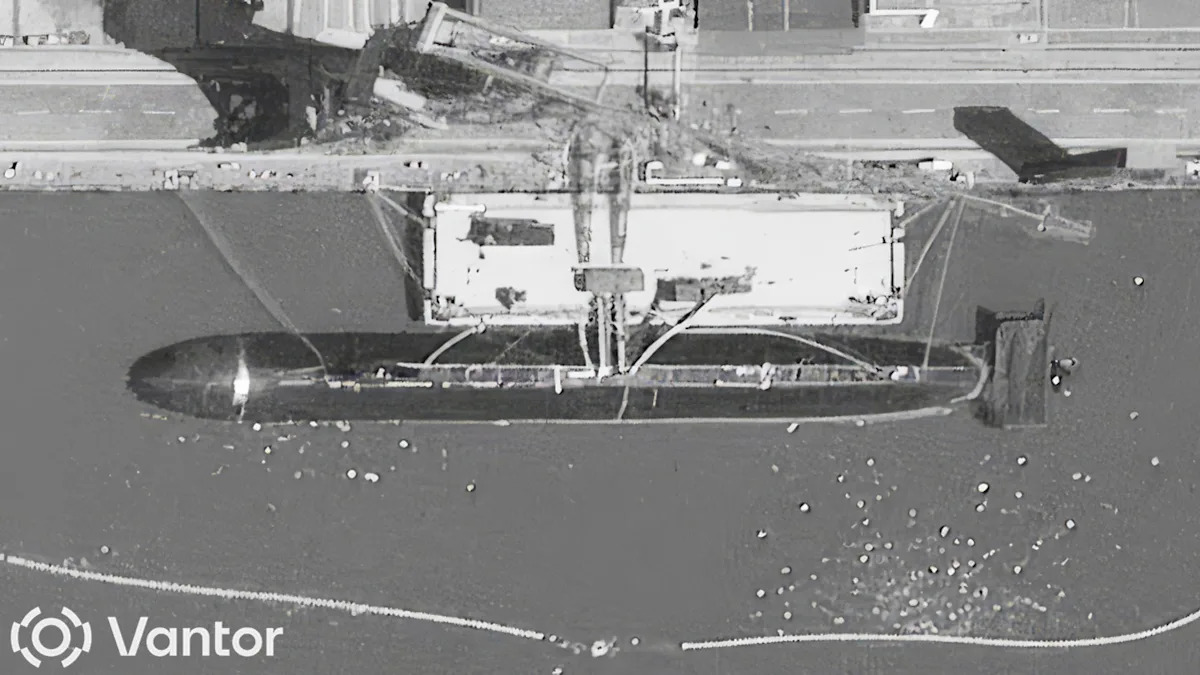
A new type of submarine has emerged in China, apparently lacking a traditional sail. Eight years ago, the same shipyard launched a smaller, "sailless" underwater vehicle—a technology demonstrator. More recently, one of China's leading shipbuilding conglomerates unveiled a concept for an unmanned underwater vehicle (UUV) with a hull shape broadly comparable to the current design. Such designs may offer advantages in terms of speed, maneuverability, and reduced acoustic signature, but also have significant drawbacks.
Edition TWZ obtained images of the submarine in question at the JN (Jiangnan) shipyard in Shanghai on June 1 (see the top and bottom of this article), provided by Vantor (formerly Maxar Technologies). According to Naval News, A boat, whose name and/or designation are currently unknown, first appeared there in late May. This publication was the first to report the event.
Satellite image ©2026 Vantor» src=»https://s.yimg.com/ny/api/res/1.2/iehZWg1BUscJNENRQXfl0g—/YXBwaWQ9aGlnaGxhbmRlcjt3PTk2MDtoPTU2OTtjZj13ZWJw/https://media.zenfs.com/en/the_warzone_735/61068b22fec40a35a30ff21fb636cb67″>A wider view of the JN shipyard on June 1, 2026. Satellite image ©2026 Vantor
Judging by the images, the submarine lacks a traditional sail. However, the exact shape of the existing sail is also unclear from the currently available images. As noted, JN Shipyard is known to have built at least one other submarine without a sail in the past, which we will return to later.
Chinese Internet» src=»https://s.yimg.com/ny/api/res/1.2/bC7jHLF3E7x6YfVewHnfEQ—/YXBwaWQ9aGlnaGxhbmRlcjt3PTk2MDtoPTU0MDtjZj13ZWJw/https://media.zenfs.com/en/the_warzone_735/f796f2b4e97fea4d5ea36569962347cc»>Photo of a stealth submarine launched by JN Shipyard in 2018. Chinese Internet.
Submarine warfare analyst H.I. Sutton wrote in an article for Naval News estimated the submarine to be approximately 394 feet (120 meters) long and 33 to 36 feet (10 to 11 meters) wide. Its intended missions are unknown, but it is certainly larger than conventional diesel-electric submarines (DESS) and even longer than most nuclear-powered fast attack submarines. By comparison, variants of China's Type 093 nuclear-powered attack submarines, some of the most advanced submarines in service with the People's Liberation Army Navy (PLA Navy), are approximately 356 to 360 feet (108 to 110 meters) long and 36 feet wide. The officially stated length and width of the Type 093-class submarines Virginia The US Navy's for all existing variants are 377 feet (114.8 meters) and 34 feet (10.36 meters) respectively.
It also shows that the submarine, built at JN Shipyard, has an X-shaped rudder configuration, first introduced on a submarine in China in 2024. This offers advantages over cruciform stern layouts with horizontal and vertical rudders in terms of maneuverability, efficiency, and safety.
The X-shaped stern is a feature now associated with China's next-generation attack submarine project, commonly but unofficially referred to as the Type 095. Naval News also reported the recent launch of what may be another conventionally rigged Type 095 submarine at the Bohai Shipyard in Huludao, hundreds of miles north of Shanghai. This apparently caused some confusion online, as some mistook the Bohai submarine for a boat without sails.
Just translated by @type36512: CSSC Bohai Shipbuilding: Launch of new submarine. Satellite images taken on May 29. I believe this image shows the new 120m-class conning towerless submarine mentioned in the accompanying article. However, due to image resolution limitations,
– @Rupprecht_A (@RupprechtDeino) June 3, 2026.
Even if we compare the hull diameter of the 09V to this mystery submarine (for illustration purposes), it turns out to be significantly shorter, meaning it's probably not the 09V, but it also doesn't match what a submarine with a diameter of 10 meters and a length of 120 meters would look like... I'm open to ideas. pic.twitter.com/AIcv5ZjXy3
— Rick Joe (@RickJoe_PLA) June 3, 2026.
The new submarine, built at JN Shipyard, may also be equipped with a shrouded propulsion system, possibly a waterjet. Waterjets offer additional advantages, such as quieter operation, especially at high speeds while submerged.
The absence of a traditional masthead sail remains the most notable feature of the new submarine developed at JN Shipyard. The absence of a large structure protruding from the upper hull significantly optimizes the overall design. Eliminating this drag allows for better optimization of speed and maneuverability while submerged. This also helps make the submarine quieter and therefore more difficult to detect, even when moving at high speeds. This can be particularly useful when rapidly approaching threats, even at a great distance.
The lack of a traditional sail can impose certain design limitations. Traditionally, naval submarines have used sails to mount periscopes and other sensor masts, as well as retractable communications antennas and air scoops to allow air circulation without fully surfacing. This space could be used for other purposes, including countermeasure launchers and general storage.
U.S. Navy/Senior Seaman 1st Class Jacob Berg» src=»https://s.yimg.com/ny/api/res/1.2/6zA4oYk3g03sr8ERHvPQgA—/YXBwaWQ9aGlnaGxhbmRlcjt3PTk2MDtoPTYzOTtjZj13ZWJw/https://media.zenfs.com/en/the_warzone_735/959134440029816d07c9de8c8c08d854″> The conning tower of the attack submarine of the class «Los Angeles» US Navy USS Santa Fe , broken by ice during exercises above the Arctic Circle in March 2026. Photo: Senior Seaman 1st Class Jacob Berg.
The lack of a sail may reflect a focus on seabed operations far below the surface, where mast installation and other considerations may be less relevant. At the same time, design features may have been aimed at enhancing performance, including enabling the fastest possible transit during open-sea operations. This could also offer advantages for shallow-water operations, although we noted that this is generally very large compared to submarines.
As mentioned, a smaller "sailless" submarine was already built at the JN shipyard in 2018. H.I. Sutton previously estimated this design to be approximately 150 feet (45 meters) long and 15 feet (four to four and a half meters) wide. This submarine also featured a non-X-shaped rudder design and, apparently, an unshrouded propeller. The exact reasons for this submarine's construction and how it was used over the years remain unknown, but it would at least have provided a testbed and technology demonstration platform to explore this design concept and possibly other possibilities. Whether it was designed for crewed or unmanned operation, or with the option of an additional crew, is also unclear. The same applies to this new submarine, although it is unlikely that it will be unmanned.
Chinese Internet» src=»https://s.yimg.com/ny/api/res/1.2/Ne_wVcL41ectJZE7jIhp8w—/YXBwaWQ9aGlnaGxhbmRlcjt3PTk2MDtoPTU0MDtjZj13ZWJw/https://media.zenfs.com/en/the_warzone_735/e184a1b144010cd7ff65de8e4dbaa4e1″> A model of the low-profile underwater unmanned vehicle CSSC was shown at the 2024 Zhuhai Air Show. Chinese Internet
Other shipyards and navies around the world have explored small-size submarine designs in the past, but these projects typically remained on paper and were limited to limited experiments. For example, the US Navy previously tested a scaled-down Large Scale Vehicle Range (LSVR) demonstration submarine with a new conning tower design. The Naval Acoustic Research Division (ARD) conducted this work on Lake Bayview, Idaho.
@MuxelAero» src=»https://s.yimg.com/ny/api/res/1.2/ReABIMBGNSBd.5aembOEiw—/YXBwaWQ9aGlnaGxhbmRlcjt3PTk2MDtoPTU0MDtjZj13ZWJw/https://media.zenfs.com/en/the_warzone_735/8eb5423501798856195b2bd23a24fabf»>A model of a small-sized ballistic missile submarine called the Arcturus, shown in Russia in 2022. @MuxelAero
In 2021, the Navy also published a call for proposals for inflatable sail design concepts that could combine the advantages of traditional sails with a low-profile design. It's unclear how much work has been done on this inflatable deployable sail system (IDSS) since then, but it highlights the importance of the sail for general surface operations.
The PLA Navy's submarine fleet continues to grow in capabilities and potential, increasing the number of more modern submarine types. American officials have previously openly stated that the quality of China's new submarines is approaching that of American models. This is further confirmed by the recent arrival of another new submarine in Bohai. In addition to new nuclear submarines, China is known to be developing at least one model with a hybrid nuclear-conventional propulsion system, known as the Type 041 or 041-class submarine. «Zhou» . The first known example of a Type 041 submarine was discovered after apparently sinking at a shipyard in 2024.