








This analysis and news compilation is taken from Canary Media Weekly. Subscribe to receive it every Friday.
There's plenty to celebrate in New York City this week. The Knicks reached the Finals, the Mets won, and the city is one step closer to achieving its clean energy goals.
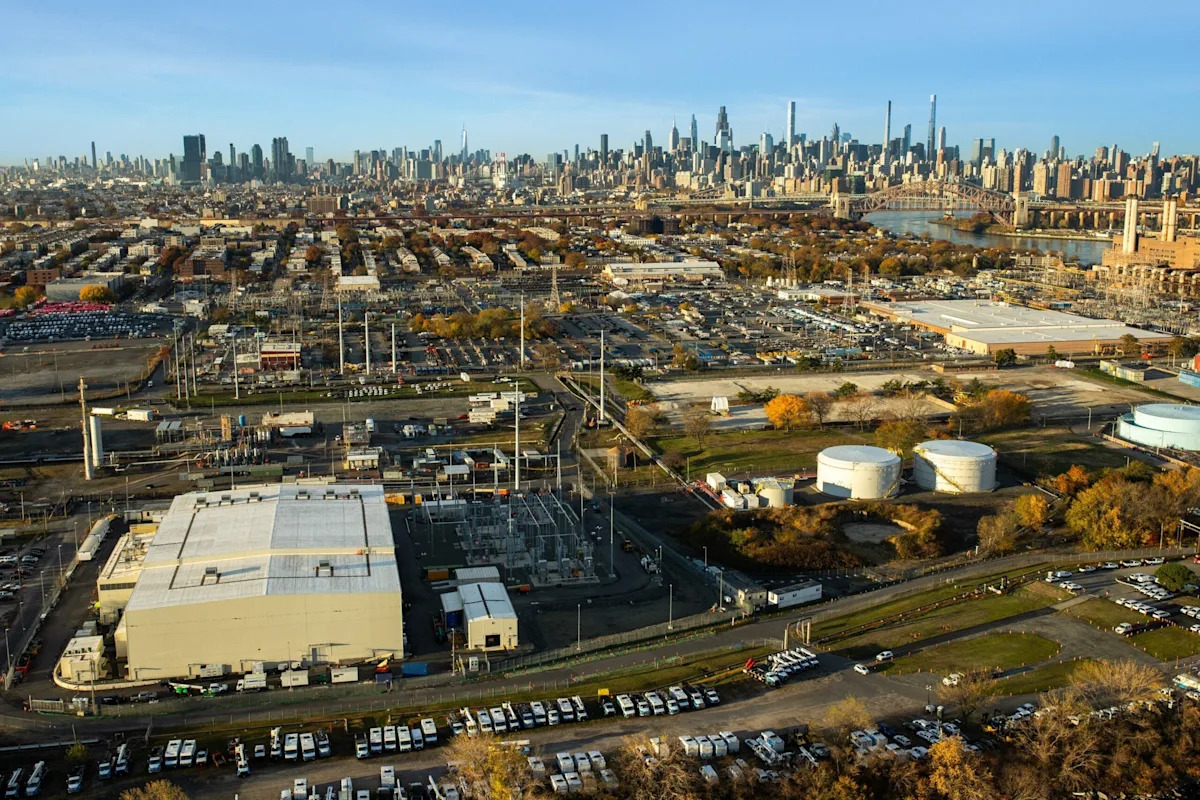
Finally, tons of clean electricity are flowing from Canada to New York City via the 1.25-gigawatt Champlain Hudson Power Express (CHPE) transmission line. The city can now power all of its government agencies and cover 20% of citywide electricity needs—the equivalent of 1 million homes—using hydropower supplied by Hydro-Québec.
Combined heat and power technology, along with the completion of the Empire Wind project off the coast of Brooklyn, is critical to achieving New York City's goal of reducing greenhouse gas emissions by 80% by 2050. Last year, the city got nearly 90% of its electricity from fossil fuels and only a paltry 3% from hydropower.
The journey from Quebec to Queens was long, but the construction of the transmission line took even longer. Plans for the CHPE began more than a decade ago, and during discussions, the project encountered opposition from environmental groups and residents. But ultimately, the CHPE was commissioned several weeks earlier than expected, just in time to ensure uninterrupted power supply before the summer peak demand.
CHPE is one of two major transmission projects recently launched to supply the northeastern United States with Canadian hydropower. Power began flowing to Maine via the New England Clean Energy Connect line earlier this year, ending a decade of controversy during which the project was repeatedly canceled and postponed.
However, both New England Clean Energy Connect and CHPE remain challenged. Some experts doubt Hydro-Québec can truly produce enough electricity to supply the United States. "When all these transmission line discussions were just beginning, Hydro-Québec was taking advantage of the abundant rainfall that had been falling for 15 years," Pierre-Olivier Pineau, professor of energy sector management at HEC Montréal, told Marketplace. However, over the past three years, the province has faced persistent drought, which has depleted Hydro-Québec's reservoirs.
Hydro-Québec, for its part, stated earlier this year that its reservoirs are prepared for drought. But Quebec also has its own decarbonization goals, and demand is growing from data centers and industry—two factors that weren't as significant when the company agreed to sell its hydropower more than a decade ago.
More news from the world of energy
Trump is trying to save the coal industry again.
The Trump administration is spending $700 million to support the coal industry, despite mounting evidence that the spending is unjustified.
On Thursday, Trump announced he would use authority granted to him under the Defense Production Act to allocate $425 million to modernize 13 coal-fired power plants across the United States. Another $75 million will go toward the construction of an export terminal in Oakland, California, and $185 million is planned for two new coal-fired power plants in Alaska and West Virginia.
This move is just the latest in the administration's campaign to support the coal industry, which has also seen Trump use the "energy crisis" to justify not closing old coal plants. But as Canary Media's Kari Lidersen reported this week, there doesn't appear to be any major emergency: one coal plant in Indiana, which was ordered to remain open, has effectively been shut down since February, and experts say the grid will cope just fine without it this summer.
Data center frustration reaches new heights.
More and more Americans are becoming fed up with data centers, and that discontent is spilling over into political action.
A Heatmap survey released this week shows that 71% Americans say they are moderately or strongly opposed to data center construction near their homes, up from 42% last fall. This growing discontent is accompanied by a wave of data center construction project cancellations, according to Heatmap: at least 20 projects were canceled in the first quarter of this year.
Meanwhile, a number of cities and states are seeking to prevent data center construction projects entirely. On Thursday, the New York State Assembly passed a one-year moratorium on new construction, though it's unclear whether Governor Kathy Hochul (D) will sign it. Residents of Monterey Park, California, meanwhile, took their discontent to the next level by voting this week to become the first city in the US to ban data center construction entirely.
Clean energy news to know this week.
Offshore Wind Litigation: Seven states have sued the US Department of the Interior after it compensated French energy giant TotalEnergies for losses it incurred when it abandoned offshore wind leases. ( Canary Media )
Turning Electrification On Its Head: New guidance from the U.S. Department of Energy prohibits states from distributing Inflation Reduction Act subsidies to people buying electric heat pumps, stoves, and other appliances to replace gas ones. ( Inside Climate News )
Debunking Myths: A rumor, supported by some state legislators, is circulating on social media that Frito-Lay refuses to buy potatoes grown on land where solar panels are installed. However, the company claims this is untrue, and experts say the panels pose no danger to the potatoes. ( Canary Media )
The power system gains new experience: This summer, a Massachusetts school district's electric buses will be used as batteries for the grid while parked, providing cleaner, cheaper energy at night and saving the district money. ( Canary Media )
Improving the safety of nuclear energy: «"Melt-resistant" nuclear fuel has largely failed to gain widespread acceptance due to its high cost, but the resurgence of nuclear power in the US could bring it to the mass market. ( Canary Media )
Risky business: The US Securities and Exchange Commission has formally repealed a Biden-era rule requiring public companies to disclose climate risks and emissions, after previously promising not to defend the rule in court. ( The Hill )