








Here's a challenge for you! Can you balance 10 books on your head without losing your balance?
How long can you do this? A few seconds? A few minutes? Definitely not longer.
Master this exceptional art by exploring the world's most massive balancing stones. Some of these formations have stood unsupported for millions of years. These stones are positioned in such a way that they appear to be about to collapse. However, no human has yet succeeded in moving them. These incredible creations attract tourists and geologists from all over the world. Geologists believe some may have been eroded over time, so be sure to explore them all before they disappear.
The existence of these balancing stones is no miracle. They were formed by natural forces over a thousand years or more. We've compiled a list of 10 such incredible balancing stones around the world.
1. Kummakivi – stone , balancing on top of another rock.

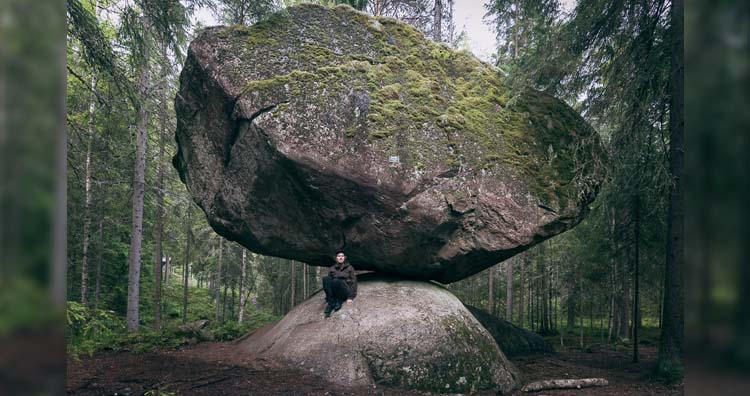
The Kummakivi Balancing Stone in Finland is more than just another stone. The seven-meter-tall upper boulder seems to be attempting an impossible task—keeping its balance. This formation consists of two stones. The lower stone has a curved, smooth surface. Half of the lower stone is sunken into the ground, giving it a solid foundation. The upper stone is not so smooth. It is enormous. Amazingly, there is only one very small point of contact between the two stones. Despite its apparent instability, no one has yet succeeded in moving it.
Several fascinating myths are associated with this stone. According to Finnish folklore, these stones were left by "Hissi," a type of giant. Geologists have a different explanation. They believe that the retreat of a glacier led to the formation of these stones. When glaciers retreated from the northern region about 12,000 years ago, this stone was left behind. This occurs when a glacier melts and slowly flows downslope. Warmer temperatures and less snow are among the main causes of glacier retreat. A retreating glacier loses more water than it receives, causing sea levels to rise. (1, 2)
2. Balancing Column on Long Island – a vertical column nine meters long.

Are you wondering if someone is hiding behind this rock, holding it in place? No. So how is it standing? This nine-meter-tall, vertical boulder-column is a geological formation. It towers over St. Mary's Bay in Nova Scotia. While many similar rocks have collapsed in the past due to erosion, this basalt rock has not. To see this giant balancing rock, you must walk a 2.5-kilometer trail and climb 235 steps. Locals say that a fisherman passed by long ago. He tried to break the rock with a rope, but failed.
Approximately 200 million years ago, during the Triassic period, molten rock, or lava, rose from deep within the Earth and spread across the surface. This event split the supercontinent Pangea and opened up the Atlantic Ocean. As the hot lava cooled, it formed numerous columnar basalt structures. Finally, weathering and erosion formed balancing rocks like the one found in St. Mary's Bay. (1, 2)
3. Balancing Stone from the Garden of the Gods – This balancing stone gives insight into earthquakes.


This balancing rock is an iconic formation in the Garden of the Gods in Colorado Springs. Weighing nearly 700 tons, it's composed of red sandstone and is nearly 290 million years old. Its formation began when liquid sedimentary sandstone roared up from the Earth's depths. The Garden of the Gods features two adjacent gateway stones, one of which is this balancing rock. Together, they create the impression of a natural entrance to the site, welcoming tourists.
The strength of this rock has been tested over time, especially during earthquakes. However, it has never collapsed. This helps geologists collect earthquake data and make predictions. Researchers photographed the rock and created 3D models to simulate the seismic vibrations required to cause it to collapse. The results showed that high-magnitude earthquakes are less common than previously thought. (source)
4. Idol Rock – Brimham Rocks – Idol Rock defies the laws of science.
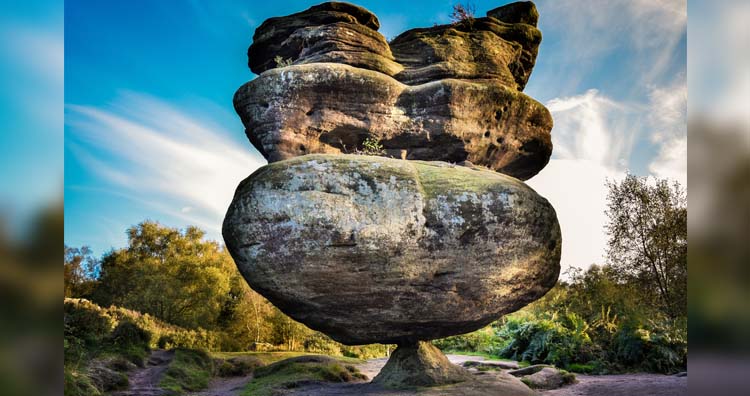
Brimham Rocks is a stunning cluster of unstable sandstone cliffs in North Yorkshire, England. One of these rocks, defying the laws of physics, is Idol Rock, also known as the "Druid's Idol" or "Druid's Desk." It stands nearly 4.5 meters tall and weighs 200 tons. This gigantic structure sits atop a tiny pyramidal base. For many years, locals believed these formations were carved by ancient Britons. However, research has proven otherwise. They are natural formations, created by the combined action of ice and concentrated meltwater.
The Brimham Rocks organization is raising awareness of the need to protect these cliffs. Two years ago, several boys threw sandstone from the cliff, forever destroying this iconic tourist site. Furthermore, tourists have carved their names into most of the rocks, damaging these natural wonders. (1, 2)
5. Krishna's Butter Ball - a giant boulder resting on a slope.


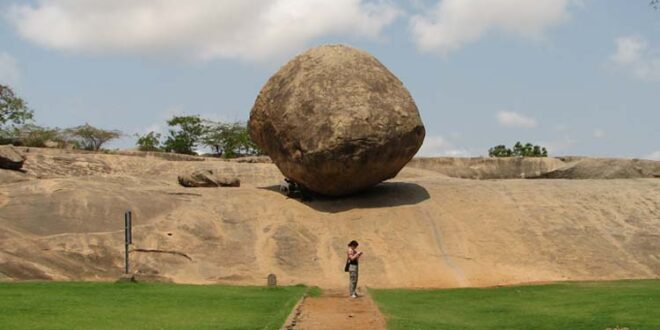
This enormous boulder, located in Tamil Nadu, India, stands 6 meters tall and weighs approximately 250 tons. Amazingly, it stands on a slippery hill on a four-foot-deep foundation. This giant balancing stone is part of the Mamallapuram Group of Monuments, a UNESCO World Heritage Site. The name "Krishna's Butter Ball" comes from the name of the Hindu god Krishna.
According to Hindu mythology, the god Krishna stole butter from his mother's vessel, called "Handi." The shape of "Handi" is very similar to this stone. This balancing stone is also known in Tamil as "Vaaniray Kal," meaning "Stone of the Sky God." Due to erosion, the upper back portion of the boulder has been eroded. Interestingly, the stone still appears round on all sides except the upper back portion.
In the past, various kings attempted to move this boulder, but to no avail. The stone's balance inspired the Indian Tamil king Raja Chola and led to the creation of non-falling clay dolls called "Thanjavur Bommai." These dolls have a hemispherical base that tends to return to its original position every time someone tries to tip it over. In the early 20th century, Arthur Havelock, the city's governor, hired seven elephants to move the stone, but again failed.
(1, 2)
Read also: 10 places that surprise even science