






When you make a purchase through links in our articles, Future and its distribution partners may earn a commission.
Source: NASA/GSFC
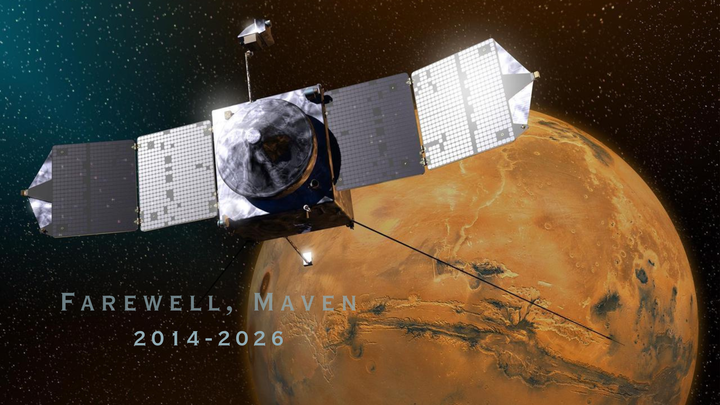
NASA is saying goodbye to one of its most advanced orbiters designed to explore Mars.
After months of repeated attempts to reestablish communication with the Mars Atmosphere and Volatile Evolution (MAVEN) satellite, NASA has declared the probe designed to explore the Red Planet inoperative. The last data transmission from MAVEN was received by NASA's Deep Space Network (DSN) on December 6, after which the solar-powered spacecraft's orbit drifted beyond Mars. As it entered the other side of the orbit, telemetry data showed the satellite had entered failsafe mode and began spinning uncontrollably, resulting in a loss of power, according to a NASA review in February.
According to the agency, attempts to contact MAVEN have since been unsuccessful, and today (June 3) NASA officials held a press briefing to discuss the end of the MAVEN mission. The cause of the incident with the satellite on the far side of Mars is still under investigation.
The announcement of the MAVEN project's completion marks the end of more than a decade of scientific and research work. MAVEN was launched on a United Launch Alliance Atlas V rocket in November 2013 and arrived in orbit around Mars 10 months later.
Shannon Currie, the MAVEN project's principal investigator, called the probe "the best Mars mission ever" during a phone call on Wednesday. Mike Moreau, the MAVEN project manager, praised the team and said they "truly felt the loss of a loved one with the mission's completion.".
Currie agreed, but emphasized MAVEN's many accomplishments. "The team was certainly disappointed about this, but at the same time, we're incredibly proud of the scientific achievements we've made over the last decade," she said, calling MAVEN "the best atmospheric leakage observer in the entire solar system.".
The MAVEN failure investigation board concluded that the probe likely lost power within hours of the December incident, "which ultimately resulted in the loss of power to the communications system and rendered the spacecraft unrecoverable," Moreau said, adding, "The MAVEN failure investigation board continues its work to determine the root cause of the failure.".
The MAVEN mission was originally planned for just one Earth year, but was extended for another 10 years as the spacecraft continued to operate normally. Since the loss of MAVEN, only two active NASA probes remain in Mars orbit: the Mars Odyssey spacecraft, launched in 2001, and the Mars Reconnaissance Orbiter (MRO), launched in 2005. Both of these probes have also operated significantly longer than their original missions envisioned.
MAVEN was also one of five spacecraft used by NASA as a communications relay for rovers on the Martian surface. The other four, which remain active, are Odyssey, MRO, and the European Mars Express and Trace Gas Orbiter spacecraft.
MAVEN was the first probe equipped with instruments to study the evolution of Mars' atmosphere and its interaction with the solar wind. The mission provided data that led scientists to new discoveries even after the orbiter lost contact.
«"The data collected by MAVEN will continue to provide valuable information about Mars for decades to come," Louise Procter, director of NASA's Planetary Science Division, said in a statement from the agency.
«"We have a lot to learn from the dataset we're going to archive," Curry said.
Editor's note: This article was updated at 3:50 PM ET (19:50 GMT) on Wednesday, June 3, to reflect statements from NASA and MAVEN officials made during a press briefing to mark the end of the mission.