






Michigan lake sturgeons have long been known as "living dinosaurs," but they may be much older than you think, according to new research from officials and the universities of Michigan and Wisconsin.
Some of these spiny, whiskered females can live up to 427 years, researchers found after analyzing populations in the Great Lakes region.
That's almost as long as the lifespan of a Greenland shark. Greenland sharks, the longest-living vertebrates on Earth, can live up to 512 years, swimming in the dark, icy depths of the Atlantic Ocean.
Moreover, the researchers' estimate turned out to be hundreds of years longer than previously thought.
Previous studies have limited the age of lake sturgeons, which have been present in the fossil record for 150 million years, to 150 years.
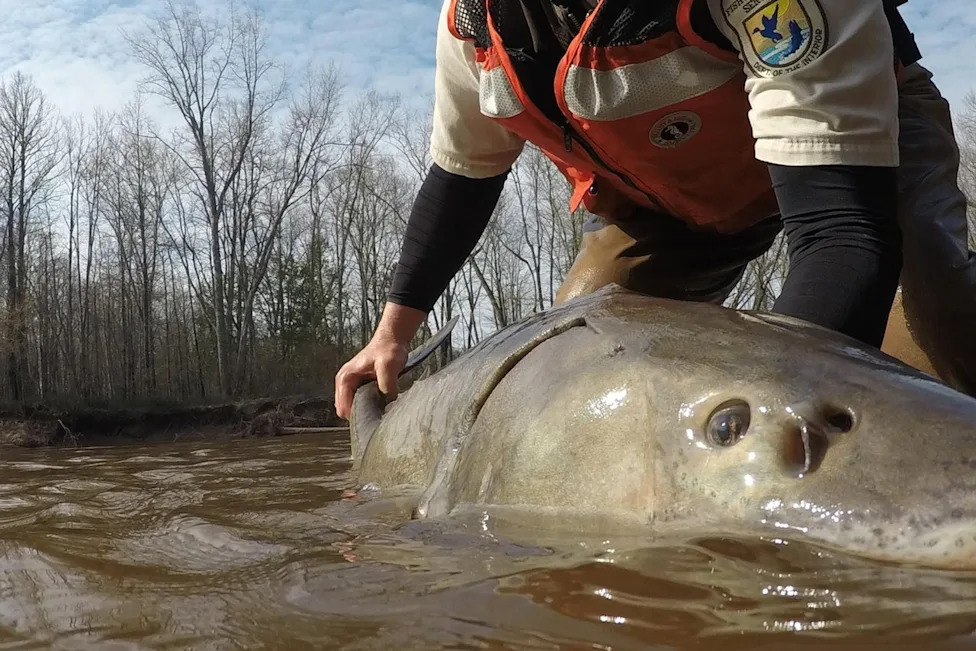
This lake sturgeon was discovered during fish sampling in the Bad River in Wisconsin. Researchers from Wisconsin and Michigan say the species may be much older than previously thought (USFWS).
To reach these conclusions, the researchers didn't actually catch fish of this age. Instead, they performed calculations using 44 years of data from five different lake sturgeon populations.
The team caught and measured the fish, determined their sex, tagged them, and released them. They then repeated this process in subsequent years, measuring the growth of previously captured fish.
Unlike humans, fish continue to grow in size as they age.
Lake sturgeon are already among the largest freshwater fish in North America, reaching weights of 200 to 300 pounds, according to the U.S. Fish and Wildlife Service.
Some species of sturgeon can grow larger than others when they have an abundance of prey, such as small fish and shellfish, which they suck up from the lake bottom with their large, extendable mouths.
Lake sturgeon can weigh up to 300 pounds and reach more than 70 inches in length, according to the U.S. Wildlife Service.
Using these measurements, the researchers were able to estimate how low the fish's lifespan was and what its growth rate was.
«"Simply put, we used this data to estimate the lifespan of lake sturgeon by asking the question: 'If a lake sturgeon grows X centimeters per year, how many years will it take for a lake sturgeon to reach a certain size?'" the agency explained in its press release.
Researchers linked sturgeon growth rates to the size of the fish, finding that 63-inch-long males can live from 90 to 279 years, while larger females (71 inches) can live from 99 to 427 years.
«"We've found that sturgeon live much longer than originally thought based on studies of growth rings and fin ray cross-sections," Edward Baker, chief of the Michigan Department of Natural Resources' Marquette Research Station, told News Channel 3.
Baker noted that less than one percent of the historic lake sturgeon population of more than two million remains in the Great Lakes.
Understanding the lifespan of these fish is important for the conservation of their species and habitats, the agency said in a statement.
U.S. Fish and Wildlife Service officers are holding a 112-pound (approximately 51 kg) lake sturgeon in Wisconsin. The fish was tagged and released (USFWS).
Lake sturgeon mature later than other fish, and females can only begin reproducing at 15 to 25 years of age. This means that strict protection of this species is crucial to ensuring the recovery of its population.
As the department noted, sturgeon were nearly hunted to extinction by fishermen in the late 1800s. Fishing is permitted, but only six specimens were caught last year, the department reported.
«"This somewhat reinforces the need for very strict limits on what we allow in terms of catch," Baker said. "These are not fish that we allow anyone to catch in unlimited quantities.".
However, according to the Center for Biological Diversity, the species is also threatened by pollution, infrastructure development and climate change.
The nonprofit said it sued the U.S. Fish and Wildlife Service earlier this year after the lake sturgeon was denied protection under the Endangered Species Act in 2024.
President Donald Trump recently announced that he intends to roll back protections provided by the 1973 law.