






When you make a purchase through links in our articles, Future and its distribution partners may earn a commission.
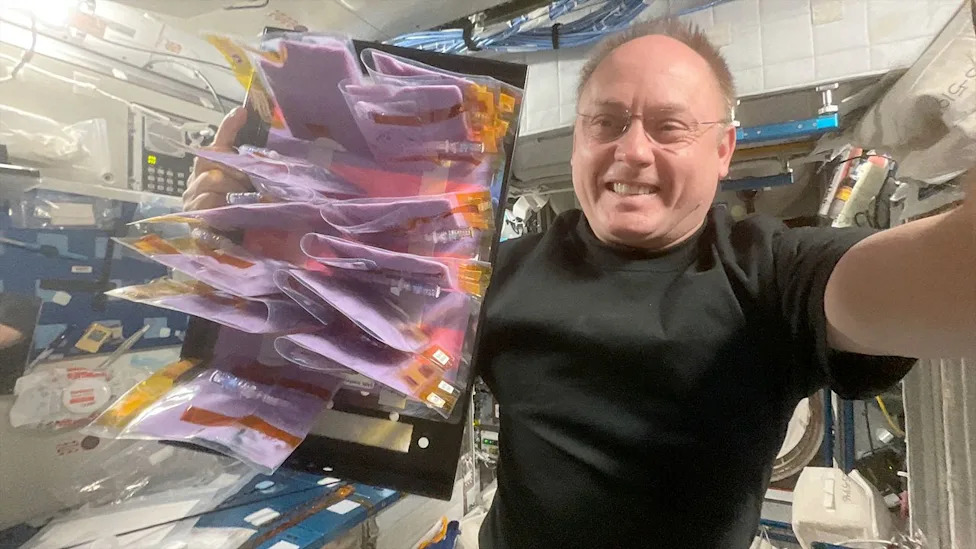
Photo: NASA/Mike Fincke
Renowned NASA astronaut Mike Fincke has announced his retirement from the American space agency after 30 years of public service.
NASA announced Fincke's decision on Wednesday (August 12), citing his contributions to spaceflight and a long career filled with accomplishments.
«"Few have had the opportunity to impact as many chapters in NASA history as Mike Fincke," NASA Administrator Jared Isaacman said in a statement that day. Fincke departs the space station as NASA's fourth-most-flying astronaut, having logged a total of 549 days in space across four separate spaceflights. During that time, he has conducted nine spacewalks and served twice as commander of the International Space Station (ISS). Most recently, he launched as pilot on SpaceX's Crew-11 mission to the ISS and then became commander of Expedition 74 from August 2025 to January 2026.
Before being accepted into NASA's 16th astronaut class in 1996, Fincke earned two bachelor's degrees from the Massachusetts Institute of Technology (MIT)—one in aeronautics and astronautics, and one in earth, atmospheric, and planetary sciences. After graduating from MIT, he completed a summer internship at the Moscow Aviation Institute and later earned master's degrees in aeronautics and astronautics and one in planetary geology from Stanford and the University of Houston-Clear Lake, respectively.
Before joining NASA, Fincke also served in the U.S. Air Force. He graduated from the U.S. Air Force Test Pilot School in 1994 and was subsequently assigned as a space systems engineer and flight test engineer at Edwards Air Force Base in California and Eglin Air Force Base in Florida, respectively. He then served as the U.S. flight test representative for the Japanese-American XF-2 fighter program in Japan.
After two years of astronaut candidate training, Fincke was assigned to Russia as part of the Crew Test Support Team of the NASA Astronaut Office's Station Operations Division. There, he served as an ISS (spacecraft) communications operator and as the ISS crew procedures team leader before officially beginning spaceflight training in 1999.
His first rocket launch was in 2004 aboard Soyuz TMA-4 on a mission to the ISS, where he served as a research fellow and flight engineer on Expedition 9 and performed four spacewalks (extravehicular activities, or spacewalks).
Fincke's second launch returned him to the ISS in 2008 as part of the Soyuz TMA-13 crew. It was then that Fincke assumed command of the space station for the first time. As Expedition 18 commander, Fincke conducted two more spacewalks and oversaw the preparation of ISS facilities for the expansion of the crew from three to six.
Fincke also participated in the final launch of NASA's Space Shuttle Endeavour, mission STS-134, in 2011, returning him to the ISS for the third time. As a mission specialist and robotic arm operator, he helped install the Alpha Magnetic Spectrometer (AMS) instrument to search for dark matter on the space station and performed three more spacewalks, which marked the official completion of the ISS's orbital assembly and were the final spacewalks performed by the shuttle crew.
By 2014, Fincke served as the head of the Commercial Crew Flight Division in the Astronaut Office, where he played a key role in the development and testing of the SpaceX Crew Dragon and Boeing Starliner spacecraft. In January 2019, he was named joint operations commander for Boeing's Crew Flight Test (CFT) mission and remained on the prime crew until June 2022, when he transitioned to the CFT backup crew.
Mike Fincke is rescued from SpaceX's Crew Dragon spacecraft after the Crew 11 splashdown in the Pacific Ocean on January 15, 2026. | Photo: NASA/SpaceX
Fincke's final mission, Crew-11, launched to the ISS in August 2025. This was his second time as a space station commander, this time as part of Expedition 74, but his stay on the station, like that of the other Crew-11 astronauts, was cut short due to unexpected health issues.
On the eve of his tenth career spacewalk, NASA abruptly canceled the spacewalk preparations planned by Fincke and fellow astronaut Zena Cardman after a "medical issue" arose that took precedence over scheduled station maintenance. While not considered an emergency, the incident was deemed serious enough for NASA to return the Crew-11 astronauts to Earth earlier than expected, and Fincke and his crewmates splashed down safely in the Pacific Ocean aboard their SpaceX Crew Dragon spacecraft a week later.
During the mission, NASA did not disclose the name and condition of the injured astronaut, citing privacy concerns. However, just over a month after the return of Crew 11, NASA and Fincke announced that he was the crew member who experienced health issues, which he later described as a temporary inability to speak, according to the Associated Press. Fincke has fully recovered from this episode and is now healthy.
«"Mike approached every assignment with expertise, humility, and an unwavering focus on the mission," said Scott Tingle, NASA's chief of astronaut operations, in a statement. "Whether flying on the station, supporting crews from the ground, or helping build the spacecraft that future crews would rely on, he consistently strengthened our team. His legacy is woven into how we fly today.".
NASA has not said whether Fincke plans to continue his work in the space industry in the private sector, but emphasized his commitment to supporting humanity's quest for space exploration.
«"I remain deeply committed to space exploration," Fincke said in a statement. "NASA has given me the extraordinary privilege of serving alongside extraordinary individuals, operating and helping develop spacecraft, and contributing to the International Space Station from its earliest days all the way to its orbital command… I'm excited to pass on this experience and help prepare the next generation of engineers, explorers, and leaders.".