






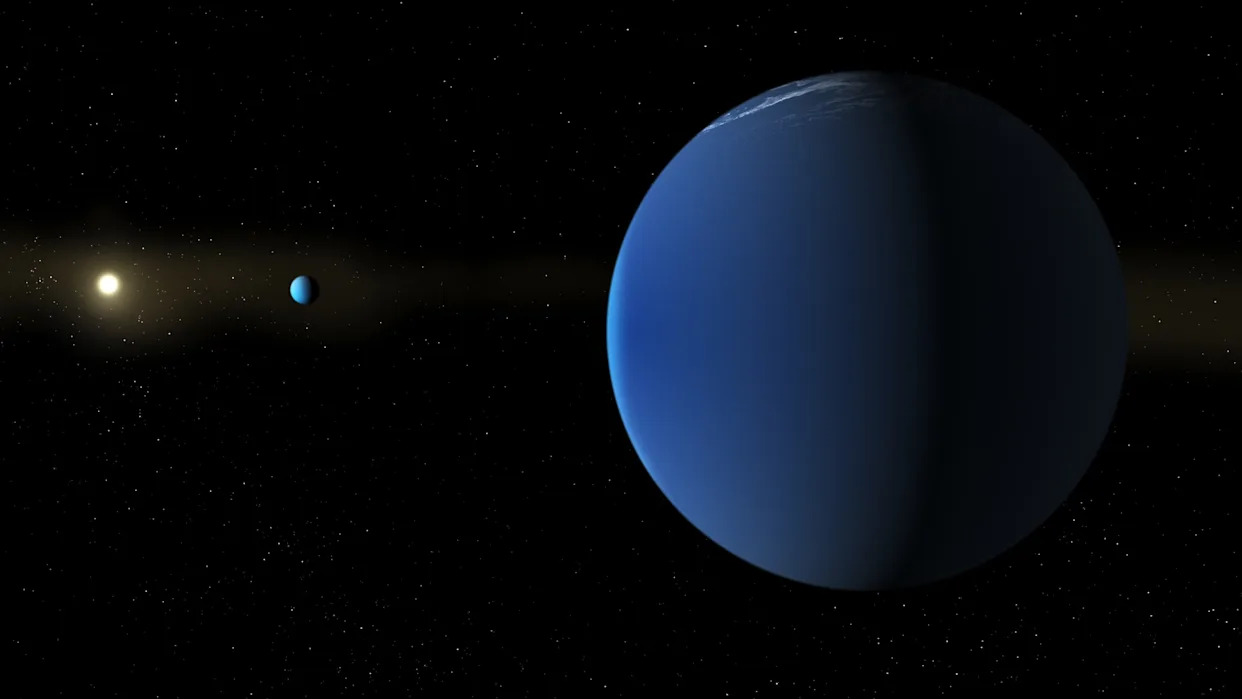
An international collaboration has discovered two of the lowest-density giant planets ever recorded. The study describes rare "super-puffs" with densities lower than cotton candy. The research, led by the University of Oxford, the Côte d'Azur, and the University of Birmingham, has uncovered an unusual system that challenges our understanding of how giant worlds form.
Planets TOI-791 b and TOI-791 c orbit an F7 dwarf star 1,110 light-years away in the southern constellation Volans. Although both planets are roughly the same size as Jupiter, they have an unusually diffuse distribution. The density of TOI-791 b is 0.038 grams per cubic centimeter, while that of TOI-791 c is 0.047 grams per cubic centimeter.
For comparison, the density of cotton candy is about 0.05 grams per cubic centimeter, and Earth's density is 5.5 grams per cubic centimeter. Jupiter's average density is 1.33 grams per cubic centimeter, which is 28–35 times greater than those of these fluffy worlds.
Analysis of the resonance of twin planets
These planets are "siblings," formed together from the same disk of gas and dust surrounding their young star. They are in a rare gravitational interaction known as a 5:3 mean motion resonance. For every five orbits completed by the inner planet, the outer planet completes almost exactly three. This gravitational interaction causes the planets to repeatedly tugg on each other, causing measurable shifts in the timing of their transits across the star.
Only four other systems are known to contain multiple superplanets, making TOI-791 an exceptionally rare laboratory. Volunteers participating in the citizen science project Planet Hunters TESS first identified these planets in 2019 and 2023 using NASA's Transiting Exoplanet Survey Satellite. The researchers then calculated their densities by combining observational data on their sizes and masses.
Harvesting in the continuous Antarctic darkness.
When a planet passes in front of its star, it slightly dims the star's light, allowing its size to be determined. By analyzing the slight variations in transit timing caused by the planets' mutual gravitational attraction, the team estimated their masses and low densities. This discovery was the result of eight years of observations, including data from the ASTEP ground-based telescope in Antarctica.
The Antarctic winter provided a unique advantage. Months of uninterrupted darkness allowed astronomers to record exceptionally long transits of planets across the Sun's disk, each lasting over 11 hours, in a single uninterrupted observation. These are officially the longest continuous transits of planets across the Sun's disk ever observed in their entirety from Earth.
Study of the evolution of gas shells
Astronomers are still debating how super-inflated planets form. One leading theory suggests that they possess enormous hydrogen- and helium-rich atmospheres that make up a significant portion of their total mass.
These giant gas shells may have formed during planet formation far from their star in cold regions of the protoplanetary disk, where gas could quickly accumulate around a solid core.
The researchers intend to conduct further research to better understand the history of this formation. They propose using the James Webb Space Telescope to assess whether these inflated atmospheres contain carbon-, nitrogen-, and oxygen-containing compounds. These space observations will provide new insights into how these unusual multi-planet systems evolved over long periods of time.
The results of the study were first published in the journal Monthly Notices of the Royal Astronomical Society.