








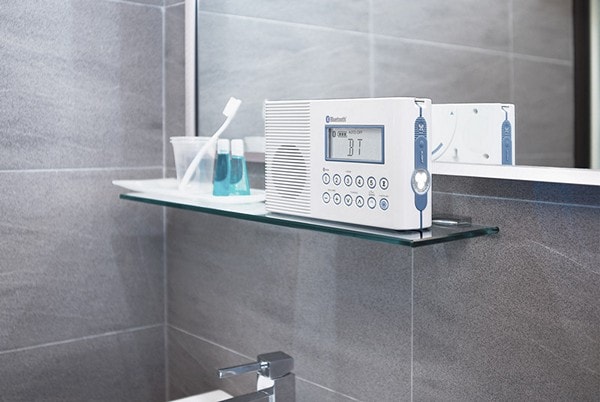
Taking a shower to your favorite music or listening to the morning news while shaving isn't a luxury, but an affordable way to make your daily routine more enjoyable. However, a standard bathroom radio will quickly fail due to steam and splashes. This space requires specialized audio equipment capable of operating in high humidity. Dozens of models are available on the market today, from simple floating toys to premium built-in systems. How can you navigate this sea of options and choose a reliable device that will delight you with sound, not hassle? Let's explore all the types, technical nuances, and installation considerations.

Types of waterproof radios: from toys to high-tech systems
All bathroom devices can be divided into three broad categories based on their placement and use. Portable models are sealed enclosures, often shaped like a soap dish or carrying case. They run on batteries or rechargeable batteries and can be placed on a shelf, hung, or even taken into the shower. They typically have an IPX7 water resistance rating (withstands brief immersion in water up to 1 meter deep). Their advantages include portability, low price, and a variety of designs. Disadvantages include lower-quality sound, battery dependence, and the risk of dropping.
Floating radios are essentially waterproof toys shaped like ducks, boats, or balls. They float in the bathtub. They often feature additional features, such as a thermometer, a backlight, and Bluetooth for connecting to a smartphone. They also have an IPX7 rating. They're more of a fun gadget for kids or a romantic evening than a serious audio source. Sound quality is a secondary concern. Built-in systems are serious audio solutions for a complete renovation. They consist of waterproof speakers built into the wall or ceiling and a separate control unit (often combined with a light switch). They operate on a 220V power supply, offer high-quality sound, and can be integrated into a smart home system. This is an expensive, but the most durable and aesthetically pleasing solution.
- Portable: Look for IPX5 (jet-proof) or IPX7. Check the battery type (AA/AAA batteries or built-in rechargeable battery). A hanging loop is a plus.
- Floating: Pay attention to the case material – soft silicone is safer than hard plastic. Bluetooth expands the capabilities (you can stream music from your smartphone).
- Built-in: These require planning during the rough finishing stage. Speakers must have a minimum IP44 rating (splash-proof). Consider the need to run audio cables through the walls.

Specifications: What to look for besides design
When choosing a bathroom radio, it's easy to get carried away by its appearance and overlook key features that determine ease of use. First, reception range. Most models only receive FM, which is sufficient for music and news. But if you enjoy listening to Radio Rossii or other AM/SW stations, look for a model with a full range. Second, signal sources. Modern devices often feature not only a radio, but also an AUX input for connecting an external source, an SD/USB memory card slot, and a built-in Bluetooth module. The latter is an extremely convenient option, allowing you to stream music or podcasts directly from your smartphone.
Third, controls. In a bathroom, where hands are wet or soapy, large, clear buttons are preferable to touchpads. Remote control is also important (but it should be stored in a dry place). Fourth, power. Battery-powered models are self-contained but require regular battery replacement. Devices with a built-in battery are more convenient, but they need to be recharged periodically. Corded models (built-in or some wall-mounted) are reliable but require a splash-proof outlet or concealed wiring. Sound quality in the bathroom is a subjective matter. Generally, a single 3-5W speaker is sufficient for a small, reverberant room.
- IP protection: Minimum IPX4 (protection against splashes from any direction). For the area directly in the shower stall – IPX5/IPX6 (protection against jets).
- Functionality: The presence of a sleep timer (auto-off), a clock with an alarm, the ability to save favorite stations in memory.
- Sound: Look for a bass radiator or stereo sound support (for built-in systems). For compact models, clarity and the absence of crackling at maximum volume are more important than wattage.

Brands and Models: Market Overview
Products of varying levels are available on the market. The budget segment (under 2,000 rubles) is dominated by Chinese portable and floating models from unknown brands. Their advantages are price and variety, but their drawbacks include questionable build quality and sound, and the claimed water resistance often doesn't match reality. In the mid-price segment (2,000-5,000 rubles), brands such as Sony, JBL, and Philips offer compact Bluetooth speakers with a high degree of protection (for example, the JBL Flip with IPX7). This offers a good balance of price and quality.
The premium segment (5,000 rubles and up) is dominated by specialized manufacturers of electrical installation equipment offering built-in solutions. German company GIRA is renowned for its radio switches, which fit into a standard mounting box. They look like a regular switch, but inside they contain a fully functional FM radio with six preset stations. Spanish company EIS offers the KBSound system, which consists of separate, waterproof speakers and a wall-mounted control unit with Bluetooth and USB support. These systems require professional installation but provide excellent sound and seamlessly integrate into any design.
- Budget segment: Check reviews and verify the actual water resistance. Often, models sold as "waterproof" are simply splash-proof.
- Middle segment: Branded Bluetooth speakers are the most popular and practical choice. They're versatile: they can be used in the bathroom or taken outdoors.
- Premium segment (embedded systems): In addition to GIRA and EIS, consider Basalte, Jung, and Berker. Their products feature impeccable design, metal frames, and extensive integration options.

Installation and safety: rules that must not be broken
The primary rule when installing any electrical device in the bathroom is safety. The room is divided into safety zones. Zone 0 (inside the bathtub or shower tray) – only devices with a power supply no higher than 12V and an IPX7 rating may be installed here. Zone 1 (above the bathtub or shower up to a height of 2.25 m) – water heaters and lamps with an IPX5 rating are permitted, but sockets are prohibited. Zone 2 (at a distance of 0.6 m from the edge of the bathtub or shower) – sockets are permitted, but only those protected by an RCD with a leakage current of no more than 30 mA, and preferably with covers. A radio, even if protected, should not be placed in zones 0 and 1. Ideally, it should be placed in zone 2 or outside it, on a shelf or in a niche.
When installing built-in systems, all cables must be routed in conduit, and connections must be made in junction boxes located outside of high-humidity areas. The power supply (if the system is low-voltage) must be located outside the bathroom. Network devices must have a grounded outlet and a residual-current circuit breaker (RCD). If you are unsure, entrust the installation to an electrician. During operation, avoid direct water jets on the enclosure, even if the system is specified as having high protection. After showering, ventilate the room to prevent condensation from accumulating inside the device. Regularly inspect the enclosure and cables for damage.
- Selecting a location: At a safe distance from water sources (faucets, shower heads). Not above the bathtub itself, but to the side, on the wall, or on a shelf.
- Power supply: For portable battery-powered models, charge the device outside the bathroom. For stationary models, provide concealed wiring or a covered outlet in a dry area.
- Fastening: Use only the original mounts or brackets. Do not use silicone sealant to secure the devices, as it may damage the plastic housing.
A bathroom radio is a detail that significantly enhances comfort. For occasional needs and on a budget, a bright floating Bluetooth speaker is ideal. For those who want to listen to music every day, a reliable, branded portable model with high protection is ideal. For a major renovation and creating a flawless interior, a built-in system from market leaders is ideal. Whichever option you choose, remember safety and follow the installation and maintenance instructions. Then, listening to music in the bathroom will only bring positive emotions, rather than problems with wiring or a speaker suddenly going silent at the most inopportune moment.