








Few people think about a trap until they encounter a blockage or an unpleasant odor from the sewer pipe. Yet this small device is one of the main protectors of cleanliness and comfort in your bathroom. Its job is not only to drain wastewater but also to create an impenetrable barrier to sewer gases and trap large debris, hair, and small objects that could clog the main drain. A properly selected and installed trap will operate for decades without requiring any attention, but a poor choice will result in a never-ending battle with puddles under the sink and unpleasant odors.
Structurally, any trap is a curved pipe or flask with a permanent water seal at the bottom—a water trap. This water seal prevents sewer gases from escaping into the room. Over time, this seal can dry out if the plumbing fixture is not used for a long time, or it can be sucked into the main drain during a powerful flush if the trap is not selected correctly. Therefore, it's important not only to buy a high-quality product but also to understand how it works.
The modern market offers traps made of various materials: plastic, stainless steel, brass, and bronze. Plastic models are most often chosen for DIY installation. They are inexpensive, corrosion-resistant, easy to install, and feature transparent casings that allow you to see if debris has accumulated. Metal traps look more solid and durable, but they are more expensive and more difficult to install due to the need for precise fitting and the use of sealing pastes.
Bottle Siphon: A Versatile and Practical Champion
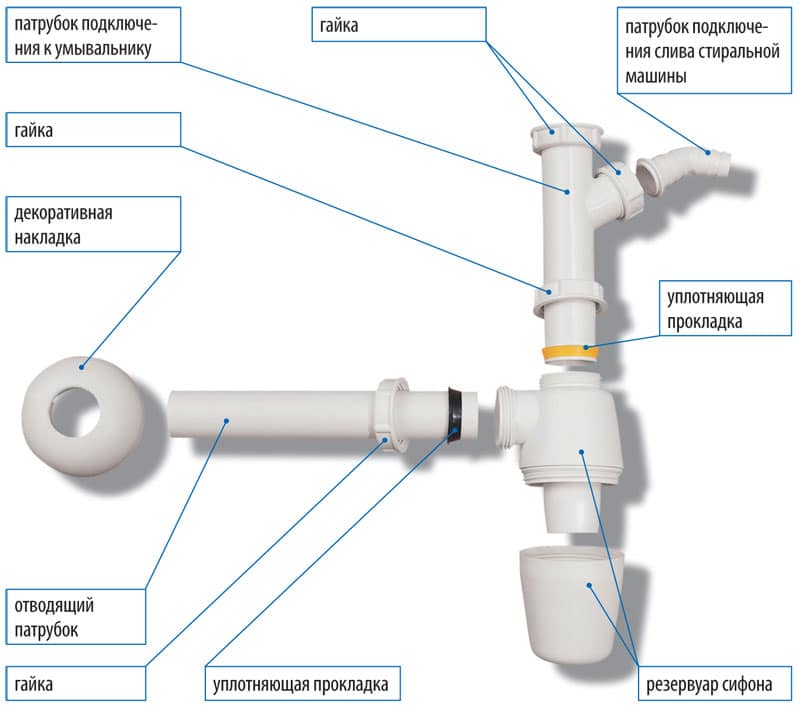
A bottle trap is the most common type for washbasins, sinks, and bathtubs. It consists of two parts: an upper outlet, which attaches to the drain hole, and a lower removable bowl (cup), connected to the sewer. Water flows down the drain and first enters this bowl, from where it flows into the outlet pipe. All heavy objects (jewelry, stoppers) and most debris settle at the bottom of the bowl, not going further down the drain.
The main advantage of this design is its incredible ease of maintenance. If a clog occurs, there's no need to call a plumber or try to clear the pipe with a cable. Simply place a bucket underneath, unscrew the bottom bowl (usually threaded), empty the accumulated dirt, rinse, and screw it back in. The entire operation takes five minutes. Transparent bowls allow you to visually check the degree of clog.
When choosing a bottle trap, pay attention to several details. First, consider the diameter of your sink or bathtub drain hole. The standard for vanities is 1 1/4 inches (approximately 32 mm), while for sinks and bathtubs it's 1 1/2 inches (approximately 40 mm). Second, consider the design of the bowl itself. High-quality models have a special skirt or relief on the bottom that prevents water from backing up from the water trap during a strong flush from upstairs. Third, consider the quality of the rubber seals. They should be thick, flexible, and fit snugly without warping.

Corrugated siphon: flexibility as the main advantage
This is perhaps the simplest trap design. It's a simple corrugated plastic tube that can be manually bent into a U or S shape to create the required water seal. One end of the tube is attached to the drain of the plumbing fixture, and the other is inserted into the drain socket. It seems like it couldn't be simpler.
This flexibility is both its main advantage and its main disadvantage. The advantage is that this type of trap can be installed in the most confined spaces, where a rigid bottle trap simply won't fit under the sink. It easily compensates for any height discrepancies or misalignments between the drain and the sewer inlet. This is a frequent savior in non-standard layouts or after rearranging plumbing fixtures.
The disadvantages, however, are more significant. The ribbed interior surface of the corrugated pipe is an ideal place for grease, soap scum, and hair to accumulate. Cleaning it mechanically is very difficult, and chemical cleaners are often ineffective. Over time, the pipe narrows, draining slows, and a persistent unpleasant odor develops. Furthermore, plastic corrugated pipe is not very aesthetically pleasing and is typically used where the trap is hidden behind a cabinet front or decorative screen. For exposed installations, such as under a pedestal sink, a more presentable option is better.

Pipe siphon: compact and reliable
A pipe (or U-shaped) trap is a rigid structure, shaped like the letter U or S, assembled from straight pipes and elbows. It occupies a position between a bottle trap and a corrugated trap. It is similar in compactness to a corrugated trap, but has smooth inner walls that are less prone to clogging. In terms of operation, it is the same as a water seal, but without the removable waste collection container.
This type of siphon is often found under shower trays, where headroom is at a premium, or in combination with designer sinks, where all plumbing is visible and must look impeccable. Chromium-plated steel or brass siphons are a design element in their own right, often found in loft, industrial, or Scandinavian styles.
A significant drawback is the difficulty of cleaning if a blockage occurs. For this purpose, a threaded inspection cap is usually provided at the top of the bend, but it's not always easy to unscrew, especially if the trap is installed close to the floor or other pipes. Also, a pipe trap is sensitive to installation accuracy: if the length is incorrect, it simply won't be assembled, unlike a flexible corrugated pipe.

Specialized siphons: for baths, showers, and household appliances
In addition to universal models, there are siphons designed to solve specific problems. Their design has some unique features that are important to understand.
Bath siphon with drain-overflow system. This is essentially two devices in one. It consists of a traditional trap connected to the bottom drain and an additional pipe leading to the overflow hole on the bathtub rim. The entire system is controlled by a single mechanism, usually located on the decorative overflow grate. There are mechanical traps (closed by turning the overflow cover) and automatic traps (controlled by a button on the rim). When choosing, it's important to check the length of the corrugated pipe connecting the overflow to the trap—it should be sufficient with some extra room.
Shower cabin siphon. Typically, this is a flat, extremely compact trap that fits into the confined space under the shower tray. It often takes the form of a box with a hinged or removable lid for cleaning. The key parameter when choosing a trap is the height of the trap (installation depth), which should be less than the height of the space under the tray.
Siphon for connecting a washing machine and dishwasher. Typically, this is a bottle or pipe trap with one or more side outlets, ¾ or ½ inches in diameter, fitted with rubber seals. The drain hoses of household appliances are inserted into these outlets. It's crucial that the hose connection point is above the water seal in the trap; otherwise, if the drain becomes clogged, dirty water can flow up the hose directly into the machine's drum.
- Check the complete set. The box should contain all necessary gaskets (flat and conical), decorative covers, and sometimes mounting nuts of various diameters. Missing even one gasket will make installation impossible.
- Pay attention to the diameter of the outlet pipe. The standard diameter for modern plastic sewer pipes is 40 or 50 mm. If your sewer pipe is cast iron and has a larger diameter, an additional transition sleeve will be required.
- For sinks with overflow Make sure that the chosen siphon model has a suitable side hole for connecting the overflow tube.
- If the bathroom is rarely used (for example, at a summer house), choose traps with a deep water seal. Water evaporates more slowly in them, and odor protection remains effective longer.
Self-installation: step by step to the perfect result
Installing a plastic trap is a task that even a novice can handle. The key is to proceed slowly and consistently. You'll need: a new trap, a screwdriver (sometimes a Phillips-head screwdriver is required), pliers, and silicone sealant.
Let's start by removing the old trap. Place a small container underneath it—there's always some water that will spill out when you unscrew it. Loosen all connections by hand or with pliers (carefully, so as not to strip the plastic threads) and remove the old structure. Thoroughly clean the drain hole seat of the sink or bathtub to remove any old sealant and residue.
It's convenient to start assembling the new trap from the top down. Insert the top grate with the gasket into the drain hole and tighten it with the screw from under the sink. Don't overtighten, otherwise you could crack the ceramic or dent the acrylic. Then screw the top bowl of the trap to this screw, remembering to insert the conical gasket. Next, attach the bowl itself and the drain pipe. Tighten all threaded connections by hand until snug, then tighten them slightly with pliers, but don't overtighten.
The final step is connecting to the sewer system. The outlet pipe of the trap is inserted into the sewer socket. If the diameters match, a standard rubber adapter cuff is used. If the trap is narrower than the socket, a reducer cuff will be required. For security, the connection between the outlet pipe and the cuff can be sealed with silicone sealant. After assembly, be sure to test the system: turn on the water, let it drain, and carefully inspect all connections for leaks. Check the area under the sink especially carefully with a napkin—sometimes a microleak will only appear as tiny drops.
A properly selected and installed trap guarantees clean air, fast drainage, and no surprises like sudden flooding. It works silently and unnoticed, but its role in the hygiene and comfort of your home is invaluable. Take the time to research, and this small part of your plumbing fixtures will serve you faithfully for years to come.