








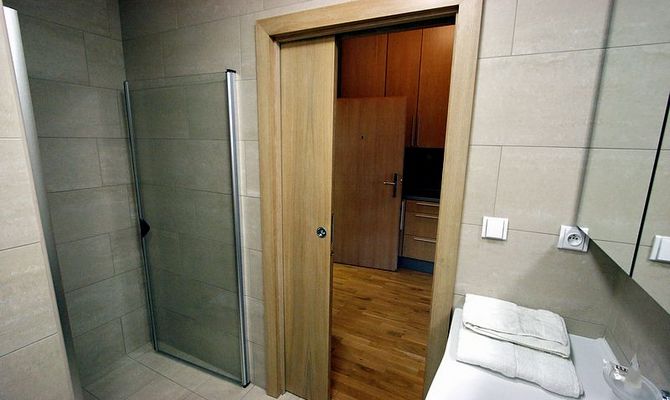
Modern renovations strive not only for beauty but also for maximum functionality and space efficiency. This is especially true in small apartments, where every centimeter counts. In such settings, traditional swing doors, which require ample space to open, often become inconvenient. They can interfere with adjacent furniture, block access in a narrow hallway, or simply eat up valuable space in a small bathroom. An alternative that has long been popular in Europe and is steadily becoming a popular choice in our homes is sliding doors.

Their operating principle is simple and ingenious: the curtain moves along the wall on guide rails, taking up virtually no additional space. This solution is ideal for combined bathrooms, where the space between the bathtub and toilet needs to be zoned, or for separate but adjacent rooms. Besides the obvious space-saving advantage, sliding doors can become a striking design detail, altering the perception of space with glass inserts and visually lightening the interior. However, they also have their own characteristics that you should be aware of before purchasing and installing.
Operating principle, advantages and limitations
Structurally, a sliding door consists of several key elements: the door panel, a roller system (carriage), an upper and/or lower track, as well as stoppers and decorative strips concealing the mechanism. The rollers, mounted on the panel, move along a track, ensuring a smooth and silent operation. Depending on the system type, the weight of the panel may be supported solely by the upper track (the most common option) or additionally supported by a lower track, which serves to stabilize the door and prevent it from swinging.


The main advantage of these doors is their space-saving nature. They require no "dead space" in front of the doorway to open. This allows for furniture to be placed flush against the doorway or for a passageway in a very narrow hallway. A second key advantage is safety. The absence of a hinged door eliminates the risk of hitting a sharp corner or pinching fingers. Sliding doors are easier for children and the elderly to open, as they don't have to overcome the resistance of hinges or the weight of the door. They also offer more design freedom: lightweight materials, large glass areas, and a combination of different textures are possible.
- Saving usable space: the door moves along the wall without taking up space in the opening radius.
- Safety and convenience: The absence of a swing door reduces the risk of injury, and the door opens easily with one movement.
- Design and visual lightness: the possibility of using panoramic glazing, a combination of materials, and creating the effect of expanding space.
- Versatility for narrow openings: An ideal solution for tight hallways, small bathrooms and toilets where a regular door would be an obstacle.
- Zoning options: Large sliding systems can separate the space of the bathroom and toilet in a combined bathroom.
However, there are limitations that must be considered. Sliding doors, especially budget-friendly ones, offer less sound insulation and airtightness than swing doors. There's always a small gap between the door leaf and the wall/frame. This can be important if you want to completely isolate noise or odors from the restroom. The system also requires a clear wall for the door leaf to slide along. If this wall is intended for furniture or shelves, installation will be impossible. Finally, the mechanism requires more careful maintenance: periodic cleaning of the guides from dust and lubrication of the rollers.

Types of mechanisms and installation features
All sliding systems can be divided into two main types based on their support method. The first, and most popular, is a top-hung system. In this case, the entire weight of the door is supported by powerful rollers that move along a rigid track fixed above the opening. The bottom rail is either absent or serves only as a side stop (a flag roller that fits into a groove). Advantages: the floor is clean, nothing interferes with cleaning or movement; a bottom threshold is not required. Disadvantage: the strength of the wall above the opening is required, as the entire load is borne by it. This system is difficult to install on a plasterboard partition without additional reinforcement.
The second type is a bottom-supported system. Here, the main weight is borne by rollers running on a track embedded in the floor. The top guide merely holds the curtain upright. This design is considered more stable and reliable for heavy curtains (such as those made of solid wood or glass). However, it has a significant drawback: it requires a groove in the floor, which easily accumulates debris, hair, and dust. This requires regular cleaning, otherwise the rollers will jam. The bottom track also creates a threshold, which can be a tripping hazard.

The installation process for a top-hung system is as follows. First, a wooden beam is attached above the opening (reinforced with a metal profile if necessary), which levels the surface and serves as a base for installation. The top guide rail is screwed to it, ensuring a strictly horizontal alignment. Then, the roller carriages and top brackets are installed on the curtain. The curtain is hung on the rail, after which its height and vertical position are adjusted using special screws on the carriages. Lastly, the bottom guide groove (if included in the system) and decorative caps are installed to conceal the mechanism.
- Top hung system: Clean floor, smooth operation, easy cleaning. Requires a solid foundation above the opening.
- Bottom support system: Increased stability for heavy doors. The presence of a threshold and the need for frequent cleaning of the floor guide.
- Mounting beam: a mandatory element for leveling and strengthening the wall under the upper guide.
- Accurate horizontal rail installation: The smooth running and absence of web distortions depend on this.
- Adjustment: Modern systems allow you to precisely set the height of the canvas and its verticality after installation.

Choosing a canvas material for bathroom conditions
The humidity and temperature fluctuations in bathrooms and toilets place special demands on door material. Classic wood, even varnished, can swell, warp, and become distorted over time in such conditions. This can lead to difficulty opening or jamming of the door. Therefore, if you do choose wood, it should be thoroughly dried, treated with moisture-resistant impregnations, and sealed with several coats of high-quality varnish. It's best to choose moisture-resistant woods such as teak, larch, and merbau.
More practical options include wood-based materials with a protective coating: laminated MDF panels, veneered panels with a moisture-resistant backing. These panels imitate the texture of wood well but are less prone to warping. Tempered glass panels (either solid or combined with an aluminum frame) are considered an ideal solution for bathrooms. Glass is completely inert to moisture, resistant to temperature fluctuations, easy to clean, and transmits light, which is especially important for dark hallways. You can choose from frosted, tinted, satin, or sandblasted glass for privacy.
Plastic (PVC) doors are another moisture-resistant and budget-friendly option. They are lightweight, require little maintenance, and come in a variety of colors. However, they can look cheap and don't always complement the interior. Aluminum profiles with glass inserts are a modern, lightweight, and durable choice, often used in offices and modern high-tech apartments.
- Tempered glass (triplex): Maximum moisture resistance, safety (it crumbles into small, blunt pieces when broken), and light transmission. Matte or tinted options are available for privacy.
- Moisture-resistant MDF with coating (laminate, veneer): good imitation of wood, resistance to deformation with proper end processing.
- Solid wood (moisture-resistant species): Eco-friendly, prestigious, and has a warm appearance. Requires the most thorough multi-layer varnish protection and microclimate control.
- Plastic (PVC): Inexpensive, practical, and waterproof. It may not match the design and may have a limited lifespan.
- Aluminum profile: Lightweight, durable, modern industrial style. Often combined with glass.
Maintenance and troubleshooting of the sliding system
To ensure a long and trouble-free service, your door requires regular but simple maintenance. Focus on the tracks. The top track should be cleaned of dust and cobwebs every 2-3 months using a vacuum cleaner with a narrow nozzle or a dry cloth. If the system has a bottom track, it should be cleaned even more frequently, as it collects all the debris from shoes. You can clean it with a brush and soapy water, then wipe it dry. Every six months to a year, it is recommended to lubricate the roller mechanisms with silicone spray or a special lubricant for moving parts. Never use oil or WD-40 – they attract dust and will make the problem worse over time.
The most common problem is a door that starts to move stiffly or squeak. This is usually due to dirty track or dry roller lubricant. Try cleaning and lubricating the mechanism. If the door sags and touches the floor or the bottom stop, its height needs to be adjusted. Modern systems have special adjustment screws on the carriages for this purpose: by turning them with an Allen key, you can raise or lower the corner of the door. If the door has come loose from the bottom track, carefully lift it, reinstall the roller, and secure it.
A more serious problem is failure of the rollers themselves. Over time, the bearings wear out, causing movement to become jerky. In this case, the roller carriages need to be replaced. Fortunately, they are usually standard and sold separately. It's important to buy the exact same model that fits your track. Replacement is a simple process: remove the decorative strip, lift the door off the track, unscrew the old carriages, and install the new ones.

- Regular cleaning of guides: Dry or slightly damp cleaning of dust and debris, especially in the bottom rail.
- Roller lubrication: Specialized silicone spray 1-2 times a year to ensure smooth and quiet operation.
- Height and vertical adjustment: using screws on the roller carriages to eliminate distortions and interference.
- Replacing rollers: If you experience any play, creaking, or jerking motion, purchase components that are compatible with the system.
- Caution when using: Do not pull the door with force, do not hang on it, do not try to move it if you feel resistance (first find and eliminate the cause).
Ultimately, sliding doors for bathrooms and toilets are a smart and stylish solution for modern homes. They save space, enhance security, and open up new design possibilities. The key to success is choosing the right system type and door material, taking into account humidity conditions, high-quality professional installation (or very careful DIY installation), and simple but regular maintenance. If these conditions are met, your sliding door will delight you with its flawless operation and neat appearance for decades, becoming an integral part of a comfortable and functional home.