








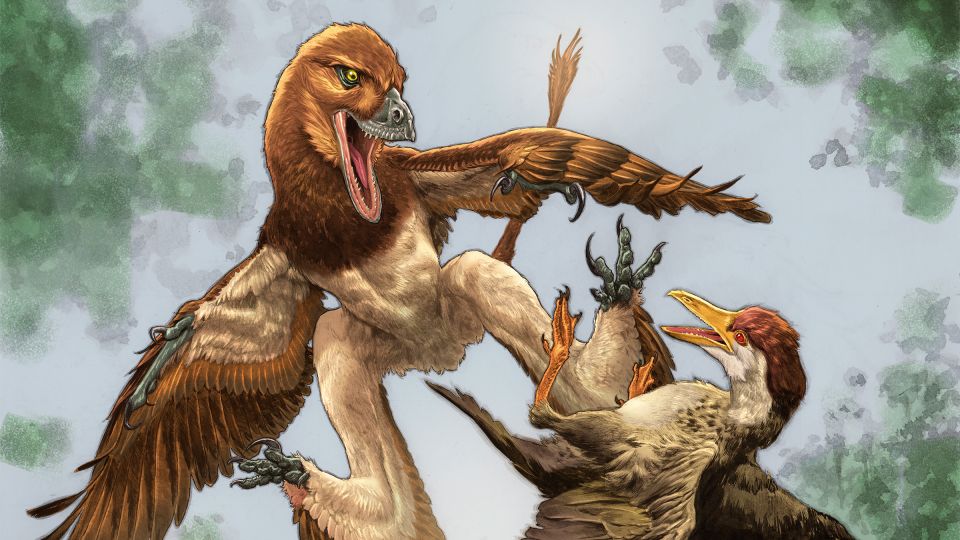
A 120-million-year-old fossil discovered in what is now northwestern China is changing scientists' understanding of the unusual group of predatory dinosaurs known as microraptors.
The fossil's discovery location expands the known geographic data on a smaller, gliding relative of the sickle-clawed Velociraptor. The bones also represent the latest confirmed specimen of Microraptor in the fossil record, allowing us to refine the timeframe of these feathered dinosaurs' existence.
A new analysis of intact shoulder and forelimb bones, first mentioned in a 2010 study abstract, has revealed that the fossil belongs to a previously unknown species of microraptor. According to the study, published Thursday in the journal Annals of the Carnegie Museum, the team of researchers named the dinosaur Jian changmaensis.
The species name "Jian" refers to a single-winged bird from Chinese mythology, alluding to the dinosaur's bird-like features. The name also alludes to the Changma River basin in Gansu Province, where the fossil was discovered—and to date, it is the only Microraptor specimen found outside of northeastern China.
«"The study of Jian changmaensis shows that non-avian dinosaurs inhabited the area of the modern Changma River basin, known for its fossil birds," said study co-author Dr. Matt Lamanna, a senior dinosaur scientist and the Mary R. Dawson Curator of Vertebrate Paleontology at the Carnegie Museum of Natural History in Pittsburgh, in a statement.
«"Our team has discovered over a hundred bird fossils in Changma, but only this single specimen of a non-avian dinosaur. Jian provides important new information about the biological history of the Changma region and the ecological context of the ancestors of modern birds.".
The well-preserved fossil could help researchers better understand how microraptors used their wings to move between trees, Lamanna said, and provide new insights into the origins of flight in birds.
Gliding Predator
At first glance, artistic reconstructions of microraptors look like depictions of birds.
«"If you saw this creature sitting in a tree, you wouldn't think it was a velociraptor from 'Jurassic Park,'" Lamanna told CNN. "It's an incredibly bird-like dinosaur that could levitate to some degree.".
The Microraptor fossil consists of only a few bones, but it is preserved in three dimensions. — Hailu Yu
Microraptor's body was covered with feathers—perhaps even more than a bird's, because in addition to its forelimbs, or "wings," the dinosaurs also had long feathers on its hind legs, giving the appearance of four wings.
«"This has led many paleontologists to speculate that these creatures likely lived partly on the ground, but could perhaps climb and glide from tree to tree, much like modern flying squirrels," Lamanna said.
The smallest microraptorids were similar in size to modern crows. Jian changmaensis was likely the size of a barn owl. Other fossils that may belong to the genus Microraptor indicate that these creatures could reach larger sizes, suggesting that Jian changmaensis occupied an intermediate position.
Velociraptors and Microraptors weren't birds, but they were closely related to the ancestors of the earliest birds, such as Archaeopteryx. The line between dinosaurs and early birds is becoming increasingly blurred as new discoveries are made, says Lamanna, especially when fossils exhibit characteristics of bird-like dinosaurs or dinosaur-like birds. Modern birds remain the closest living relatives of dinosaurs, which became extinct about 66 million years ago after a massive asteroid impact on Earth.
«"In an evolutionary sense, they're all dinosaurs, but it really depends on which side of Archaeopteryx you're on," Lamanna said.
In the case of the Jian changmaensis fossil, a clear indication that the wing belonged to a Microraptor and not an ancient bird, as with many other finds in the Changma Basin, was a distinctive feature of the coracoid process, a component of the shoulder structure.
The supracoracoideus is a large opening that nearly bisects the humerus. This feature is common to all microraptors but is virtually absent in other creatures, Lamanna said.
The purpose of this hole remains an open question for researchers; Lamanna said he believes it may be related to flight. Like modern birds, microraptors had long humeri. Jian changmaensis's humeri are exceptionally long.
«"This could be related to gliding, or it could be that endangered animals are changing the structure of their shoulder girdles to better adapt to efficient flight," Lamanna said.
The fossil consists of only a few bones, but its length suggests the dinosaur was likely a flyer, said Steve Brusatte, professor of paleontology and evolution at the University of Edinburgh in Scotland. Brusatte was not involved in the study.
«"It's exciting, a new fossil of these dinosaurs that were essentially on the cusp of becoming true birds," Brusatte said.
A rare fossil from the Changma River basin.
The Changma River basin, where an ancient lake once stood, is located in Gansu Province in northwest China. — Matt Lamanna
Researchers continue to speculate about why smaller relatives of Velociraptor evolved wings and moved into the trees in the first place, but Lamanna suggests that there was an open niche for arboreal predators that microraptors filled.
Microraptor's relatives lived on the ground, but living in the tree canopies and flying from tree to tree may have been a safer way to avoid attack by larger carnivorous dinosaurs.
«"It's possible these creatures first lived on the ground, then started climbing, and then, once they were in the trees, they developed features that helped them stay there," Lamanna said.
So what did Jian changmaensis eat? Since it lived in trees, birds were likely on its menu.
A fossilized Microraptor was previously found with bird bones inside its ribcage. Lamanna's co-author, Jingmai O'Connor, a vertebrate paleontologist and associate curator of fossil reptiles at the Field Museum in Chicago, also noted that the bone clumps found in the Changma River basin resemble the pellets regurgitated by owls after eating prey.
Jian may also have fed on fossils of Gansus yumenensis, one of the first dinosaur-era birds discovered in China. Paleontologists discovered these fossils in 1981 in the Changma River basin.
Lamanna and his team have been exploring the Changma River basin since 2004. They have discovered complete skeletons, some of which have feathers and skin, indicating that Gansus had webbed feet and likely spent some of its time in the water.
According to Lamanna, thanks to the discovery of Jian's remains, researchers finally know what likely preyed on Gansus and other ancient birds at this site. But if so, why was only one Microraptor fossil found at this site?
«"If you could travel back in time 120 million years in a time machine, you'd find yourself on the shores of a vast lake surrounded by vegetation," Lamanna said. "It's logical to assume that if you searched the lake, you'd probably find more animals living there than on its shores.".
Many bird and microraptor fossils are typically found crushed, flattened into a two-dimensional state, making it difficult to study their bones and flight abilities. But Jian's fossilized wing was preserved in three dimensions.
Researchers work at a quarry in the Changma River basin. — Jingmai O'Connor
«"Seeing a Microraptor shoulder in 3D is a rare thing," said T. Alexander Dececchi, an associate professor in the College of Arts and Sciences at Dakota State University in Madison, South Dakota. Dececchi was not involved in this study but has studied other Microraptor specimens.
«"This also expands the geographic range and helps demonstrate the anatomical diversity of this group, which is important for determining where, when, and which of them may have used aerial locomotion," Dececchi wrote in an email. "It also likely represents a different paleoenvironment, which, combined with our knowledge of the diverse diet of these animals, suggests that while all but one of the putative microraptorines originate from northeastern China, they were a common and common component of the ecosystem in that area and at that time.".
He also added that the discovered fossil will allow scientists to study the evolution of wings and flight in microraptors.
As a next step, Lamanna says he and his colleagues are interested in scanning the wing to see what it might reveal about the microraptors' flight or gliding abilities.
Subscribe to CNN's Wonder Theory newsletter. Explore the universe with news about exciting discoveries, scientific advances, and more.
To receive more CNN news and newsletters, create an account at CNN.com.