








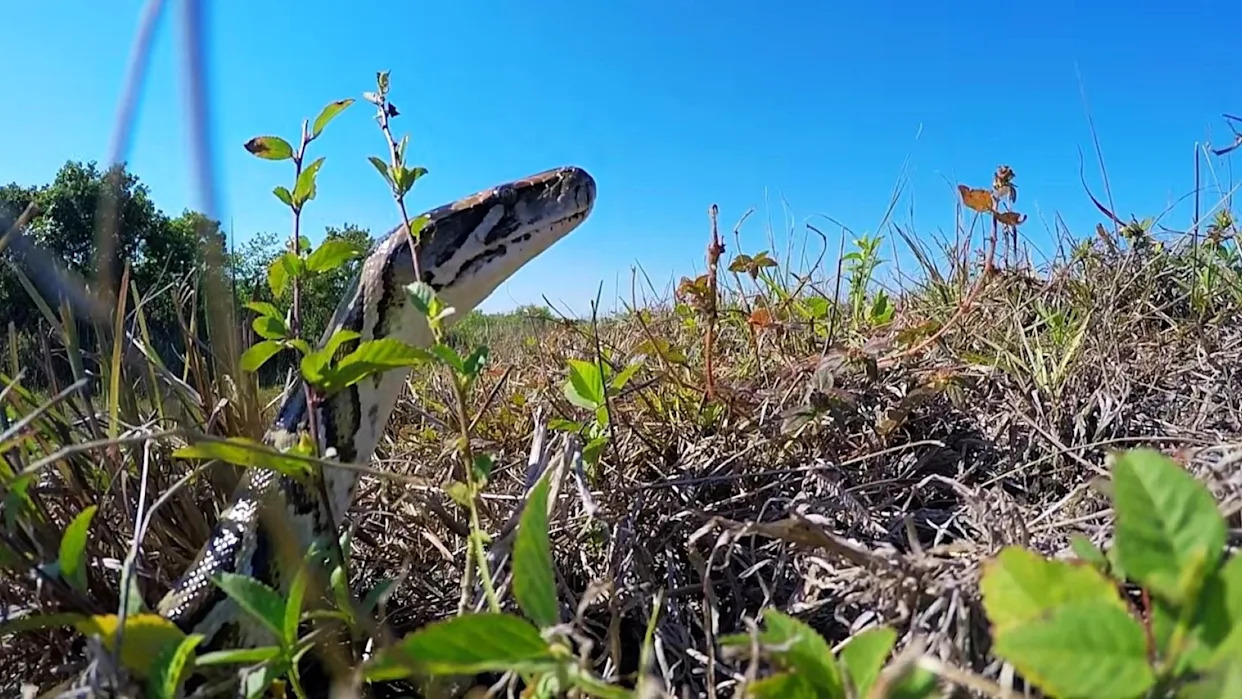
Florida authorities are warning potential hunters that Burmese pythons, one of the most dangerous invasive species in the Everglades, are easier to spot on land than in water.
A new state advisory advises search teams to check dam banks and trees, and to avoid encounters with the large snakes in bodies of water where the reptiles have the advantage.
What's happening?
As Popular Science magazine reports, the Florida Fish and Wildlife Conservation Commission has released a safety video for those attempting to track and capture Burmese pythons in the Everglades. This announcement comes ahead of the annual Florida Python Challenge, a summer campaign aimed at slowing the spread of one of the region's most dangerous predators.
Even with an estimated population of 100,000 to 300,000 Burmese pythons in the Everglades, most people are unlikely to spot a single one. Their camouflage is so effective in the subtropical environment that conservationists estimate that fewer than 5% of them are visible to the average person.
To increase your chances of success, the commission recommends searching for pythons along dry banks and among vegetation, rather than in canals. During warmer months, pythons often bask on the banks of dams or near trees. Hunters are also advised to identify the species by the arrow-shaped markings on the head, dark spots around the eyes, and a giraffe-like pattern on the body, while avoiding snakes in the water.
Why is this important?
Burmese pythons are an invasive species that can seriously disrupt local ecosystems by preying on native mammals, birds, and reptiles.
In an ecologically important place like the Everglades, disturbances like these can have a ripple effect, impacting biodiversity, habitat stability, and the health of the landscape that supports local communities, recreation, and tourism throughout South Florida.
This problem also directly poses a safety risk to the public. Florida is calling on the public to help, but only if they understand the risks involved. These snakes can grow up to 4 meters in length, and the commission's video emphasizes that appropriate clothing, gloves, and snake handling equipment are essential, even in the sweltering summer heat.
Limiting the spread of invasive species can help promote a healthier Everglades and reduce the likelihood of dangerous encounters for both local residents and tourists.
What is being done?
Florida's current strategy combines public education, organized trapping efforts, and reporting tools. Hunters who successfully capture a python are required to humanely kill it in accordance with state regulations, record its location using latitude and longitude, and take several photographs to help conservationists track the reptiles' spread.
For those who want to help but don't want to personally catch a snake, state officials report sightings of snakes by calling the exotic species hotline at 888-IveGot1 or, as Popular Science reported, through the website www.IveGot1.org or the IveGot1 mobile app.
Invasive species control often depends on a combination of professional expertise and public participation. In this case, even knowing when not to intervene—especially when it comes to water resources—can make response efforts safer and more effective.
As the video says, hunters should "prepare themselves by imagining large snakes over six feet long, either stretched out or coiled," and ask themselves, "Is this really something I want to do, or is it better to leave it to the professionals?"«
Subscribe to TCD's free newsletters to receive helpful tips, actionable advice, and a chance to win $5,000 toward your home improvement. To see more stories like this, change your Google preferences here.