






Dogs have been known as man's best friend for decades, but new research has helped us learn even more about our furry friends.
It turns out that Fido, Princess, and Reginald the Amazing Destroyer can read our emotions just by looking at our faces.
Researchers have previously found that dogs can interpret laughter, frowns and tears, but the biological aspects of this phenomenon have remained largely unexplored, according to scientists from the University of Vienna in Austria.
A brain scan study of dogs has shown for the first time that dogs can detect negative facial expressions – although perhaps differently than humans.
«"Humans are very good at recognizing fine details on the face, just like dogs," said Raul Hernandez-Perez, the first author of the study, in a statement.
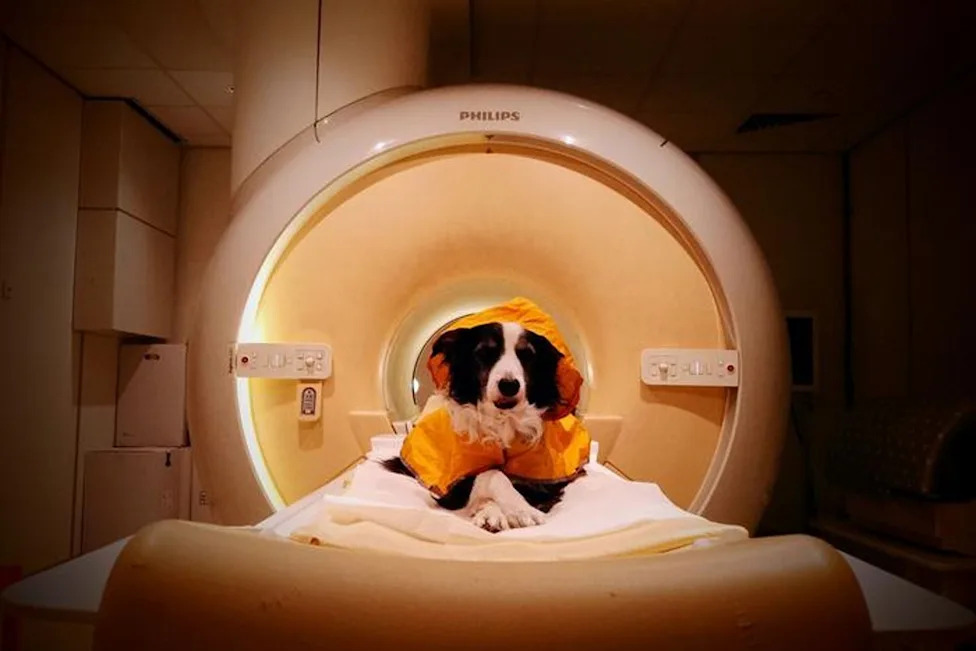
A new study has shown for the first time that dogs can detect negative facial expressions in humans. The dogs were trained to lie still during MRI scans so researchers could scan their brains (Laura V. Quaya).
«"By studying their brains, we can understand what adaptations they have evolved to support their remarkable social and emotional understanding of people," he said.
The study was relatively small and included more than a dozen young dogs volunteered by their owners, who received no compensation. The dogs were of various breeds, including border collies, Labrador retrievers, and golden retrievers.
All dogs were well socialized with people and other dogs, and some had previously participated in similar experiments and were already trained to lie still in the scanner.
After the remaining dogs were trained to lie still and wear earmuffs to protect their hearing inside the apparatus, the researchers took pictures.
These were MRI scans: a type of scan that shows which areas of the brain are most active.
The dogs, who were allowed to leave the session area at any time, were shown static images of people expressing happiness, anger, fear, and sadness.
As the researchers reported to the publication TIME , The scan took several minutes, and to obtain the correct result, dogs needed to spend at least six minutes in the machine.
Scan results showed that dogs' brains react differently to different emotions.
When dogs saw happy faces, their temporal cortex and caudate nucleus, areas associated with higher cognitive functions and reward processing, respectively, were activated.
However, exposure to other negative emotions did not elicit the same response—even though analysis revealed brain patterns that allow one to distinguish between these emotions, the researchers wrote.
This may be partly due to the Border Collie breed's characteristics. These dogs are very good at understanding social cues and spend more time observing people.
«"Therefore, it is possible that Border Collies have a greater ability to interpret human facial expressions, and further research is needed to determine whether there are behavioral and brain differences in the perception of human facial expressions across breeds," the authors said.
Pictured here, from left to right, are the four dogs in the study: Morante, Kunkun, Odin, and Molly (Laura V. Kuaya).
However, a photograph of a human face doesn't tell the whole story, and what the researchers observed doesn't mean dogs experience emotions in the same way as humans. Future research will also address this issue.
Dogs are adept at reading body language and vocal cues, and they also have a heightened sense of smell, which research has shown helps them recognize signs of stress in humans.
And what they feel matters too.
«"Their reaction can change depending on their mood at the time or perhaps their outlook on life at the time," Dr. Zoe Parr-Cortez, a former veterinarian, previously told NPR.