






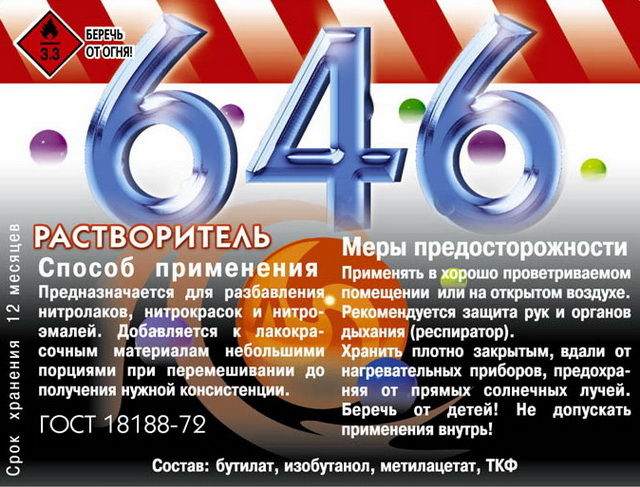
Every DIYer or professional decorator has a small set of must-have liquids in their arsenal, essential for any major renovation. Solvent 646 occupies a place of honor on this list. It's not just any chemical, but a multifunctional tool with specific purposes. It's a volatile, flammable liquid, usually yellowish in color, with a pungent, characteristic odor. Its primary purpose is to bring paints and varnishes to working viscosity and degrease surfaces, but its applications are much broader. Understanding its properties and capabilities allows you to use it effectively and, importantly, safely.

Thinner 646 was historically developed as a universal thinner for nitrocellulose materials, but thanks to its balanced composition, it works well with other types of coatings as well. Its versatility is both a plus and a minus. The plus is that you don't need to keep a dozen different cans for each paint on your shelf. The minus is that it isn't always the optimal choice for specific materials that require a special, "delicate" thinner. However, it is ideal for most household and general construction applications. Its key feature is high evaporation, which ensures rapid drying of the applied layer.
Let's take a look at the composition: what is this liquid made of?
The "646" marking is not a random number, but rather a specific formula defined by GOST. The composition is selected to ensure aggressive dissolution and rapid evaporation. The base (approximately 50%) is toluene, a powerful aromatic solvent responsible for dissolving many types of resins. Next come alcohols (ethyl, butanol) and esters (butyl acetate, ethyl cellosolve), which improve miscibility with various film-forming agents and regulate evaporation rate. A small amount of acetone (approximately 7%) adds penetrating power and further accelerates drying.
It's this combination that produces the universal effect. Butyl acetate, evaporating more slowly, prevents the film from drying too quickly, allowing the paint to flow well and reducing the risk of defects (cloudiness, shagreen). Alcohols improve surface wetting. The result is a solvent with high dissolving power and a moderate evaporation rate, making it easy to work with. It's important to note that there are many variations and "analogues" of 646 on the market, the composition of which may deviate from the GOST standard, affecting quality. It's safer to buy products from reputable chemical companies.
- Density: About 0.87 g/cm³. The liquid is lighter than water.
- Flash point: Only +7°C. This means that vapors above the liquid's surface can ignite from a spark even at this temperature. Store and handle away from sources of ignition!
- Autoignition temperature: About +400 °C.
- Volatility: Very high. Evaporates quickly, requiring work in a ventilated area.
- Toxicity: Vapors are harmful if inhaled. They can damage the nervous system and mucous membranes. Work only with a respirator and adequate ventilation.

Where and how to use 646 solvent in repairs
Its applications in everyday life and decorating are quite extensive. The first and most important is, of course, thinning paints, varnishes, enamels, and primers. It is excellent for nitro enamels (NC), some types of acrylic (AK) and glyphthalic (GF) paints, and epoxy primers. Before use, be sure to read the instructions on the paint can! The manufacturer always specifies the recommended type of thinner. Using a non-standard thinner may result in curdling, uneven film, or poor drying. To test, mix a small amount in a separate container.
The second most popular function is degreasing. Before painting, gluing, or filling, any surface (metal, plastic, concrete) must be degreased. Solvent 646 does this brilliantly, removing oil stains, fingerprints, and wax residue. It evaporates quickly, leaving no film. A third use is cleaning tools. Brushes, rollers, spatulas, and spray guns can be easily cleaned with this solvent after working with nitro or oil-based paints. The key is to do this immediately, before the paint dries completely.

Case Study: Bathtub Renovation
One striking example of the off-label, yet highly effective, use of solvent 646 is preparing a cast-iron or steel bathtub for a self-leveling acrylic coating (so-called "restoration"). After mechanically cleaning the old enamel and degreasing it with conventional detergents, invisible silicone or grease residues often remain on the surface. If acrylic is poured onto these residues, adhesion will be weak, and the coating may peel off.
This is where 646 comes in handy. Wipe the entire surface of the bathtub with a rag soaked in solvent. It dissolves and removes any organic contaminants, creating a perfectly clean, "active" surface for the new coating to adhere to. After this treatment, do not touch the bathtub with your hands! Wear gloves, and after the solvent has evaporated (10-15 minutes), immediately begin applying the primer or acrylic. This simple step on the 90% guarantees the success of the entire restoration.
- To dilute the putty: Some nitro putties (for example, for car repair) are also diluted with 646 to a paste-like state.
- Removing old coatings: A rag soaked in solvent, applied briefly to the old layer of nitro paint, softens it, after which the paint can be scraped off with a spatula. This method may not work with varnishes and modern acrylics.
- Be careful with plastic! When degreasing plastic parts (panels, window sills), test on an inconspicuous area first. Aggressive cleaning agents can damage (dissolve or cloud) some types of plastic.
- Wood impregnation: Sometimes it is used as a base for making stains or antiseptics yourself, dissolving the necessary pigments or preparations in it.
Safety precautions: strict rules
Failure to observe safety precautions when working with solvent 646 can have serious consequences for your health and property. First and foremost, fire safety is key. Its flash point is only 7°C! This means working with it in a garage or on a balcony during the summer poses an increased risk. Avoid open flames, sparks, and smoking within a 10-15 meter radius. Keep the container tightly sealed when not in use. Store in a cool place, away from heat sources and direct sunlight.
The second aspect is health protection. The fumes are toxic. Work only with open windows, or better yet, with forced ventilation. Be sure to wear a respirator with a carbon filter to protect against organic vapors. Rubber or nitrile gloves will protect your hands from degreasing, which can lead to dermatitis and cracking. In case of contact with skin, wash immediately with plenty of soap and water. In case of contact with eyes, rinse with running water for 15 minutes and seek medical attention. Do not dispose of residues down the drain or onto the ground—this is harmful to the environment. Dispose of as hazardous waste at designated collection points.

Choosing a quality product and alternatives
Solvent 646 is available on the market in tin and plastic cans of various sizes. How can you tell if it's high-quality? First, by its smell. While it's always pungent, a counterfeit may have a distinctly off-putting, sour, or overly sweet scent. Second, after a drop evaporates from a clean surface (glass, metal), there shouldn't be any greasy streaks or whitish spots—this is a sign of low-quality additives. Third, a good solvent should mix easily with the recommended paint without causing flakes or lumps.
Sometimes, 646 may not be suitable. For example, thinning automotive acrylic paints requires its own specialized thinner, otherwise drying time and gloss will be unpredictable. Polyurethane varnishes also require their own, "slower" thinners. In such cases, versatility is a disadvantage. Therefore, for demanding projects (car painting, furniture, artwork), always use the thinner specified by the paint manufacturer. And keep 646 your reliable partner for roughing out, cleaning, degreasing, and other non-standard tasks where its aggressiveness and speed are an advantage.

Ultimately, Solvent 646 is a true repair workhorse. Its value lies in its predictability, affordability, and broad spectrum of action. By understanding its properties and limitations and strictly adhering to safety precautions, you gain access to a powerful and effective tool capable of solving a variety of tasks, from surface preparation to final tool finishing. The key is to remember that this is not harmless water, but a serious chemical compound that requires careful and competent handling.