






(NEXSTAR) — The rusty-spotted bumblebee once inhabited roughly half of the United States, from Maine south to Georgia and west to the Dakotas. Today, sightings of this bee have only been documented in about a dozen states.
A new initiative by the U.S. Fish and Wildlife Service aims to further restore bee populations.
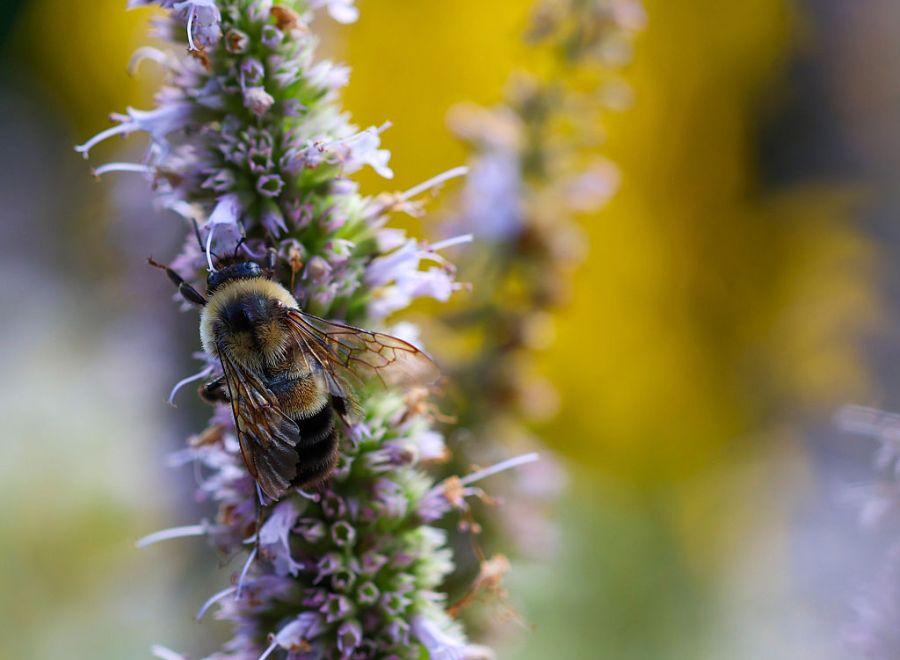
Rusty-spotted bumblebee, or Bombus affinis , is similar in appearance to many other bees. It is primarily yellow, with a black base and a spot or stripe between the wings. Workers and males have a completely yellow first abdominal segment, explains the U.S. Wildlife Service, while queens have a completely yellow first segment and black remaining segments.
However, their distinguishing feature is a rusty-brown spot located in the middle of the body, closer to the wings. This spot is present only in males and workers.
- An endangered rusty-spotted bumblebee collects nectar from an anise hyssop stem in Amanda Nugent's roadside garden on August 25, 2025, in Wilmette, Illinois. (Stacy Wescott/Chicago Tribune/Tribune News Service via Getty Images)
- HALLOWELL, ME - JANUARY 10: A rusty-spotted bumblebee is pictured Tuesday, January 31, 2017, in the archives of the Maine State Museum in Hallowell, Maine. (Staff photo by Joel Page/Portland Press Herald via Getty Images)
Since 2000, confirmed sightings of the rusty-spotted bumblebee have been reported in only 13 states: Illinois, Indiana, Iowa, Maine, Maryland, Massachusetts, Minnesota (which has declared it its state bee), North Carolina, Ohio, Pennsylvania, Tennessee, Virginia, and Wisconsin (plus Ontario, Canada). In 2017, it became the first bee species to be federally listed as endangered.
On Friday, the Fish and Wildlife Service announced that approximately 1.5 million acres of land in five of those states – Illinois, Iowa, Minnesota, Virginia and Wisconsin, as well as West Virginia – have been designated critical habitat for the rusty-spotted bumblebee.
The retirement age has changed this year: here's what you need to know.
The transfer of ownership rights to these areas is not affected by this decision. This move also does not create new preserves or protected areas. Instead, as the U.S. Wildlife Service explains, "the designation may impact development or other activities in which federal agencies participate in the planning, permitting, or implementation.".
The Natural Resources Defense Council called protecting these areas "vital to the survival of one of America's most vulnerable pollinators." In a press release published Friday, the organization said the U.S. Wildlife Service's announcement followed a lawsuit filed jointly by the Center for Biological Diversity and Friends of Minnesota Scientific and Natural Areas.
The press release said the lawsuit was filed after the U.S. Wildlife Service previously decided not to designate critical habitat for the rusty-spotted bumblebee.
We're experiencing the worst wheat harvest in decades. You'll soon see the consequences at the grocery store.
«"This decision is the culmination of more than a decade of fighting to protect the rusty-spotted bumblebee and the habitats it depends on," said Lucas Rhodes, senior attorney at NRDC. "Many of its native grasslands have been destroyed, so protecting its last remaining habitat from further destruction is simply common sense. These legal safeguards will help us ensure the best possible recovery for this once-common pollinator.".
Where did the bumblebee with the rusty spots go?
According to the U.S. Wildlife Service, this bee's population "experienced significant and rapid declines even before it was listed as endangered." The exact cause of the spotted bumblebee's decline remains unclear, but several factors are suspected.
«"These could include pathogens and parasites, pesticides and fungicides, habitat loss and degradation, beekeeping, as well as the effects of climate change and the characteristics of small populations," Jay Watson, a conservation biologist with the Wisconsin Department of Natural Resources, told Nexstar in 2024.
Vibrio season has arrived: how can you avoid becoming infected with this flesh-eating bacterial infection?
Previously, this bee could be found in Connecticut, Delaware, the District of Columbia, Georgia, Illinois, Indiana, Iowa, Kentucky, Maine, Maryland, Massachusetts, Michigan, Minnesota, Missouri, New Hampshire, New York, North Carolina, North Dakota, Ohio, Pennsylvania, Rhode Island, South Carolina, South Dakota, Tennessee, Vermont, Virginia, West Virginia, and Wisconsin.
Where was the bee spotted and where might it spread?
The rusty-spotted bumblebee's range has been reduced by approximately half. Confirmed sightings are now limited to an area stretching from Minnesota east to Maine and south to Iowa and Virginia.
Earlier this month, conservation officials updated a map showing the bee's current range, as well as areas where they believe the bee may return.
In which states is it cheaper to own an electric car, and in which is it more expensive?
The greatest potential for the rusty-spotted bumblebee to spread is found in southern, eastern, and northeastern Wisconsin; southeastern Minnesota; northeastern Iowa; northern Illinois; and along the West Virginia-Virginia border. Other small pockets of "high-potential zones" are scattered throughout Iowa, Wisconsin, Minnesota, Michigan, Indiana, Virginia, Massachusetts, and Maine.
What areas have been identified as critical habitat for bees?
Maps provided by the U.S. Wildlife Service show that regions in 33 counties are now designated critical habitat for the rusty-spotted bumblebee. Because it is primarily found in and around major Midwestern cities—Minneapolis and St. Paul, Chicago, Iowa City, and Milwaukee—many of these protected areas also fall into this category.
The table below provides information on counties that are currently at least partially planned to be protected from destruction or damage that could impact bee survival.
|
State |
Districts |
|---|---|
|
Illinois |
Boone, Ogle, Winnebago, McHenry, Lake, Cook, Kane, Lee |
|
Iowa |
Johnson |
|
Minnesota |
Ramsey, Scott, Dakota, Pierce, Washington, Carver, Hennepin, Rice, St. Croix, Olmsted, Winona |
|
Virginia |
Highland and Bath |
|
West Virginia |
The Greenbrier and Pocahontas |
|
Wisconsin |
Sauk, Iowa, Dane, Milwaukee, Ozaukee, Racine, Washington, Waukesha, Kenosha |
More detailed maps of these regions can be found here.
How to support bumblebees living in rust patches
Helping bumblebees affected by rust spot disease to restore their population is not much different from helping other pollinators.
Watson emphasized two ways to support the species: providing more floral resources and reducing pesticide use.
«"The best way to attract a variety of bumblebee species and other pollinators to your property throughout the season is to create a favorable habitat for them," Watson told Nexstar. This includes providing a variety of native flowers that bloom from spring to fall, as well as nesting and overwintering sites such as leaf piles, plant stems, branches, rodent burrows, and grassy areas.
Want to help pollinators this spring? An expert offers the following tips.
Research has shown that the best flowers for the rusty-spotted bumblebee include Dutch bumblebee, oriental bluebell, wild bergamot, culver's root, and species of milkweed. It's worth noting that the best pollinators may vary depending on the location.
«"By helping rusty-spotted bumblebees improve and create more habitat, we also help other pollinators whose numbers are declining, like the monarch butterfly," Watson explained.
© 2026 Nexstar Media, Inc. All rights reserved. This material may not be published, broadcast, rewritten, or redistributed.
For breaking news, weather, sports, and live video, visit The Hill.