








The 2026 World Cup qualifiers are a momentous occasion in football. While Russia's participation is hotly debated, the South American qualifying tournament sees Latin American football giants battling for coveted spots.
Qualification format
In 2026, three countries—the United States, Canada, and Mexico—will join forces for the first time to co-host a major football event. Furthermore, the 2026 World Cup qualifying rounds and main matches will feature a larger number of teams competing in the tournament. This is due to the growing global talent pool and the inclusive approach of the organizers, who will ensure that a wide variety of countries will have the opportunity to participate in the footballing competition.
The FFI expects revenue from the 2026 World Cup to increase by €600 million, despite additional operating costs and an increase in prize money.

A key aspect of the qualification process is the distribution of places across continents. While specific numbers may vary, the overall distribution follows a common pattern:
- CONCACAF (North America, Central America and the Caribbean) - given the joint hosting of the tournament, the confederation is ready to receive 7 places;
- AFC (Asia) - Asian teams will compete for 8 spots in the championship;
- CAF (Africa) - African countries will participate in a tough selection process for the top 9 places;
- CONMEBOL (South America) - South American teams will compete for 7 places;
- UEFA (Europe) - A wealth of football talent and a storied history will ensure the confederation has a significant 16 spots;
- OFC (Oceania) - Oceania traditionally has fewer places, but at this championship it will receive 1 quota.
Features of the UA qualifying tournament
The South American qualifying tournament is the Conmebol Confederation's 2026 World Cup tournament, which consists of a double-round robin system across ten national teams. Following a blind draw, each team plays each other twice: once at home and once away.
South America, with its storied football history, is traditionally awarded six direct berths, with the additional option for a seventh team to secure a spot through the intercontinental playoffs.
The football qualifying format ensures that only the most resilient and talented teams earn the right to represent the continent in the global spectacle. South American teams undergo a challenging journey, where the stakes are incredibly high and the competition is fierce.
Strong teams
As South American giants embark on the 2026 World Cup qualifiers, the weight of history, the expectations of millions, and the pure love of the game collide on the pitch. These teams aren't simply playing for qualification; they're playing to preserve the legacy of South American football, showcase the beauty of their game, and write new chapters in the annals of the legendary World Cup.
As the 2026 World Cup qualifying rounds unfold, South American clubs are showcasing the beauty and extraordinary technique of their game on the world stage.

Among the teams, the following stand out in particular:
- Brazil's Seleção, a five-time World Cup champion (1958, 1962, 1970, 1994, and 2002), boasts talents such as Pelé and Ronaldo. The team's goal is to maintain a balance between attacking flair and defensive solidity. The Seleção is looking to add another star to its iconic jersey.
- Argentina's "Albiceleste" team has won two World Cups (1978 and 1986). The team is closely linked to Lionel Messi, whose presence should ensure qualification. Managing the pressure and finding the right combination of talent on the pitch is also crucial.
- Uruguay's Charrúa team are two-time champions (1930 and 1950), whose history began with victory at the very first World Cup. The team's goal is to compete with larger countries and harness the collective spirit that has defined Uruguay's successful campaigns in the past.
Stars and emerging talents meet in South America's 2026 World Cup qualifiers. These players aren't just competing for individual accolades, but are also actively influencing their countries' qualifications for the 2026 World Cup.
Who will be interesting to watch:
- Lionel Messi, Argentina - One of the greatest footballers of all time, noted for his graceful dribbling, precise passing and intelligent shooting;
- Neymar, Brazil - A flamboyant striker known for his great skill, flair and goal-scoring ability;
- Luis Suarez, Uruguay - the national team's sniper, an experienced veteran, is distinguished by his tenacity, goal-scoring instinct and penetrating play in front of the goal;
- Erick Pulgar, Chile - A young midfielder known for his winning spirit and vision;
- Ezequiel Barco, Argentina - A rising star of Argentine football, known for his talent, creativity and versatility;
- Vinicius Junior, Brazil - a young striker with incredible speed and skill.

Analysis of match dynamics
Brazil will face a potential challenge from Paraguay, a team known for its defensive resilience. The clash between the former's attacking prowess and the latter's solid defense could prove decisive.
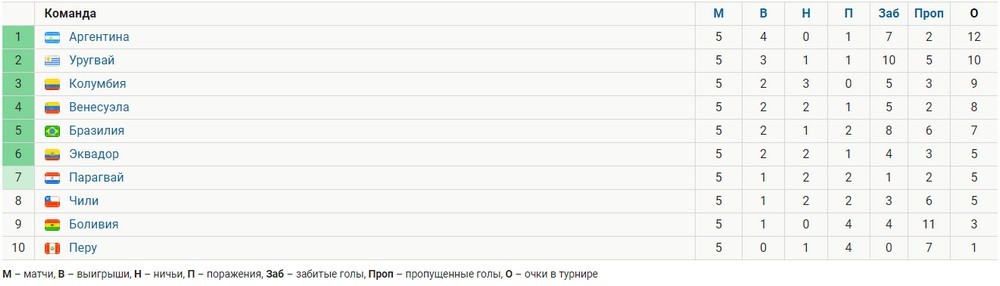
Argentina is considered the tournament's headliner and is a firm favourite, but Uruguay, with its historical past, will pose a number of challenges for the team.
An interesting match between Colombia and Chile is coming up – the tactically structured midfield and attacking talent of the former against the defensive reliability of the latter will make this clash a highlight.
Uruguay's clash with Venezuela and Bolivia's determination to disrupt the established order of qualification for the world stage are turning the qualifying round into a melting pot of football narratives. Ecuador, due to a scandal at the 2022 Games and the loss of three points, remains at the bottom of the standings.
2026 World Cup qualifying calendar, match schedule, and match results. Data from Sports.ru.
As South American teams head to the qualifying tournament and ultimately to the 2026 World Cup, they carry not only the weight of expectations but also the collective dreams of nations. The significance of the South American qualifying tournament extends beyond just determining the participants. As the world prepares to witness a magical event in 2026, the Latin American teams are poised to leave an indelible mark, adding another chapter to their storied football history.