






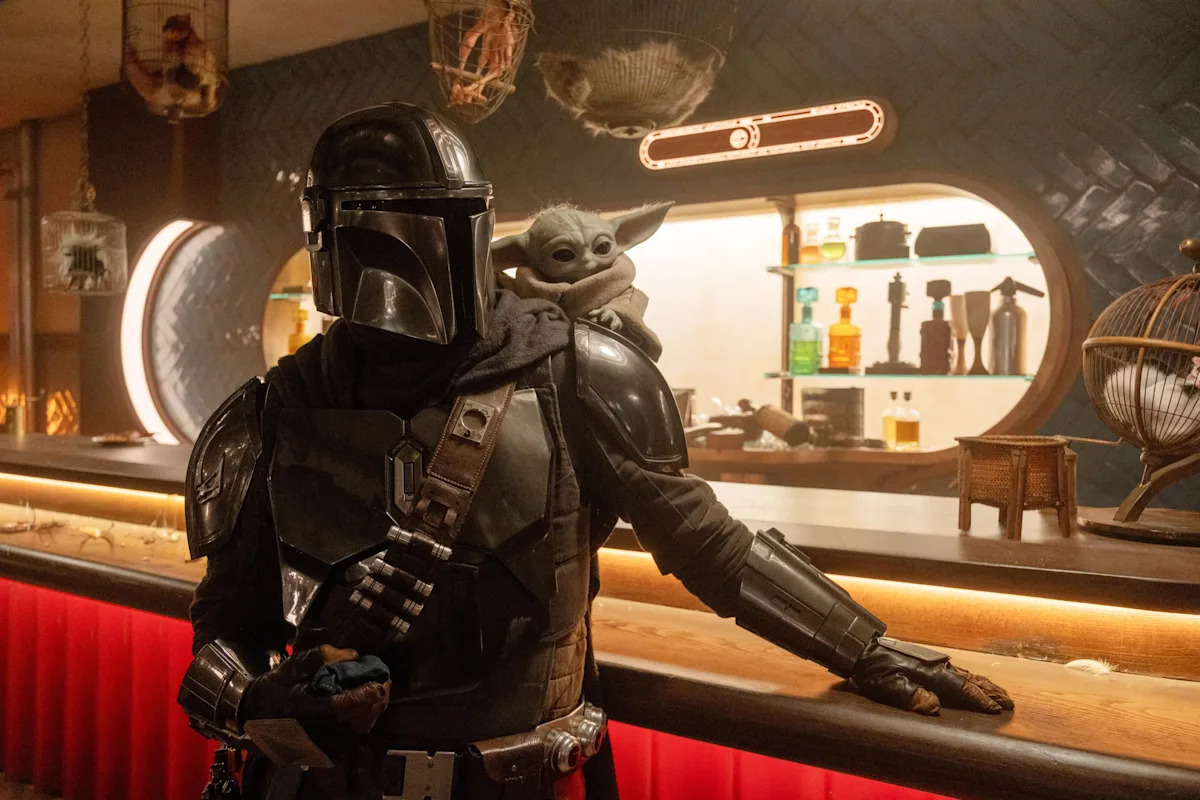
«"'The best tool for the job' has always been the show's credo," John Knoll, visual effects supervisor on Star Wars: The Mandalorian and Grogu, told IndieWire. "On the one hand, director Jon Favreau is a big fan of handcrafted visual effects." He's been working on Star Wars films as a visual effects supervisor since The Phantom Menace.
Favreau's sci-fi film (which has grossed $176 million worldwide to date) combines virtual production techniques with all the tricks of old-school Hollywood special effects. Knoll explained, "John's philosophy is that it's okay when you see a puppet, that you can tell it's a puppet. When you have a character in a rubber mask, that's okay. And if you're looking at a miniature or stop-motion animation, it's okay that you can tell, because John thinks that's part of the charm.".
Knoll won an Emmy Award for his visual effects work on Favreau's television series "The Mandalorian," which was filmed primarily in a 110-foot ellipsoidal "LED volume" in Manhattan Beach that creates digital environments by projecting high-resolution images onto screens that span the entire surface of the building.
When Disney decided to expand the series into a standalone feature film about intergalactic bounty hunter Din "Mando" Djarin (Pedro Pascal) and his assistant Grogu, aka Baby Yoda, Knoll set to work on their spaceship, the Razor Crest. He recalled, "From the very beginning of the series, I wanted to have an LED volume for shooting miniatures, so for this film, we built an 8-by-8-foot LED cube with one exposed face to get accurate reflections and realistic lighting on our characters and sets while we were shooting. I had a gorgeous 48-inch raw metal model of the ship, so if we were flying through clouds, we made sure you could see the clouds reflecting off the side of the ship. For the same reason, we shot Mando in an LED environment rather than in front of a bluescreen to get all those reflections on his polished armor.".
«The Mandalorian and Grogu LUCASFILM LTD
Working with animation production supervisor Hal Hickel, who oversaw digital characters including Rotta the Hutt, and the puppeteers at Legacy Effects, who were responsible for Grogu, Knoll created a virtual travelogue of exotic planets, including the snow-capped mountains that serve as the backdrop for Mando and Grogu at the beginning of the film.
«"We knew one thing: it was a mountainous area with pine forests, so we did a lot of scouting. Andrew Jones, our production designer, identified an area north of Vancouver called Mount Waddington as a real location we could base the environment on. My fellow supervisor, Justin van der Leck, went there and did a four-day helicopter shoot, capturing thousands and thousands of shots. Most of the images you see at the beginning of the film are of Mount Waddington.".
Other sets were constructed as large-scale physical sets, including Shakari's cityscape, reminiscent of the set from Blade Runner. "We found a large industrial warehouse in downtown Los Angeles and built a main street there," Knoll said. "We can see for miles, and instead of installing a blue screen at the end of that street for a [digital] extension, we installed LED screens at both ends of the street, placed traffic cameras, and thus created an extension of the street. It was a clever use of [the LED space], since it's not a circular set with a 110-foot diameter.".
In Shakari, Mando and Grogu meet the gregarious Hugo, a four-armed food truck vendor voiced by Martin Scorsese. Hugo was ultimately created using CGI, but during production, Knoll wanted a real actor to temporarily fill the role.
«"When working with artificial characters, Hal and I are firm believers in bringing in an actor to play the role on set whenever possible. It helps the camera operators frame the shots, the other actors have someone to act with, and the editors cut the scene. So, Misty Rojas, a short woman, played Hugo. We didn't know Marty would be voicing the character until after the scene was shot and John had sealed the deal. God bless him—Marty delivered a brilliant performance, despite all the hesitation and grimaces. The camera was trained on Marty while he was voicing the character, so our guys were able to include some of his gestures and facial expressions.".
In one of the film's most thrilling chase scenes, Mando races across dunes (based on the Magdalen Islands in Nova Scotia) in a low-flying speeder, pursued by bandit droids. According to Knoll, time-tested special effects were used to create the vibration and bounce. "The full-size speeder prop was supported by what we called a rubber ring structure—a very simple, spring-loaded mount that our lighting crew could bounce around to give it some bounce.".
«The Mandalorian and Grogu Lucasfilm Ltd / François Duhamel
To dramatize the film's climactic battle, where Mando battles two very tall droids, Knoll enlisted the legendary Phil Tippett, an Oscar winner for Jurassic Park, and his stop-motion animation team to employ a technique immortalized back in 1933. "It's just like King Kong," Knoll noted. "The droid puppets were 12 or 14 inches tall and had three arms, lots of movable armor plates, multiple points of articulation. Tippett's team said it was the most challenging thing they'd ever done.".
The Star Wars canon served as inspiration, but sometimes the iconography needed updating, something Knoll realized a few years ago when he tried to revive the original stormtrooper look for Rogue One: A Star Wars Story.
«"We went to George's archive, where he keeps a lot of the original Star Wars costumes," Knoll said. "Seeing the Stormtrooper helmets in person is a bit shocking because they look like high school crafts. It was clear these helmets weren't going to last, so we made brand new ones, much better quality.".
Previously, no one complained about helmets looking unnatural, but now, as Noll noted, «with digital cameras and more advanced projection systems, you can see things much more clearly than before.».
This relatively modest-scale Star Wars film fits neatly into the tradition of pulp-style entertainment films like Flash Gordon and Tarzan, which George Lucas famously admired in his youth.
«"I'm glad this movie is generally viewed in the spirit it was intended to be," Knoll said. "John wanted to make a kind of old-fashioned adventure. 'Oh, do I really have to do a ton of homework to enjoy this movie?' No, it's just a fun adventure you can watch without spending 40 hours preparing.".
Star Wars: The Mandalorian and Grogu is now in theaters.
Subscribe to the Indiewire newsletter. For the latest news, follow us on Facebook, Twitter, and Instagram.