






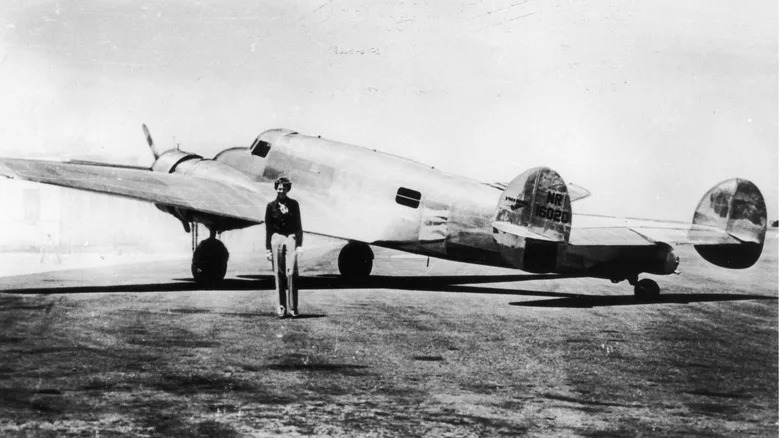
The disappearance of Amelia Earhart and her co-pilot, Fred Noonan, somewhere in the Pacific Ocean is one of the greatest mysteries of the 20th century. According to Purdue University, in October, a team of 16 researchers will travel to the remote island of Nikumaroro to determine once and for all whether an object that has appeared periodically on satellite images for years is the wreckage of Earhart's Lockheed Electra 10-E.
Since Earhart and Noonan's disappearance, there have been numerous theories about what happened to them. The prevailing theory was that they crashed in the ocean while en route to Howland Island on July 2, 1937, during an attempt to circumnavigate the globe. Wreckage of a plane that could have belonged to Earhart was found near Howland Island, but this has never been confirmed. Some believe Earhart was captured by the Japanese and executed as an American spy, although the evidence does not appear to support this theory.
One intriguing theory holds that Earhart survived a soft landing on Nikumaroro Island and even made several emergency radio transmissions shortly afterward. The azimuths of her final radio transmissions converge near the island. Artifacts dating to the 1930s have been found there, including a shoe, a jar of freckle cream, a compact powder case, and a medicine bottle, all of which could have belonged to Earhart. Human bones found in the 1940s could have belonged to Earhart, judging by her height and build, but they have been lost, making modern DNA testing impossible. There is still no conclusive evidence linking Earhart to Nikumaroro Island.
Read also: 10 of the strangest Boeing planes ever built
Taraia object
Purdue University/YouTube
The most compelling evidence supporting the soft landing theory is the so-called Taraia object. It appeared on satellite images of Nikumaroro Island beginning in 2015, after being discovered by a strong storm, and resembles what could be the wreckage of Earhart's plane. By 2020, it had sunk back into the ocean, but its location appears to have remained unchanged. In 1991, researchers from the International Group for Historic Aircraft Recovery (TIGHAR) discovered what they believe is part of Earhart's plane on Nikumaroro Island. Its size and shape match the skin panel installed in Miami at the start of Earhart's fatal flight.
The TIGHAR website cites numerous pieces of evidence supporting the theory that the Taraya object is Earhart's plane. However, TIGHAR founder Rick Gillespie has changed his mind in recent years. He recently told NBC News that he believes the Taraya object is not Earhart's plane, but a coconut palm. "We've looked at the site, and there's nothing there," he said on the Today show in 2025. On the TIGHAR forum, Gillespie shared an email exchange with expedition leader Richard Pettigrew:
Gillespie: "If I thought someone needed to go and see it, I would. We've done it before. In 2002, the lead scientist for the New England Aquarium's Niku expedition saw what he thought was an airplane wheel in the shallow water off the coast of Tatiman Channel. In 2003, we sent a small expedition to check it out, but by then it had disappeared, apparently washed away in a storm.".
Pettigrew: "I ask that you grant us your blessing to return to the island to determine once and for all what the Taraia object truly is.".
Gillespie: "I don't believe there's enough evidence of debris in Tarai to justify the expense of an on-site investigation. I can't say otherwise.".
Pettigrew: "I know people will ask you what you think of our plan... I hope you will entertain the possibility that we are right, and express your hope (if not expectation) that traces of the Elektra may indeed be found.".
Gillespie: "I would never object to responsible archaeological exploration of Niku.".
As Gillespie notes, conditions are constantly changing. A researcher could see a wheel in 2002, but by 2003 it had washed away. What looks like plane wreckage became visible in 2014, but by 2020 it had sunk again. The coastline itself has also changed significantly over this time due to storms and erosion. Essentially, the only way to determine whether an object in Tarai is an airplane or a coconut palm is to make the long trip to Nikumaroro Island and look there.
Flight delays
Bettmann/Getty Images
If this sounds like a rehash of Purdue University's latest announcement about an expedition to Nikumaroro Island, it is. The research team discovered they lacked the political connections in the Republic of Kiribati, of which the island is a part, to secure permission to travel. It took a year of networking and meetings to secure government approval. Now that it has been granted, the expedition is making concrete plans:
Some expedition members will depart from the Amelia Earhart Terminal at Purdue University Airport on October 3 and join the full 16-person team on Tarawa, Kiribati, on October 6. The team, consisting of archaeologists, filmmakers, logistics, diving, and safety specialists, as well as Kiribati representatives, will depart Tarawa by sea on October 7, sail approximately 830 nautical miles to Nikumaroro, and then spend several days on the small island participating in the search operation.
The team will spend time on the ground, documenting the site as it currently stands. Since the Taraia object has sunk below the surface, researchers will search for the aircraft using sonar and magnetometers. They will then send a hydrosonde through a thin layer of silt to establish physical contact with the object. Afterward, they will use a hydraulic dredger to carefully extract it and identify it. Or it could simply be a fallen coconut palm shaped like an airplane. As Pettigrew put it, "The only way to answer this question is to go to Nikumaroro, inspect the Taraia object in person, and follow the evidence wherever it leads.".
Want more like this? Subscribe to the Jalopnik newsletter to get the latest automotive news delivered straight to your inbox, and follow us or add us to your preferred search engines in Google.
Read the original article on Jalopnik.