






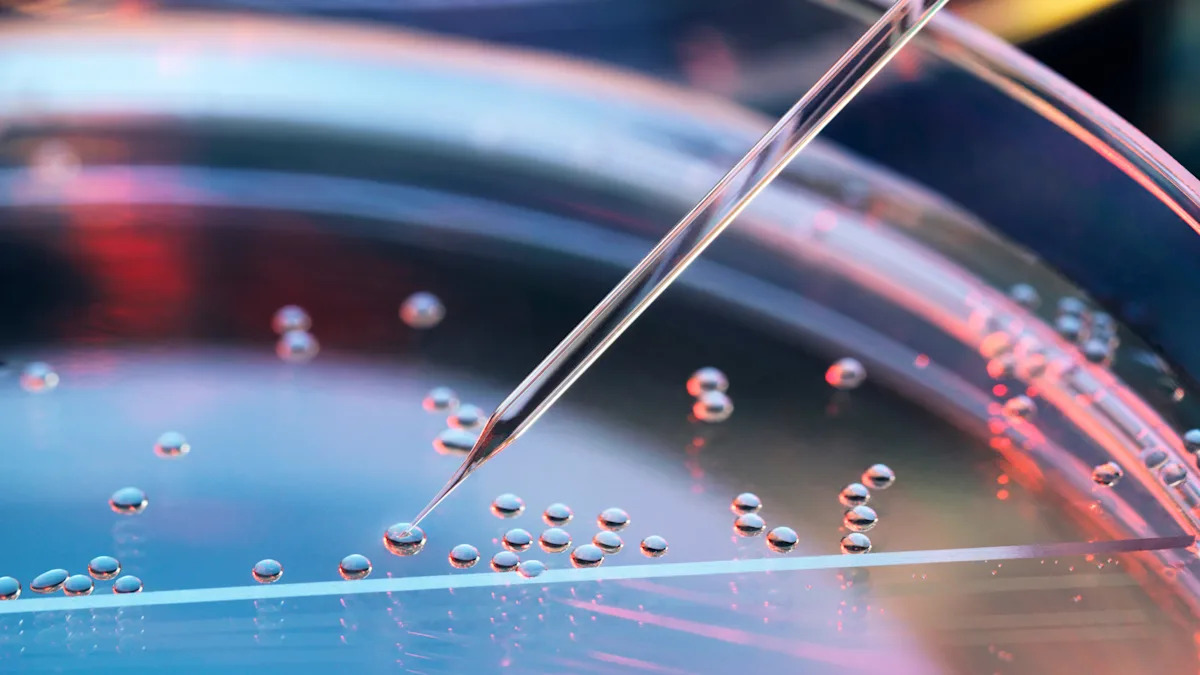
The Chinese Academy of Sciences has announced a surprising and potentially controversial new project to test the development of "artificial human embryos" in space.
What is an artificial human embryo? It is a collection of human cells arranged in such a way as to closely mimic an early-stage embryo, but without the ability to develop into a real human fetus.
This critical distinction limits the potential for medical data but makes it important for research that could be hampered by ethical concerns surrounding experiments on human cells. These multicellular complexes contain the "majority" of cell types found in the embryo during the earliest stages of development.
There are actually two different types of artificial embryos: one that lasts for about two weeks of development, the other that lasts for about three weeks.
cargo aircraft carrier Tianzhou-10, Tiangong station
China's Tianzhou-10 cargo ship approaches the Tiangong space station. (Photo: Han Qiyang/Xinhua)
After five days of cultivation, each of these samples will be frozen and analyzed both on board the station and on Earth. The Chinese Academy of Sciences has not specified when this will occur, meaning it may already have happened.
The goal of the experiment is to compare the development of these human analogues with that of those grown similarly on Earth. It is currently unknown whether embryonic cells can develop without the directed force of gravity.
Yu Leqian, a professor at the Institute of Zoology of the Chinese Academy of Sciences and the project's leader, says the artificial embryos "were sent into space to investigate whether the sudden absence of life that has evolved under the influence of gravity for hundreds of millions of years would have an impact.".
The consequences may be minimal or extreme, negative or possibly positive; some science fiction even predicts that some people will prefer develop or go through certain stages of life in zero gravity.
Tiangong Station in China
A rendering of the Tiangong station in China, where this experiment is currently underway. Source: CMSA
Weightlessness can easily affect the early development of a fetus, raising concerns even in the case of an accidental pregnancy in space. Although NASA has never confirmed any cases of sexual intercourse in orbit, several married couples have gone into space, and there were numerous rumors of Soviet "sexual experiments" in the early days of the Russian space program.
However, recent research is not particularly encouraging, and it's worth remembering that weightlessness is only one aspect of space that can impact development. One recent study analyzed the data and concluded that space (in particular, its tendency toward high levels of radioactivity) is "inherently hostile" to human life.
Another study found that microgravity causes real problems with sperm motility and fertilization, which could significantly impact the chances of conception in space.
If space turns out to be truly challenging, there may be solutions. Fetal development could take place in the station's rotating components or even in more modest, low-speed centrifuges, with shielding helping protect it from stray cosmic rays.
However, with private space missions sending more and more civilians into space each year, it seems inevitable that some couple of millionaires with active lifestyles will find a way to test this hypothesis the old-fashioned way.