








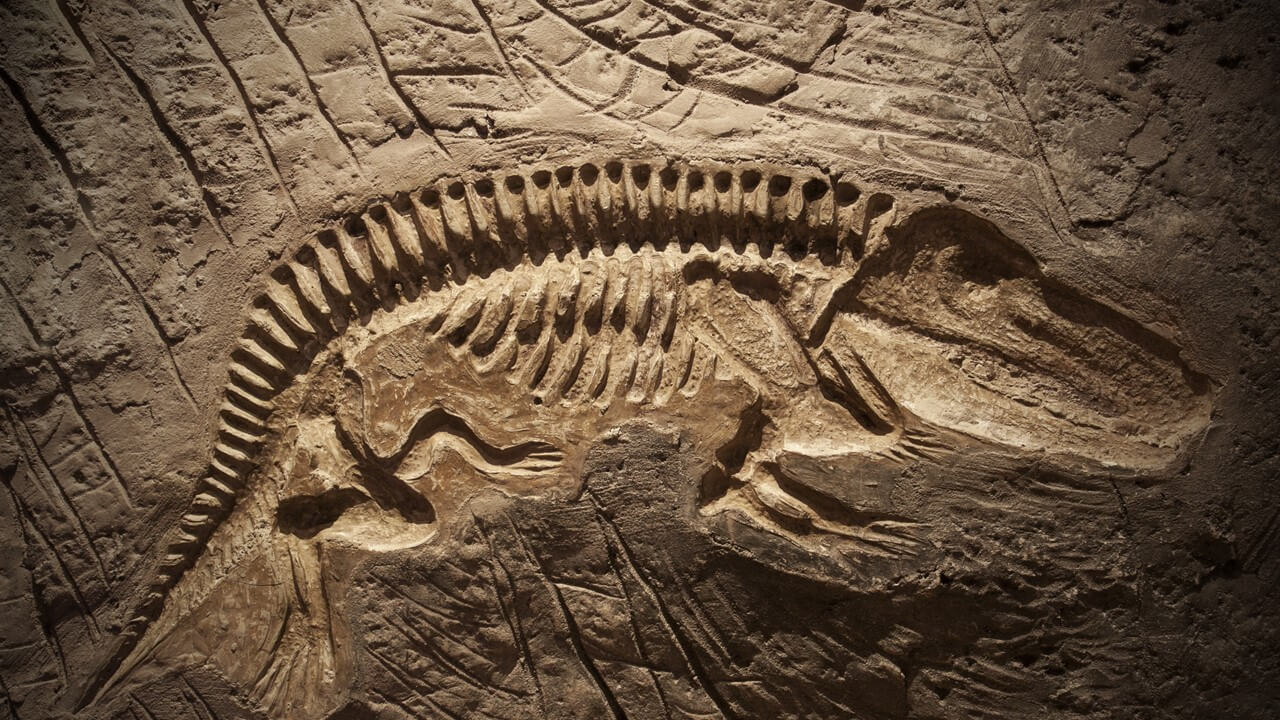
«"Who cares about these fossils except paleontologists?" a reader who isn't easily impressed might think. But don't be so hasty. Fossils aren't just "boring rocks"; they're also a kind of cast of the primordial world. And sometimes they contain very interesting creatures, which we'll tell you about and show you in photographs in this article about the top 10 most amazing fossil finds.
10. A dragon hunts a dinosaur.

Dinosaurs once ruled the Earth. Yet they had to share the planet with creatures that, given the chance, would have bitten off a chunk of these terrifying lizards, big or small.
The first specimen in our list of amazing fossils shows how a snake from the genus Sanajeh indicus (which lived about 67 million years ago) decided to take a gastronomic tour of a dinosaur nest.
The snake, measuring 3.5 meters in length, was found near a clutch of sauropod dinosaur eggs. Other fossils found nearby show other Sanajeh indicus snakes coiled around other eggs, suggesting that baby dinosaurs were their favorite delicacy.
9. The parasite escapes from its dying host.

Parasites are amazing, albeit very unpleasant, creatures. Instead of searching for food, they are perfectly adapted to stealing nutrients from other creatures. Sometimes they move inside their hosts to feast on something particularly tasty or to find safety.
When a parasitic nematode senses its host is dying, it often attempts to escape. This amber forever captures such an event. When the tiny cicada found itself in thick tree sap, the worm, which had almost completely filled its body cavity, began its journey out. Unfortunately for the parasite, it was trapped in the sap, just like its host. Both died 35 million years ago.
8. Turtles during mating season

For two unfortunate turtles, the moment of mating was more than just a "little death." It seems this pair loved extreme sports; otherwise, how can one explain their decision to mate while swimming in a volcanic lake, or perhaps they accidentally fell in?
Before research determined the sex of these turtles, some scientists speculated that the turtles had died in some kind of strange fight.
7. Dinosaur Fight
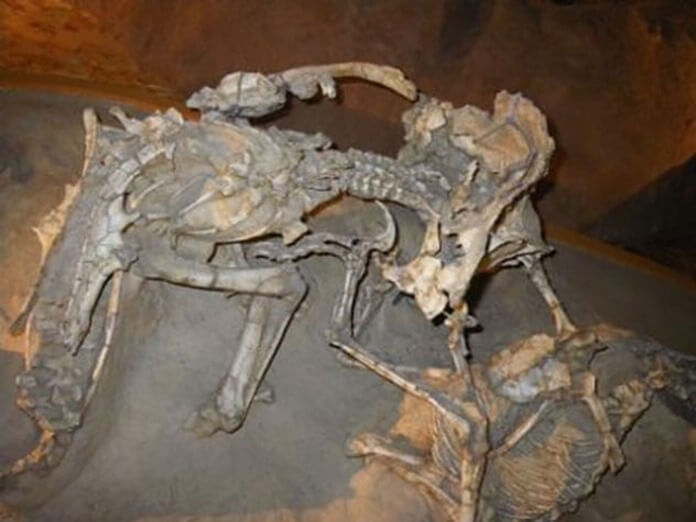
Velociraptors weren't quite the threat they posed in Jurassic Park. Firstly, they were small (up to 1.5 meters long, 40-70 cm tall), so it's unlikely they would have hunted humans, at least not alone. However, the long sickle-shaped claw on their foot made them dangerous opponents for creatures they could handle.
For one Protoceratops that lived about 74 million years ago in ancient Mongolia, an encounter with a Velociraptor was fatal.
The Velociraptor's claw sank into its victim's throat, which would likely have been fatal. But the Protoceratops retaliated, apparently biting its attacker on the paw with such force that it fractured the Velociraptor's bones.
Scientists believe that while these dinosaurs were fighting for their lives, a large land mass (presumably a sand dune) suddenly collapsed on them.
6. Common burrow

The first animal discovered inside the 250-million-year-old burrow was a proto-mammal called Thrinaxodon. This animal is believed to have been the burrow's occupant. But right next to it was an amphibian called Brumistega.
Since Brumistega is precisely the kind of animal that the predatory Thrinaxodon would prey on, these two were unlikely to have been den mates. The key to understanding why they shared a burrow was the injuries on the amphibian. Two bite marks on the top of its head indicated it had been attacked, but the bite marks were not consistent with Thrinaxodon.
Researchers believe the Thrinaxodon was likely asleep or in a state of torpor when the wounded Brumistega crawled into its burrow. Unfortunately, both denizens of the burrow were trapped in the murky mud when a sudden flood buried them alive.
5. The hunter became the prey
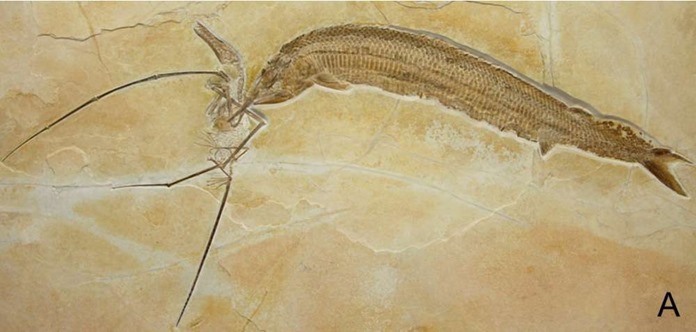
When the pterosaur caught a small fish, a second, much larger fish burst out of the water and grabbed the pterosaur itself. A remarkable incident that ended fatally for all involved.
4. Traces in Laetoli

The discovery of footprints at Laetoli, Tanzania, in 1978 provided compelling evidence that our distant ancestors walked on two legs at least 3.7 million years ago.
These tracks were most likely left by an Australopithecus afarensis, which walked through a layer of ash following a recent volcanic eruption. Light African rains likely moistened the ash, turning it into clay and preserving it perfectly for science.
3. Prehistoric Pompeii
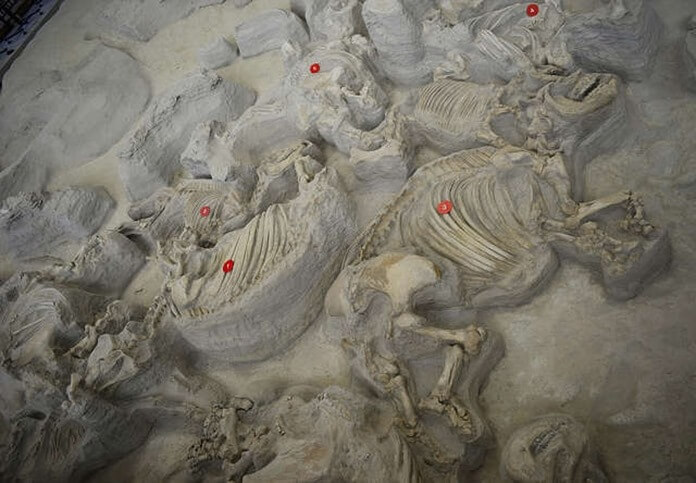
Compared to many of the other entries on the list of the most unusual fossils, this one is still a baby, but what it lacks in age, it makes up for in how incredible it is.
Around 12 million years ago, a volcanic eruption killed more than 200 animals, including rhinoceroses, early horses, long-necked camels, and cranes. Their perfectly preserved and fully articulated skeletons are still being excavated 40 years after they were first discovered.
2. A female ichthyosaur gives birth on land.
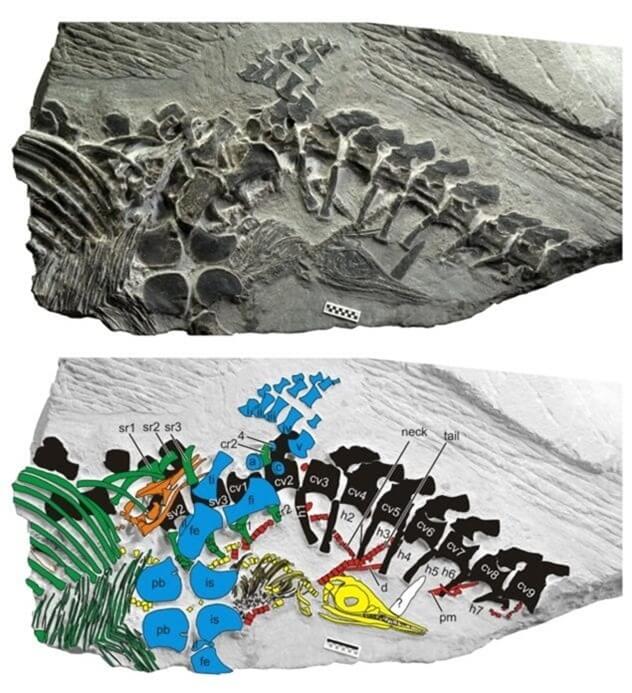
The moment of birth can be quite perilous, and there are numerous fossils of unfortunate mothers who died during childbirth. Sometimes these fossils can reveal a great deal about the lives of these creatures from birth to death.
For example, many fossils of ichthyosaur mothers and their young have been discovered immediately after birth. Most of these show the young emerging from their mothers tail-first, suggesting they were born in the sea. However, one of the first ichthyosaurs, which lived 250 million years ago, was discovered giving birth to young that hatched head-first.
Since head-first birth is only found in terrestrial animals, this suggests that the first ichthyosaurs crawled onto land to give birth. Subsequently, ichthyosaurs evolved into creatures that lived exclusively in water.
1. Flea with plague bacteria

One of the strangest fossils is approximately 20 million years old. One of the world's leading amber researchers, American paleoentomologist George Poinar Jr., and his colleagues from Oregon State University discovered it in amber from the Dominican Republic.
Dominican amber is one of the most important types of amber, often nearly transparent and obtained from the resin of the extinct Hymenaea protera tree. Much of Dominican amber preserves the remnants of Neotropical forests that existed in this region 25 to 20 million years ago.
Numerous insects had already been found in this amber, so it wasn't a big surprise to find a flea in it as well. However, the discovery of the deadly plague bacterium in this creature's body was quite a surprise to the researchers. Poinar claimed that this microbe may be the ancestor of the modern plague bacillus, or Yersinia pestis. He further stated that several strains of the disease evolved and became extinct over time, and, as interesting as the new find was, its true significance remained a mystery at the time.
However, he did mention that the bacteria was present in a dried drop of blood in a flea's proboscis. This suggests that the plague's mode of transmission was the same as that seen during the worst pandemics in world history.
The find dates back to the early Miocene, a time when mammal diversity began to rapidly increase. At that time, the Dominican Republic was likely covered in dense tropical forests, and this plague flea had the misfortune of becoming stuck in fresh resin.