








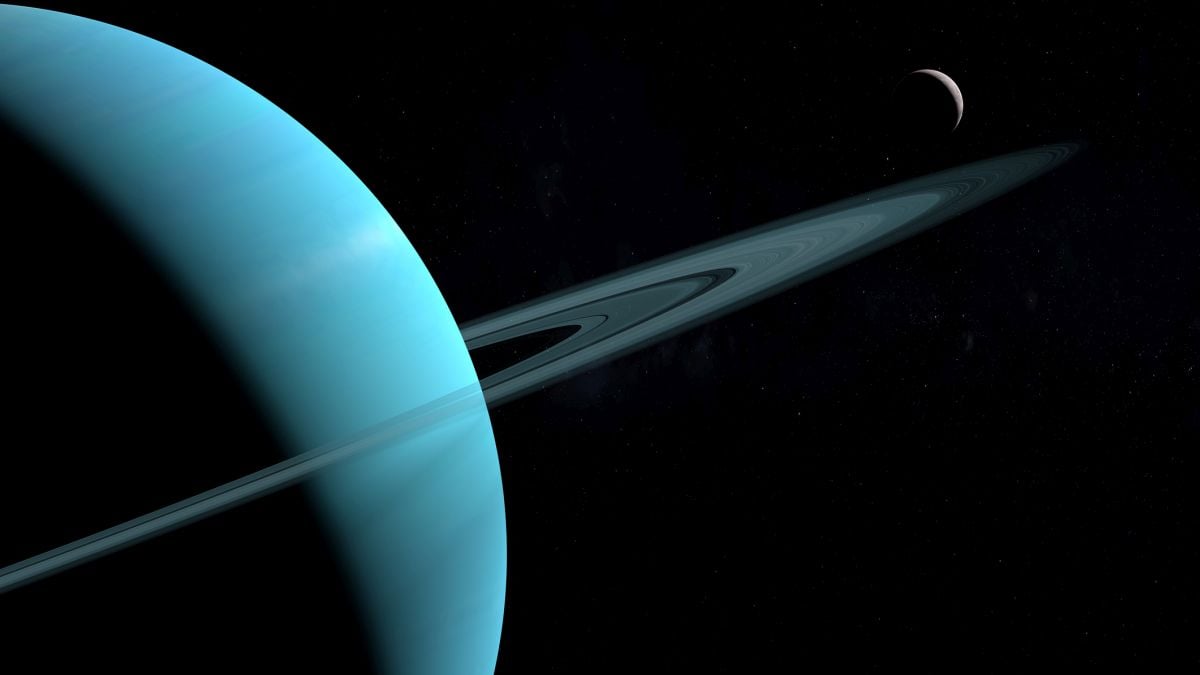
The solar system is one of those constant components of human existence that brings comfort.
No matter what else happens, the planets will continue to orbit the Sun, creating predictable patterns in the sky, lining up in a neat row along the plane of the system's orbit.
But perhaps things were not always so orderly.
According to one of the most popular models of the early Solar System, the Nice model, our corner of the galaxy may have once had two more ice-rich planets, as it contained four ice giants instead of the two that exist today – Uranus and Neptune.
However, a new test of this idea has revealed a potentially serious problem.
By modeling the turbulent period when these hypothetical worlds would have been ejected from the solar system, astronomers found that the model suggests a much more turbulent history for Uranus's moons than their current appearance suggests.
This image of Uranus, its rings, and the moons Rosalind, Puck, Belinda, Desdemona, Cressida, Bianca, Portia, Juliet, and Perdita was taken with the Joint Wide-Sight Telescope (JWST). (NASA, ESA, CSA, STScI)
This discovery suggests that the story of the evolution of the Solar System to the clockwork precision we know today is still a work in progress.
«"These results have three potential implications," the researchers, led by astrophysicist Matthew Clement of Johns Hopkins University, wrote in their paper.
First, during this turbulent period, Uranus's satellites became so unstable on several occasions that they collided.
Secondly, the current version of the Nice model needs to be revised; or, thirdly, "the Solar System is the result of a rather unlikely evolution of instability, which would have negligibly implied no deep collisions between Uranus and other giant planets," the researchers write.
The nascent Solar System is believed to have been a much more chaotic place than it is today. As giant planets migrated through the debris disk, their gravitational interactions could have destabilized the entire outer Solar System.
To try to explain the gravitational chaos that created real chaos in the solar system, scientists developed the Nice model, published in 2005.
YouTube thumbnail
In its modern interpretations, the Nice model suggests that the Solar System may have started with one or even two additional ice giants, and then all six giant planets migrated from their original positions, causing instability as they went.
The four giant planets still in our solar system eventually settled into their current orbits, while the other two disappeared into thin air.
For the period known as the Late Intense Bombardment, the large-scale architecture of the Solar System, and Jupiter's extensive collection of Trojan galaxies, the Nice model works remarkably well.
But Clement and his colleagues wanted to know: how does this affect the solar system at a more detailed level?
They created a simulation to test what would happen to the moons of Jupiter and Uranus in two versions of the Nice model: one with an extra ice giant, and one with two.
The team modeled collisions based on a "full spectrum" of possible initial conditions in the outer Solar System, and generated more possible outcomes than previously considered.
What Uranus might look like from the surface of its moon, Ariel. Although Uranus is highly inclined relative to its orbit, all of its large inner satellites orbit in the same equatorial plane. (Mark Garlick/Science Photo Library/Getty Images)
And here's where things get interesting: most simulations destabilized Uranus's moons to the point that they collided, were ejected, and experienced significant orbital changes.
Jupiter's moons were in a much better position, but it turned out that maintaining the integrity of the lunar systems of both planets was surprisingly difficult.
Researchers have found only one scenario in which the moons of Jupiter and Uranus consistently experience the same instability.
If the Nice model is correct, we are left with two main options.
Either the Solar System took a highly unlikely evolutionary path, leaving Jupiter and Uranus alone, or Uranus's current system of satellites arose as a result of collisions and gravitational chaos.
The latter suggests that Uranus was impacted at least twice: the first event caused its sideways tilt, and the second caused Nice Model instability, which upset the balance of its satellites.
Subscribe to ScienceAlert's free fact-checked newsletter.
Of course, the third option is that the Nice model is incomplete, which wouldn't be a big surprise, since it tries to reconstruct events that happened 4 billion years ago.
On the topic: For the first time, scientists have recorded X-ray radiation emanating from Uranus.
«"It is highly likely that none of the instability models described in the literature contain the precise collision sequences needed to accurately reproduce all aspects of the Solar System," the researchers write.
«"While it is certainly possible that all four original regular satellite systems in the outer Solar System were unharmed by planetary impacts, our results strongly suggest that this is not the case.".
The results obtained should serve as an incentive for further research aimed at studying the consequences of different collision trajectories for our Solar System.
The results of the study were published in the journal Icarus.
ScienceAlert articles are written, fact-checked, and edited by humans; they are never generated by artificial intelligence. Don't miss a single article; subscribe here.
Related news
-
«The "heartbeat" of our Sun has been changing mysteriously for 40 years.
-
It's official: NASA has announced the end of its mission to Mars using the Mars Exploration Venture (MAVEN) spacecraft.
-
Astronomers have discovered a strange pattern in the winds of alien worlds.