








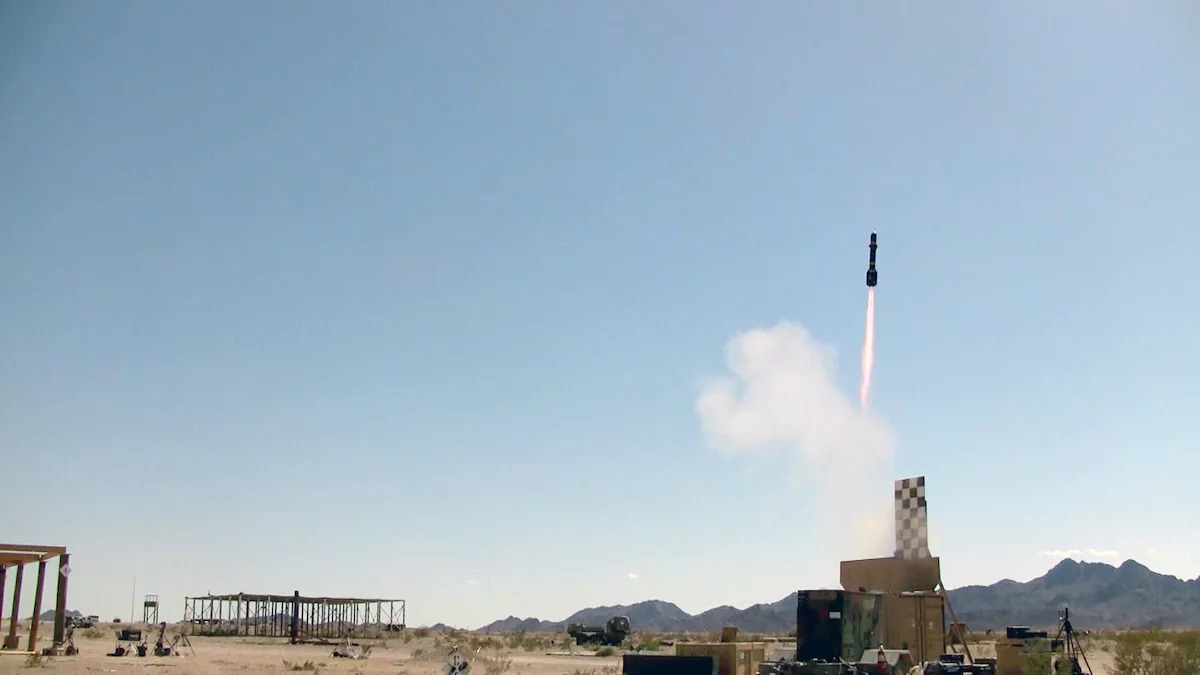
Lockheed Martin successfully shot down a Group 3 unmanned aerial vehicle (UAV) designed for a single-attack mission using a Joint Air-to-Ground Missile (JAGM) fired from a GRIZZLY launcher. The test integrated the company's Sanctum anti-UAV combat management system with Fortem R-40 radars for detection, tracking, and engagement of targets.
As Lockheed announced on June 3, the live-fire demonstration involved the use of Sanctum radars, software, and a launcher to destroy a target at the Yuma Proving Ground in Arizona. Lockheed said it integrated the system and completed the live-fire testing in less than 45 days.
The Fortem R-40 drone is the result of Lockheed's counter-drone partnership, which the company strengthened in April by investing $25 million in the Utah-based firm to more closely integrate its radars and interceptors into the Sanctum system.
The test follows GRIZZLY's first live-fire test in March, when Lockheed fired a Hellfire missile from the same canister during a vertical launch test at Yakima Training Center, Washington, six months into the program.
The launcher is designed to fire both Hellfire and JAGM missiles and borrows design elements from Lockheed's M299 launcher. While the launcher's operability was demonstrated in March, June tests added the capability to launch JAGMs and a full detection-track-kill chain against a combat target—a Group 3 unmanned aerial vehicle (UAV), a class defined by the Department of Defense as UAVs weighing up to 1,320 pounds, flying below 18,000 feet and flying at speeds below 250 knots.
«"Building on existing prototype architecture, the GRIZZLY system enables users to deploy the Sanctum C-UAS system ready to fire without the need for extensive infrastructure and logistics. By integrating advanced sensor, combat management, and missile technologies, Lockheed Martin delivers decisive counter-UAS capabilities that meet our customers' needs for flexible and distributed combat effectiveness," the company stated.
The GRIZZLY system accommodates up to eight missiles in a 10-foot shipping container, features tool-less reloading, and can be operated from ground stations or ships. Wireless communication between the radars, battle management system, and launcher allows for rapid deployment. Lockheed marketed the system as a low-cost way to protect forward bases, key facilities, and vessels.
The maritime proposal aligns with the Navy's interest in containerized weapons that can be carried by unmanned surface vessels to increase firepower at sea, a demand signal Lockheed cited when it first unveiled the launcher in March.
«The ability to integrate the proven GRIZZLY launch architecture with the Sanctum battle management system in an accelerated manner demonstrates how Lockheed Martin is leveraging battlefield innovation and cross-program collaboration to rapidly deliver layered defense capabilities to warfighters,» said Randy Crites, vice president and general manager of Lockheed Martin’s Advanced Programs Division.
«"This test demonstrates a rapid, low-cost, and modular point defense solution that can be deployed on land or sea platforms within days," added Paul Lemmo, vice president and general manager of Lockheed Martin's Sensors, Actuators, and Mission Systems business.
The demonstration comes as the Pentagon and its allies seek to build more effective, layered defenses against the growing drone threat.