






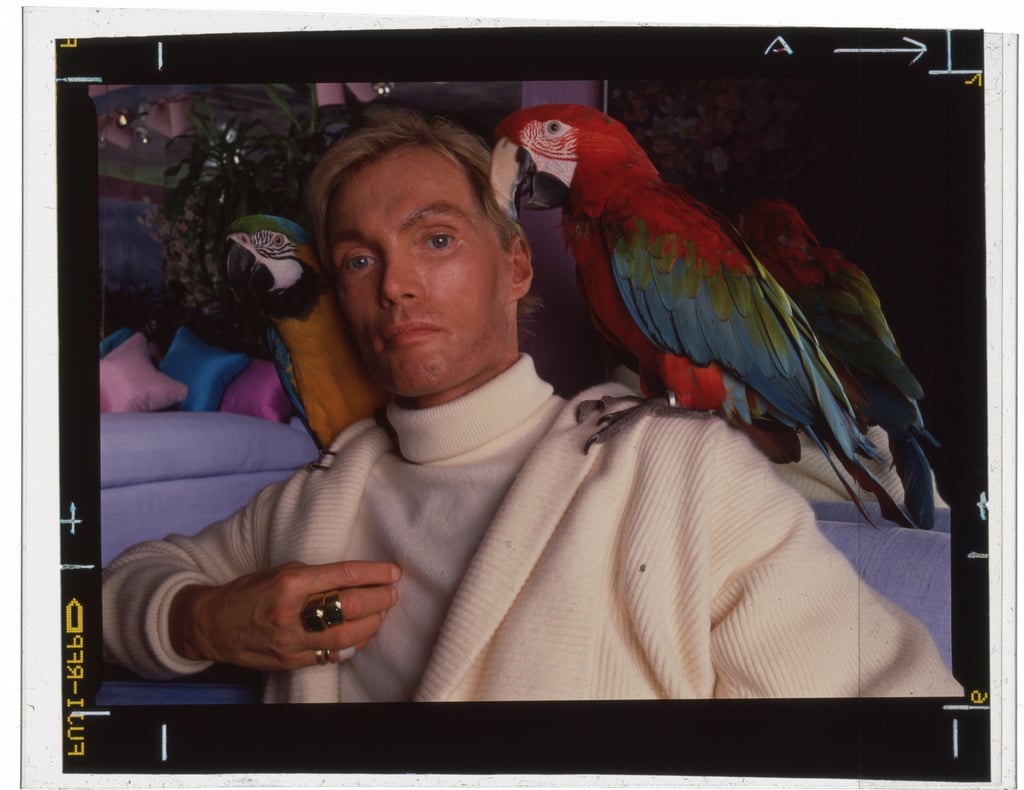
One summer when Hoyt Richards was 16, his family took their annual trip to Nantucket, where he spent long, unplanned days on Nobadeer Beach. It was there, on the pale sand, that Richards first met Frederick von Mierers: older, lean, striking, and inquisitive, he talked about Eastern philosophy, astrology, and the hidden architecture of the universe. Von Mierers hosted parties nearby almost every night, and young Richards would show up for the free beer, confident he was the one getting away with it. But he left feeling like someone was paying attention—the very vulnerability von Mierers would eventually exploit.
Over the next two decades, von Mierers enmeshed Richards in one of the most incredible and revealing cult stories of the late 20th century. A self-proclaimed prophet who claimed to have come to Earth from the distant star Arcturus, von Mierers recruited models, young professionals, and New York socialites into a group he called "The Eternal Values," attracting them with charisma, flattery, and the promise of spiritual destiny, then retaining them through psychological pressure, public humiliation, and ever-increasing demands for total loyalty. Richards, meanwhile, became one of the most photographed male models of his generation, appearing in advertising campaigns for Versace, Valentino, and Ralph Lauren, as well as working with Richard Avedon and Helmut Newton. He also donated millions of dollars of his earnings and nearly 20 years of his life to the group.
Vanity Fair magazine revealed this story in 1990 in his exhaustive article about the band Eternal Values. Von Mierers died of AIDS-related complications a few days before the article's publication, never fully realizing what the revelation would mean. The band moved and gradually disbanded; Richards left for good in 1999.
Now documentary filmmaker Chris Smith is bringing the story to HBO in a three-part documentary. «"Bring me the beauties"» , premiering June 1st, Richards' story forms the basis of the series, which traces the Eternals from their glittering Manhattan origins to their disintegration in a North Carolina farmhouse, and asks a question that transcends the cult itself: How can a person control their own mind without realizing it?
The series draws on archival footage, new interviews with former members, and extensive conversations with Richards to paint a portrait of von Mierers' influence on his followers and Richards's long, tentative struggle to understand his own role in it. He was simultaneously one of the era's most visible figures and one of its most invisible hostages: a man who spent his working hours in front of cameras around the world and his personal hours sleeping on a mat on the floor of a cult apartment, convincing himself that these two lives constituted a single whole.
«"His family had an extensive archive of information about his childhood," Smith says. "It's impossible to imagine a more ideal, idyllic American family. And nothing in it indicated that this man would have ended up in such a group.".
The Prophet in Brooks Brothers
Hoyt Richards pictured in "Bring Me the Beautiful Women" — courtesy of HBO.
Von Mierers began working with Richards long before Richards even realized he was involved. Summers on Nantucket were followed by years of study at Princeton and a closer proximity to New York City, where Von Mierers rented an apartment and moved easily into the city's social scene. In the documentary series, Richards describes him as "a Brooks Brothers version of a guru": stylish, sophisticated, and demanding of his followers' dress and manners. Parties became better; access became easier. By the time Richards graduated in 1985 and his modeling career began to gain momentum, the relationship had evolved from mentorship to something more difficult to describe.
Von Mirers told his followers that they had come to Earth from Arcturus—a star in the constellation Bootes, located approximately 37 light-years from the Sun—which he considered the spiritual center of the universe. Destiny had chosen them, he said, to prepare humanity for a coming planetary catastrophe. The pole shift would occur by 1999. The "Eternal Values" would survive it; everyone else, for the most part, would not. Deep in the Smoky Mountains of North Carolina, he had already identified a location where alien spacecraft would one day land to conduct his group through rejuvenation chamber testing.
On paper, this belief system seems simple and easily criticized. But Richards says that wasn't the case for him. "I joined a spiritual movement that I thought would be amazing," he tells TIME. "It just took me 20 years to realize it wasn't what it really was.".
Richards now describes, with the clarity he honed over decades, the process of gradual submission. The group encouraged mindfulness and emotional discipline, condemned alcohol and drug use, and demanded celibacy in its early years. Its social world brought people together and kept them close. Members constantly monitored each other. When someone broke the rules—or when von Mierers decided they had—he would inflict what the group called "punishment sessions": hours of yelling, humiliation, and public reprimands. Von Mierers viewed these sessions as spiritual correction. Richards now understands them as mechanisms of control.
«"Looking back, I felt like I was in a mental prison," Richards says. "But at the time, I didn't see it as a prison. I saw it as the foundation for my life." He, as he now puts it, "financed and built the prison" he found himself in.
The man behind the lens
Still from the documentary series, courtesy of HBO.
Smith came to this story the same way many of the best documentary subjects find their directors: by accident. He was interviewing Richards for another project when he started talking, and the questions kept coming as the story unfolded. It took four or five days of filming before Smith felt he had what he needed.
The result is a documentary series that, above all, seeks to make Richards' experience relatable—to place a familiar, utterly relatable man at the center of a story that many believe can never touch them.
«"Sometimes when you read stories about cults, you don't see much in common between yourself and the people who were in them," says Smith. "Hoyt speaks so well, fits the situation so seamlessly. He's nothing like what we imagine a cult member to be. It changes everything. You suddenly realize something like this could happen to anyone.".
Part of the reason it worked was that when von Mierers found him, Richards wasn't visibly traumatized or gullible. He came from a comfortable, well-off family—six children, summers on Nantucket, Princeton on the horizon—and he was athletic and easygoing. By any conventional measure, there wasn't an obvious opportunity. But he was 16, yearning for something more, and von Mierers offered him a place where he could feel like he belonged.
At the peak of his modeling career, flying transatlantically and staying in five-star hotels, Richards returned to New York and slept on a mattress on the floor of a cult apartment, seeing no contradiction in it. He secretly attributed every success he had on the runway to the group, convinced it was the result of their spiritual work. This belief made him feel like he belonged to the cult not as a constraint, but as a secret advantage. "I became my own worst enemy because I was so in love with the story," he says.
When the world didn't end
Undated photo of Hoyt Richards - Courtesy of HBO.
Von Mirers died in February 1990. A few days later, the article was published in Vanity Fair , which introduced the band Eternal Values to the public under conditions von Mierers was unable to challenge. The band continued its activities, moving to North Carolina and abandoning the Eternal Values name in favor of a construction company called the Lotus Group—a thin veneer of normalcy stretched over the same mechanisms.
Von Mierers' death left the group without a clear leader, and when Fritz Diekmann—a television producer and member of Eternal Values—attempted to fill the void, the group split in two. Within six months, Richards's side staged a mutiny, locking Diekmann in his apartment and forcing him to relinquish control. The group then turned on Richards.
By 1999, the apocalypse von Mierers predicted had clearly not arrived. Richards began to secretly doubt the predicted timeline—he traveled to Paris and London for modeling work, looked around, and noticed the absence of a catastrophe. The band's identity simply didn't correspond to reality, and Richards, somewhere under the influence of years of indoctrination, began to realize this.
He was also secretly in a relationship with a woman named Donna. When he finally confessed to the group about the relationship and his doubts, nine weeks of night classes followed, along with low-skilled work and a shaved head that deprived him of any modeling opportunities. His nickname was "Deep Chic." The humiliation hit his self-esteem the hardest: he left not in anger, but in a haze of humble shame, writing a resignation note.
He stayed for a while with his friend and fellow model, Fabio Lanzoni, and gradually began to understand what had happened. It took almost a year and a half before he could accept the possibility that he had completely misinterpreted the events of the previous 20 years. "The main criterion that it couldn't be a cult was that I was a member of it," he says.
Finding my way back
In 2002, Richards' lawyers reached a settlement with the remaining members of the group, liquidating Eternal Values' assets, and the organization effectively ceased to exist. By then, Richards' mother was dying of cancer. He hadn't seen her for 12 years; when he returned, she was wearing a wig due to hair loss from chemotherapy. He became her primary caregiver a few months before her death, and in the remaining time, they reconnected. This reconciliation, as well as subsequent reconciliations with his siblings, marked another stage in his recovery. In some ways, it was the hardest part.
Richards spent 25 years trying to reframe what happened to him, seeing it not as an anomaly but as an extreme version of something far more common. "A cult relationship is any relationship in which you give away your power to someone, usually unconsciously," he says. "They offer flattery, attention, what you perceive as love—and you become addicted to seeking it. Most people will find a way out, but they won't necessarily understand how damaging it is to their self-esteem." Without this awareness, he argues, the pattern repeats itself. He has dedicated his life to making sure people understand this.
In September, Richards will marry Donna, the woman whose existence he once hid from the band for four years. He speaks of "Eternal Values" with the clarity of someone who has transformed two decades of uncertainty into a hard-won understanding, more purposeful than bitter. He answers without hesitation when asked what he would say if he could somehow speak to his younger self, who was first finding his place in "Eternal Values." "It won't be a fun journey, but it will be a journey that will teach you lessons you'll be deeply grateful for," he says. "So just don't give up. Trust that when everything starts to make sense, you'll truly be grateful you went through it.".
In archival footage, von Mierers still possesses a subtle charisma: he commands attention, seeming like the most unique person in the room. The series allows this charisma to linger long enough for viewers to feel its pull before realizing what it ultimately cost its victims. "If you don't know these people exist, you're really vulnerable to them," says Richards. "And if you don't think it can happen to you, you're sitting in the same chair I was sitting in when it happened to me." He once was so sure. This is the true devastating force at the heart of the series. «"Bring me the beauties »: Confidence in one's own safety often hides danger in plain sight.