






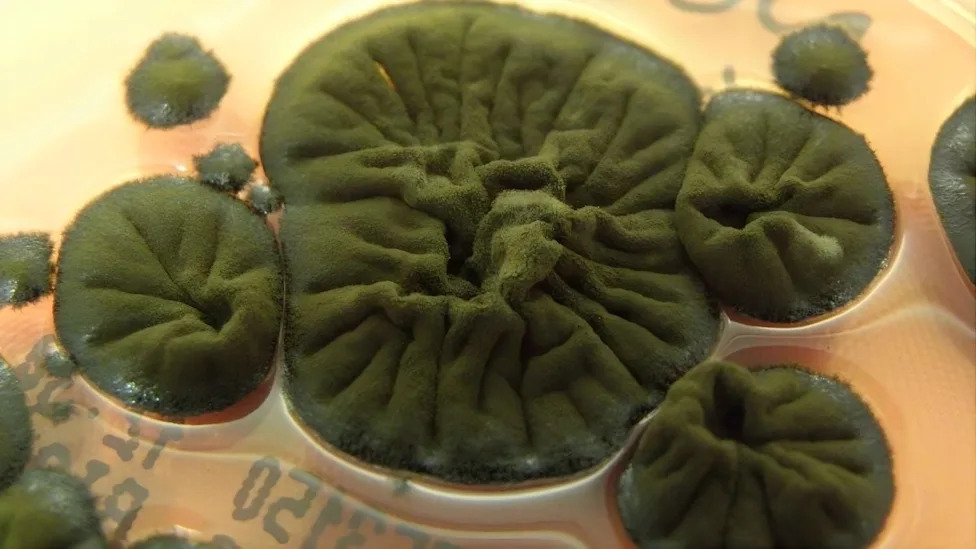
Most organisms avoid radiation. But that's not the case here. Inside the ruins of Reactor No. 4, where a lethal dose accumulates in minutes, researchers discovered dark, melanized fungi that not only survived but apparently thrived in the most radioactive areas. Inside the shelter, they identified thirty-seven species of mushrooms . The darkest and most pigmented of them clustered where radiation levels were highest. This isn't a coincidence. It's a pattern that deserves serious consideration.
What did scientists actually discover?
The available evidence is strange enough without any embellishment.
Field research and laboratory work have allowed us to establish a number of confirmed data:
-
Inside the reactor shelter of the Chernobyl nuclear power plant it was discovered 37 types of mushrooms , while melanized—darkly pigmented—species are disproportionately common in areas with the highest levels of radiation.
-
One of the most common types was Cladosporium sphaerospermum , found on reactor structures in heavily contaminated areas.
-
In their work, published back in 2007, the researchers Ekaterina Dadachova и Arturo Casadevall exposed melanized fungi to ionizing radiation in the laboratory; some of them showed improved growth rather than damage.
-
Wangiella dermatitidis demonstrated a clear increase in growth under the influence of radiation; Cladosporium cladosporioides increased melanin production, but without a similar effect on growth—the responses are species-specific, not universal.
-
In experimental work 2020, the results of which were published as a preprint, mushroom C. sphaerospermum was placed outside the International Space Station; less radiation passed through the mushroom layer than through a control sample, confirming its shielding function.
Melanin may not only protect the fungus but also convert ionizing radiation into useful energy in a process roughly comparable to photosynthesis. This is a hypothesis, not a result.
The idea is intriguing. There's no evidence yet.
Radiosynthesis is a compelling concept, but biochemical evidence to support it has not yet been presented.
The proposed mechanism is called: radiosynthesis . Think of it like solar panels, but instead of collecting sunlight, the input is energy that kills a person in about the time it takes to drink a cup of coffee. Melanin—the same pigment found in human skin—appears to interact differently with ionizing radiation in these fungi. Scientists speculate that it may convert this radiation into metabolic energy, a rough biological parallel to how plants use light.
The problem is the word "possible." According to a critical review of the available literature, no one has demonstrated radiation-dependent carbon fixation, a specific biochemical pathway, or a measurable energy gain from ionizing radiation. The ISS experiment confirmed shielding . He did not confirm the collection of carbon. These are two completely different statements, and it is precisely their conflation that leads to a misinterpretation of science.
What remains remains astonishing. A fungus that thrives in one of Earth's most hostile environments—and could potentially serve as radiation shielding for deep-space missions—is a very real scientific story, without any exaggeration. If radiosynthesis is ever proven, it will rewrite the definition of what counts as a viable energy source. For now, the fungus guards its secrets, quietly growing in the darkness, seeking the source of something that destroys everything else.
From the coolest cars to must-have gadgets, GadgetReview's daily newsletter keeps you in the know. Subscribe - it's fun, fast and free .