








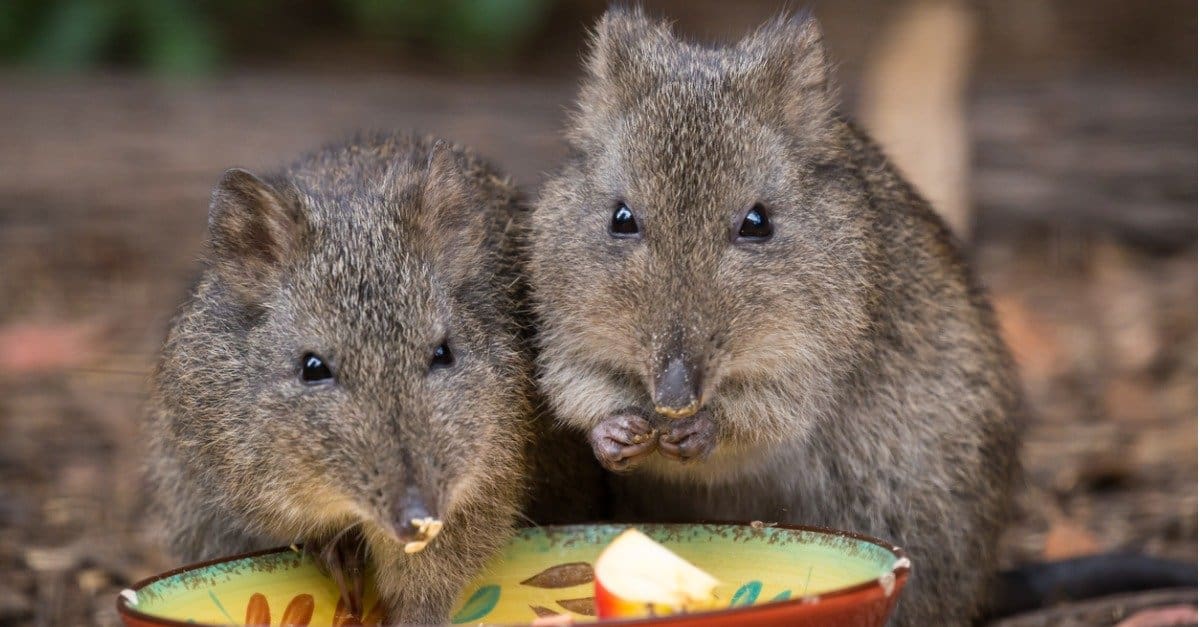
The article "Once thought extinct, Gilbert's potoroo hides survival clues in its poop" first appeared on AZ Animals.
The world's rarest marsupial, once thought extinct, may be getting a second chance at survival thanks to DNA found in its feces. Researchers are searching for clues on how to save the endangered Gilbert's potoroo. (Potorous gilbertii ), studying the DNA in its droppings to learn more about its diet. Currently, only a small population of Gilbert's potoroo exists, living in a single location. Conservationists hope to relocate this marsupial to several locations to increase its population. However, this would require shifting the potoroo's main food source—truffle-like mushrooms.
Gilbert's potoroo is a rabbit-sized marsupial with a long tail and soft fur.
©Mick Wackers, English Wikipedia, CC BY 3.0, via Wikimedia Commons – Original / License
What is Gilbert's Potoroo?
Gilbert's potoroo is one of three species of potoroo found in Australia. The other two species are the long-nosed potoroo ( Potorous tridactylus ) and the long-legged potoroo ( Potorous longipes ). The most widespread of the three species is the long-nosed potoroo, while the long-legged potoroo is listed as vulnerable.
Gilbert's potoroo is a small marsupial, about the size of a rabbit, covered in thick, dark brown fur. Sometimes mistaken for a Quenda, Gilbert's potoroo has much softer fur and longer tails. These nocturnal animals live beneath dense bushes and dig tunnels underground to move undetected by predators. They live in small groups of three to five individuals and feed on mushrooms.
Why is the potoroo population declining?
Only about 150 individuals of this species remain in the world, concentrated in one location: Mount Gardner in the Two Peoples Bay Nature Reserve in Western Australia. The species was discovered in 1840 but was presumed extinct since the early 1900s. At the time, it was reported to be "very common" due to habitat loss and the introduction of red foxes and feral cats to Australia. Since the rediscovery of this small marsupial in 1994, conservation efforts have helped its population increase to its current estimated 150 individuals.