








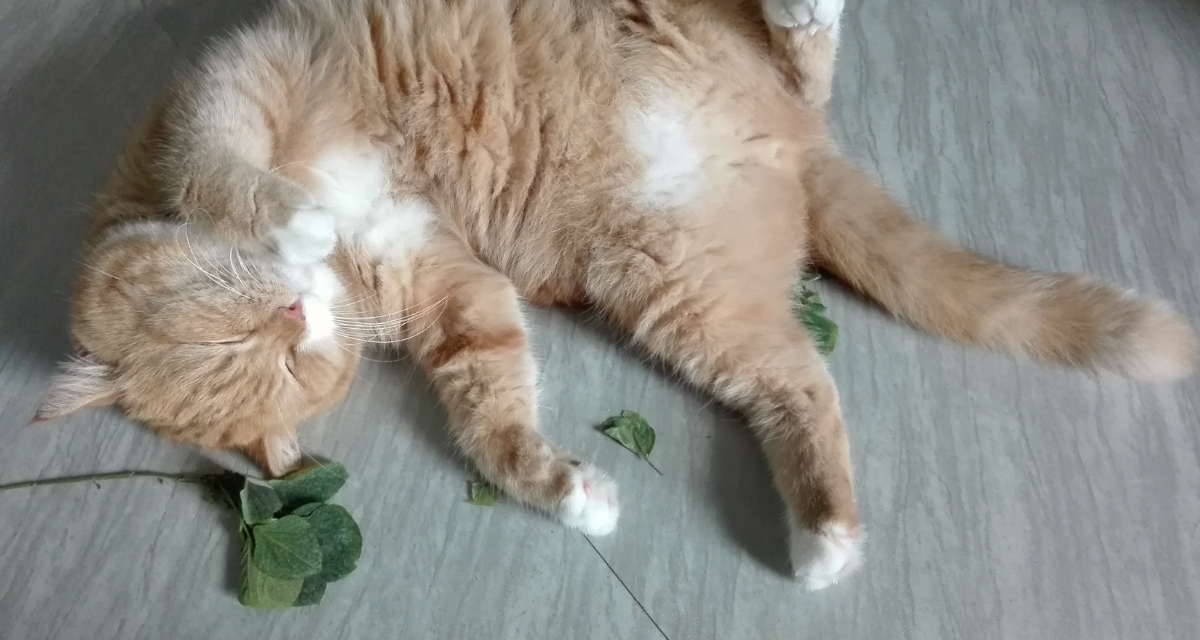
If you want to see your cat act like it's on drugs, give it some catnip (Nepeta cataria ). Dried or fresh catnip leaves have a distinct effect on most cats, causing them to act as if they are in a drugged state.
But why? What is it about catnip that causes such a reaction? And what, if any, function does this plant serve for our feline friends, beyond euphoria?
A chemical compound that makes them feel euphoric.
As explained in a TedEd video by Jaap de Roode, these questions were first explored by Japanese cat behavior expert Masao Miyazaki and chemist Toshio Nishikawa in 2013. Their research teams began studying a plant called silver vine, which elicits a similar reaction in cats.
First, they extracted individual chemical compounds from the plant and dropped them in various combinations onto filter paper. When they brought in cats to observe which compounds attracted the animals, it became clear: the cats overwhelmingly chose the filter paper containing the compound nepatalactol.
The researchers then took blood samples from cats exposed to nepatalactol and found that their bodies were flooded with endorphins—stress-relieving hormones that block pain signals and enhance feelings of happiness. Catnip contains a similar chemical, nepatalactone, which is what causes this characteristic "euphoric state" in cats.
Large cats also respond to the euphoric substance found in catnip.
And this reaction isn't limited to domestic cats. Researchers took treated filter paper to zoos to test it on large cats such as leopards, lynxes, and jaguars. They also "dived face down" into the paper containing the compound nepetalactol. This discovery led the scientists to speculate that there must be an evolutionary reason for this common trait.
Silvervine researchers presented their findings at a conference and received interesting feedback. An evolutionary biologist noted that nepetalactol and nepetalactone are iridoids with insect repellent properties. Is it possible that cats used these plants as a natural insect repellent?
Even large cats react to bites. (Photo: Canva)
What do mosquitoes have to do with catnip?
The researchers' most likely explanation is that cats are attracted to catnip and silver vine specifically because of their repellent effect. The euphoric state causes cats to rub against the plant (as we see in our own cats when they roll around in it). The friction distributes nepetalactone throughout their fur.
«"To test this," the video explains, "the researchers set up mosquito cages into which cats could stick their heads. Indeed, cats treated with nepetalactol suffered fewer mosquito bites than cats in the control group. The same effect was observed in the scientists who voluntarily offered their hands in solidarity with their feline subjects.".
A cat with a mosquito on its nose (Photo: Canva)
The researchers also found that biting, licking and rubbing the plant caused it to release more of the mosquito-repellent substance.
«"So your cat isn't tearing apart catnip packets just to annoy you," the video concludes. "Her evolutionary instincts are simply aimed at gaining even more protection from insects.".
Nature is amazing, isn't it?
The article "Why Does Catnip Make Cats Drunk? Oddly enough, it's probably because of the mosquitoes" first appeared on Upworthy.