








Diversity exists in virtually all natural objects, be it flora or fauna. There are over eight million species in the world, and evolution is the only way to survive. Some bird species clearly demonstrate the importance of evolution and creating better versions of themselves. Their unique characteristics and abilities allow these birds to stand out and stand out from the crowd. Read on to learn about 10 of the most unusual birds with eccentric behaviors and abilities that will amaze you.
1. The lyrebird possesses the most unique sound-imitation abilities in the entire animal kingdom. Thanks to variations in its vocal organs, this bird is capable of imitating absolutely any sound, whether natural or artificial.
Vocal imitation is not uncommon in the bird world, but the lyrebird, a native of southeastern Australia, is certainly unique. This bird is one of the best mimics of all birds and can imitate both artificial and natural sounds. When it comes to vocal imitation, the bird has an incredibly developed vocal system. This allows it to imitate the sounds of other animals and birds, chainsaws, cell phones, people, camera shutters, car engines, alarms, and much more. This unique ability to imitate sounds arose as a result of the evolution of the sound-producing organ, the syringa. While other birds have four pairs of syringeal muscles, the lyrebird has only three. This makes the bird one of the most advanced mimics in the animal kingdom.
Voice imitation is a highly complex task, and it takes chicks only a year to master the art. Thanks to such extraordinary abilities, the AI-powered voice imitation app is also named after our own feathered mimic. (1, 2)
2. The hooded pitohui is the first scientifically documented poisonous bird. Its feathers secrete a neurotoxin called homobatrachotoxin, previously found only in the skin of poisonous tree frogs, and touching them can cause numbness.

Have you ever heard of a bird that causes muscle paralysis due to the toxins it secretes? If not, now's the time to find out. The hooded pitohui is one of the few poisonous birds known to man. Native to New Guinea, this bird belongs to the passerine family. At first glance, the bird looks extremely attractive: a black head and a reddish belly. This species is distinguished by its bright coloring, indicating its aposematism. Experts recommend staying away from this bird and never touching it. This is because the bird produces toxins stored in its feathers. Homobatrachotoxin protects the bird from unwanted prey and serves as an excellent defense mechanism. The main reason for this is the bird's diet, which consists primarily of choresine beetles, which contain toxins.
Homobatrachotoxin can paralyze and kill humans if ingested. The toxin also repels lice from the bird's body. Residents of New Guinea eat poultry despite the toxins. However, before rolling the bird in charcoal and roasting it for a long time, it is necessary to remove the skin and feathers to neutralize the poison. (1, 2)
3. The Black Heron is an unusual species that hunts by foraging in the tree canopies. The bird converts its wings into an umbrella-like structure, creating the illusion of shadows for fish.
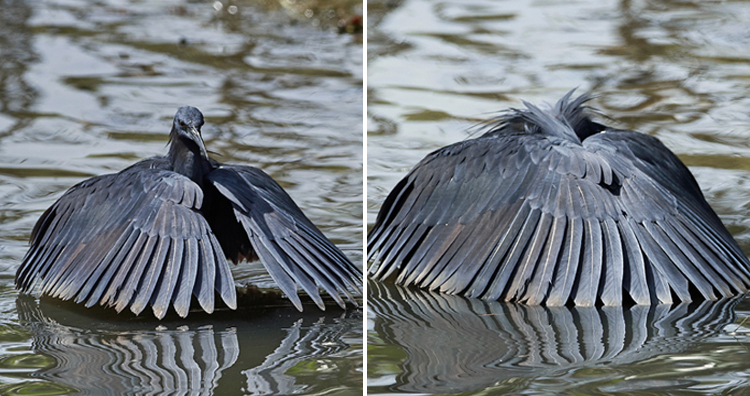
In the animal world class birds Demonstrates diversity in feeding and hunting habits, as well as appearance. One such example of unusual hunting is the black heron's foraging in tree canopies. This bird uses a unique yet effective method to hunt fish in freshwater. By folding its wings into an umbrella shape, the bird creates the illusion of cover. Furthermore, small fish misinterpret the wings and are drawn closer. This is when the bird captures the fish for its prey.
The black heron is a medium-sized bird with yellow legs and black feet. It lives in the Sahara Desert and prefers to catch freshwater fish. When it comes to hunting, the bird typically hunts in groups of ten to twenty individuals. However, solitary hunting is also quite common among black herons. During periods of food shortage, the bird survives by feeding on insects, amphibians, and crustaceans. With such a variety of hunting methods, the black heron is undoubtedly a bizarre and unusual bird. (1, 2)
4. The olivebird navigates using a unique method called echolocation. Besides bats, these birds are the only species to demonstrate such a remarkable navigation tactic.

While most birds navigate visually, some use additional means, such as echolocation. Oilbirds exhibit characteristics similar to bats; they navigate using sonar. These birds, found primarily in northern South America, use this method to avoid collisions with other birds in their group inside the caves where they live. However, when hunting or flying outdoors, they avoid obstacles using this advanced feature. The bird switches to echolocation, especially in low light, whether inside caves or at night. Using shrill calls or clicking sounds at a frequency of approximately 2 kHz, the bird interprets the echoes.
Butterbirds produce sounds that take the form of echoes after encountering objects around them or in their path. The stronger these echoes, the larger the object ahead. These regular spatial calls serve as a means of avoiding collisions with danger and ensure smooth navigation. This characteristic makes butterbirds one of the most unique birds on the planet. Furthermore, the limitations of these birds' echolocation are significantly higher than those of bats. Unlike mammals, butterbirds can only detect objects larger than 20 centimeters using echolocation. (1, 2)
5. The hoatzin emits a strange odor reminiscent of "cow dung." Furthermore, it is believed that this bird is an evolutionary link between reptiles and birds due to the presence of a claw on its wings.

Here's a bird that's believed to be a link between reptiles and avian populations. The hoatzin, or "reptile bird," is native to South America and is an attractive bird with brightly colored wings and a striped body. What distinguishes this bird from others is the presence of talons on its wings. This is what, to some extent, connects it to its evolutionary ancestors—reptiles. There are two talons, located on each wing. As the bird matures, the talons disappear, leaving the adult hoatzin talonless. However, its unique characteristics don't end there.
In addition to their claws, this bird also has a distinctive cow-dung odor. This is a result of differences in diet and body anatomy within the species. The bird feeds on leaves and uses a specialized digestive tract to digest them. Additionally, the bird has a fermentation chamber located in its throat. These chambers are filled with essential bacteria that break down plant matter. As a result, they emit a distinctive odor similar to cow dung. Experts estimate that digestion takes 40 to 50 hours, forcing them to periodically chew undigested food. (1, 2)