








They say "necessity is the mother of invention," and this is especially true when it comes to war and weapons. Throughout history, there have been countless arms races, with one side developing a new weapon and the other frantically searching for a way to neutralize it. This has led to the development of some truly innovative weapons, as well as some so bizarre that they'll leave you shaking your head in amazement. So, in this list, we've compiled 11 of the most unusual weapons ever invented.
1. During World War II, as the Japanese prepared to defend against an Allied invasion, they trained suicide divers. They were armed with bombs attached to bamboo poles. Their mission was to defend Japanese beaches by detonating explosives on the hulls of enemy landing craft flying overhead.

The suicide divers were called "« fukuryu »", meaning "hidden dragon." They were equipped with a diving helmet and wetsuit, and had weights to help them move along the seabed in shallow water. They were expected to remain at depths of 16 to 23 feet, and they were provided with liquid food to help them remain at their post as long as possible.
By the end of the war, the Japanese military had trained 1,200 soldiers. fukuryu , and several of them died during training due to malfunctions. More than 1,000 diving suits were manufactured, and another 8,000 were planned, but the war ended before they were used. Fukuryu were just one of Japan's many suicide aviation methods. Although the pilots -kamikaze well known, they also had suicide boats and suicide torpedoes. (1,2)
2. In ancient wars, burning pigs were used to scare away war elephants.
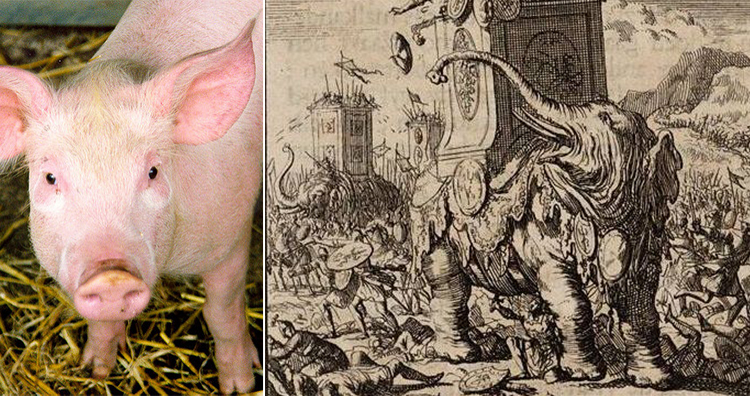
Historical sources claim that Greek and Roman armies used pigs as a countermeasure against enemy war elephants. Pigs were coated in a flammable substance, such as crude oil, then set ablaze and driven toward enemy elephants. The logic behind this tactic was that elephants are frightened by the squealing of pigs. Whether it was the squealing itself or the sight of flaming animals running toward them that frightened them, it worked. During the siege of Megara in 266 BC, the Megarians released flaming pigs, which sent the enemy war elephants fleeing in terror, trampling many of their own soldiers in the process.
Similarly, flaming camels were used to scare off war elephants. The Mongol conqueror Timur successfully used flaming camels at the Battle of Delhi to scare off 120 armored enemy war elephants, and then sacked the city. (1,2)
3. The "sword breaker" is a type of parrying dagger that had deep serrations and jagged teeth along the blade, capable of trapping an opponent's sword.

«A "sword breaker" is a special type of parrying dagger. Parrying daggers were defensive weapons, designed to be held in the weak hand while the user wielded a one-handed sword in their dominant hand. These daggers typically had wide guards to protect the user's hand, as the dagger was used to parry attacks.
The swordbreaker took this idea even further when it was invented around 1600. Its unique design allowed for effective capture of an opponent's blade. However, the swordbreaker was a rare weapon, as it was difficult to manufacture. There is debate as to whether this weapon was capable of breaking swords, as its name suggests, as swords were typically designed to withstand greater force. However, some scholars argue that the small swords and rapiers used in the late Renaissance were not as durable as earlier swords and sometimes broke. (source)
4. The Progvev-T is a Soviet tank equipped with a MiG-15 jet engine mounted on its turret. It was designed to clear mines from roads by exposing them to thermal radiation.

«The Progvev-T had an innovative design, but it also had its drawbacks. For example, the jet engine consumed a huge amount of fuel. Another problem was the large fuel tank and high noise levels, making it an easy target. Finally, there was no guarantee that the jet engine would be able to neutralize all the mines on the road.
The tank was later modified and fitted with two MiG-21 engines, after which it was used to extinguish oil well fires. It reportedly proved more effective in this role. (source)
5. The "Archimedes' Claw," also known as the "shaking ship," was a crane-like machine with a grappling hook at the end. Historians believe the ancient Greeks used it to defend their cities by lifting enemy ships and smashing them against rocks or causing them to capsize.
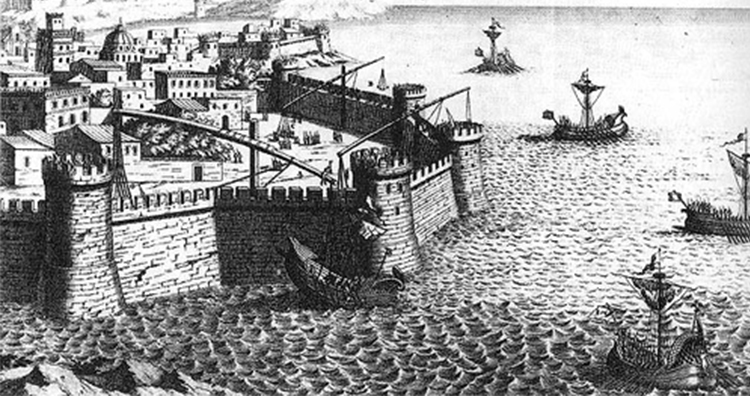
In 213 BC, the Romans attacked the Greek city-state of Syracuse with a large force. One of the weapons the Greeks used to repel the attack was the "Claw of Archimedes." As the enemy ships approached the sea wall of Syracuse, the Greeks deployed several of these "Claws." Ancient historians described them as enormous beams that could be thrown over the walls and tipped with a claw or grappling hook capable of grabbing a ship, lifting it, rocking it, and either throwing it into the water, where it would capsize, or hurling it against the rocks and cliffs beneath the city walls.
To describe what the Claw looked like in action, the ancient biographer Plutarch wrote: «Often a terrifying sight could be seen: a ship would be lifted out of the water into the air and, while it was hanging, would spin around until all the people were shaken out of the hold and thrown in all directions, after which it would fall empty with a roar onto the walls.». (1,2)
6. The Davy Crockett weapon system was a weapon that fired a nuclear warhead. It was adopted by the United States during the Cold War. The primary purpose of this weapon was to create a deadly radioactive zone.

The Davy Crockett pistol could be fired from a tripod or mounted on a jeep. It was intended to be used as a defensive weapon in the event of war in Europe or Korea. During testing, the Davy Crockett demonstrated poor accuracy, which is one of the reasons why its primary effect was radiation.
After firing, the enemy would be forced to either retreat or pass through a radioactive dead zone. Within 500 feet of the warhead's detonation, radiation levels would be so high that exposure would be almost instantaneous. At a distance of up to a quarter mile, radiation levels would remain lethal, but it would take days for the exposed soldiers to die. The Davy Crockett launcher had a maximum range of 1.25 or 2.5 miles, depending on the model. It had a timed detonation system that could be set to one second. This gave a detonation range of 1,000 feet—close enough that the soldier firing it would be at risk from radiation.
Proponents of this weapon argued that it would save resources by replacing troops and equipment needed for more traditional defenses. However, critics pointed out that this plan would leave no choice but to resort to nuclear weapons in the event of war. Beginning in 1956, the United States produced over 2,000 Davy Crockett missiles. They served in the US Army from 1961 until their decommissioning in 1971. (1,2)
7. During World War II, the Japanese attached bombs to hydrogen balloons and launched them to be carried by the wind across the Pacific Ocean to North America.

These flying bombs were called "balloon bombs" or "fireballs." Since it was impossible to accurately predict where they would land, the weapon's primary purpose was to spread fear in the United States rather than to hit high-value targets. The idea came to the Japanese military after researchers, using balloons to map air currents around Japan, discovered a powerful jet stream flowing over the Pacific Ocean at an altitude of 30,000 feet. Experts say it likely took the balloons 30 to 60 hours to cross the ocean.
In total, the Japanese launched over 9,000 balloon bombs during the war, and they estimate that approximately 101,000 of them reached North America. About 300 of these were detected or observed in flight over US territory, and experts believe that many more reached North America but fell in uninhabited areas. The balloon bombings resulted in six deaths and minor damage.
This was the first time in history that a weapon had reached intercontinental range. When the first balloons landed in North America, no one knew where they came from. So the military brought in geologists, who were able to identify the sand used in the balloons' ballast bags. (1,2)
8. The urumi is a flexible sword originating from the Indian subcontinent. It is known as one of the most difficult weapons to master, as it exposes the user to a high risk of injury.

Like other "soft" weapons, such as flails and chain whips, the urumi has the advantage of being very difficult to block. However, the urumi differs in that instead of a chain, it consists of a flat, sharp blade.
Users must learn to follow and control the blade's movements, harnessing centrifugal force. This weapon is so difficult to wield that it is always taught last in Indian martial arts. Techniques used with the urumi include long-range spins, which are well suited for engaging multiple opponents simultaneously.
As if wielding a single long, flexible blade weren't enough, multiple blades are often attached to a single hilt. In fact, the Sri Lankan version of the sword can have up to 32 blades, and users typically hold one blade in each hand. (source)
9. Sodegarami is a non-lethal weapon used by police in Japan during the Edo period (1603-1868). The name translates as "entangling sleeve," as the weapon was used to hook the sleeves of a criminal's kimono to pin them to the ground and immobilize them.

After the unification of Japan in 1603, a centralized government and police force were formed. Previously, various military and civilian groups in Japan were responsible for self-defense. Samurai, who defended Japan from foreign enemies, were recruited into the police force, where they maintained civil order. Criminal suspects were to be captured alive whenever possible, and this is where the sodegarami emerged.
The sodegarami device was cleverly designed to entangle the suspect's kimono and keep them under control. It featured numerous jagged prongs pointing forward and backward, as well as spikes along the pole to prevent the suspect from grabbing it.
It was one of three weapons that made up the torimono sandogu (three weapons of arrest). The other two were the T-shaped tsukubo (push lever) and the sasumata (spear-shaped fork), designed to grab a suspect by the neck or limb and pin them to a wall or the ground. (1,2,3)
10. The US Department of Homeland Security has developed an "LED immobilizer"—a flashlight capable of immobilizing a person by causing disorientation, temporary blindness, and nausea. It's been nicknamed the "vomit light." The flashlight emits rapid pulses of bright light in various colors, causing a disorienting effect.

By constantly changing colors and pulses of light, the device leaves no time for the eyes and brain to adjust. This can reportedly cause increased intracranial pressure, leading to headaches, disorientation, nausea, and visual impairment. A press release from the Department of Homeland Security states that this disorienting flashlight could be issued to police, border patrol, and National Guard personnel. A prototype has been developed, and work is underway to reduce its size.
Although the LED device that disables people is called an "anti-vomit light," the developer claims that no one vomited during testing, and that nausea is a minor side effect. The primary side effect is disorientation and temporary blindness.
This disorientation-inducing flashlight uses a rangefinder to determine the distance to the target's eyes, then automatically adjusts brightness to prevent permanent damage. The flashlight is also specifically designed to prevent epileptic seizures. People with photosensitive epilepsy only react to flashing lights with a pulse frequency below 25 Hz, so this LED disorientation flashlight operates above this threshold.
There are many similar weapons that use light or lasers to temporarily blind a target, and they are collectively referred to as "dazzlers." For example, the US Army is currently developing a weapon that is a cross between a laser and a sniper rifle. It's called the PHASR (Personnel Halting and Stimulation Response Rifle) and will be able to temporarily blind people at long distances. (1,2,3,4)