








While it's not uncommon for films to influence our lives in countless ways, sometimes the opposite is true. Real people have lived such compelling lives that they've inspired films on a wide range of topics.
Here is an interesting list of people whose lives were so eventful and full of ups and downs that they even had films made about them.
1. Henry Hill Jr. – «Goodfellas» (1990)

Henry Hill Jr., associated with one of New York's largest crime families, was a mobster turned FBI informant who orchestrated the Air France heist, the Lufthansa plane hijacking, fixed basketball games, trafficked drugs, and then had several powerful gangsters arrested.
In the film by Martin Scorsese «Goodfellas» Ray Liotta plays Henry Hill, a gangster in the Lucchese crime family, one of the most dangerous in New York City. When Hill was just 11 years old, he was looking for a part-time job after school to earn some money. That's when he began running errands for a convenience store owned by Paul Vario, a capo in the Lucchese crime family. At 13, he met James Burke, a notorious car thief who worked for the same crime family. Burke generously tipped Hill for serving drinks and sandwiches during card games, much to Hill's surprise.
Eventually, his connection to the crime family deepened. In 1967, Hill committed a robbery, duplicating keys to an Air France cargo hold, taking advantage of a security guard's penchant for women. He stole money estimated at approximately three million dollars today. He later committed the Lufthansa robbery at John F. Kennedy International Airport, stealing approximately $22 million (in today's dollars), as well as jewelry. It was one of the largest cash heists ever committed and one of the longest-investigated crimes. He was a wholesale dealer in drugs such as cocaine, heroin, and marijuana, for which he was arrested on drug trafficking charges in 1980.
After his arrest, to avoid conviction and life imprisonment, he testified against his colleagues and became an FBI informant. Thanks to him, more than 50 convictions were secured, including those of Vario and Burke. (source)
2. Homer Hickam – October sky (1999)
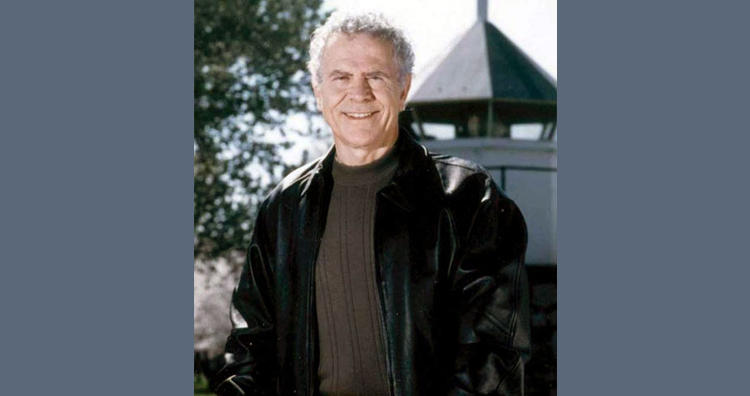
Growing up in a family where the ultimate goal after graduating from college was to work in the coal mines, Homer Hickam not only defied tradition but also became an engineer at NASA. He trained astronauts for the Hubble Space Telescope deployment mission and is also a writer.
Homer Hickam, who grew up in Coalwood, West Virginia, wanted something different. After six years in the U.S. Army, he turned to writing. Beginning with accounts of his scuba diving adventures, he moved on to stories of his wartime experiences. His second autobiography, «Rocket Boys: A Memoir» was filmed under the title «October Sky. The book tells about his life in Coalwood and experiments in launching rockets into the sky. Title «October Sky» - this is an anagram of the name «Rocket Boys.
Hickam continued to work at NASA as an aerospace engineer. Throughout his career, he worked on spacecraft design and crew training. He specialized in preparing astronauts for various Spacelab and Space Shuttle missions, including extravehicular activities and scientific payloads. In 1984, after being decorated for rescuing passengers from a sunken steamship in the Tennessee River, Hickam was honored by the United States Olympic Committee, who asked him to carry the Olympic torch through Huntsville, Alabama. Hickam's story, about making a dream come true through dedicated work, was made into a film. «October Sky» was loved by audiences after its release in 1999. (source)
3. Frank Abagnale – «Catch me if you can » (2002)
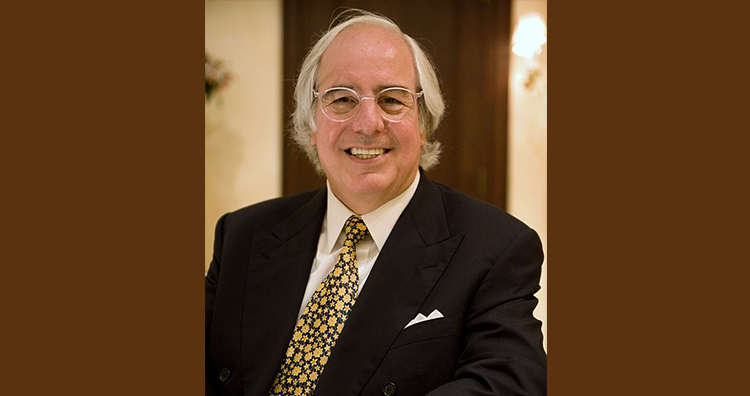
The son of a stationery store owner, Frank Abagnale posed as various professionals and forged checks and credit cards around the world. At the age of 21, he was arrested by French police and subsequently hired by the FBI as a consultant.
Leonardo DiCaprio's famous film "« Catch me if you can"» Based on the life of real-life con artist Frank Abagnale Jr., who later trained several financial institutions and government agencies in fraud detection techniques. As a young man, Abagnale suffered the intense pain of his mother's death. He lived with his father, to whom he was very close, and often accompanied him on business trips, where he learned the intricacies of economic fraud.
As a teenager, he started with petty crimes like shoplifting, but when he grew bored, he got involved in several small-time scams, eventually getting sent to a school for troubled boys. At 16, he ran away from home. He forged his driver's license to add 10 years to his age and also concocted elaborate lies about his education. But even then, he wasn't satisfied with his earnings. He wrote several bad checks for himself and overdrawn his account by thousands of dollars. He then posed as a Pan Am pilot, creating a fake ID, and wrote even more bad checks. When the police uncovered this scheme, he changed his identity and became a doctor. After cashing $2.5 million in bad checks, he decided to settle in France.
An ex-girlfriend recognized his face on a wanted poster and turned him in to the police. He served time in prisons in France, Sweden, and the United States. While in the United States, he struck a deal with the government: in exchange for his freedom, he would teach them his methods to prevent future fraud. For 30 years, he worked for the FBI as one of the world's foremost experts on fraud, embezzlement, and other similar crimes. He eventually founded his own firm, Abagnale & Associates, with the same goal in mind. (source)
4. Christopher Johnson McCandless – In the wild (2007)

Immediately after graduating from college, McCandless embarked on a journey from the concrete jungle to the real world. He hitchhiked alone to Alaska and lived in a converted bus until his death, relying on the resources of the wild for survival.
Christopher McCandless, also known as "Alexander Supertramp," was a hitchhiker who traveled across North America and eventually ended up on the Stampede Trail, living in a converted bus near Denali National Park. The Stampede Trail is an old mining road in Alaska, where McCandless planned to live off the wilderness, isolated from the world.
He had 4.5 kilograms of rice, a Remington semiautomatic rifle, several books, including one on plant life, a camera, and some camping gear. He is known to have kept a diary of his experiences, which was later recounted in Jon Krakauer's book, «Into the Wild . He survived 113 days in the wild and then wanted to return to civilization, but was unable to do so because the Teklanika River blocked his path. When he had crossed the river before, the current had been weaker and less swift. He had no choice but to return on foot and wait. He sent out an SOS signal in the hope that someone would pass by and rescue him. His last journal entry, on the 107th day, read: "Beautiful blue berries." He died in the wild, possibly from starvation or poisoning. His decomposing body was found by a hunter on September 6, 1992.
From the book "Into the Wild" »"In 2007, a film of the same name was made, starring Emile Hirsch. . (source)
5. Lionel Logue - «The King's Speech» (2010)
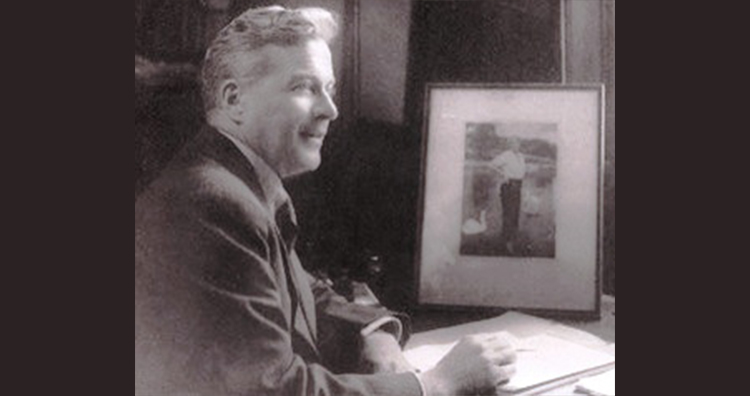
Australian speech therapist Lionel Loughe helped King George VI overcome his stutter. Because of this problem, the king was afraid to speak in public. One of his treatments involved having him repeat various tongue twisters.
Lionel Logue was an Australian speech therapist who once embarked on a round-the-world trip with his wife to study various public speaking techniques. He began his professional career in Perth, where he taught not only public speaking and diction but also acting. He developed treatment methods for Australian soldiers suffering from shell shock and speech impediments as a result of World War I. Two years after traveling to England, he opened a speech therapy practice in central London. Among his many wealthy clients was King George VI, who suffered from a stutter. At the time, George VI was the Duke of York, having not yet ascended the throne.
After being hired by the King in 1926, Loughieu diagnosed the King with a lack of coordination between his larynx and thoracic diaphragm, as well as muscle spasms caused by tension. Loughieu developed an hour-long daily exercise program for the King, and by 1927, the King was able to confidently address the people. Loughieu helped the King rehearse tongue twisters for his important public appearances, such as radio broadcasts during World War II and at the coronation. In 1944, the King awarded Loughieu the title of Commander of the Royal Victorian Order (CVO). They remained friends until the King's death.
Logue's period of life under King George VI is shown in the film «The King's Speech» , which won numerous awards, including an Oscar. The role of Logue was played by actor Geoffrey Rush. (source)
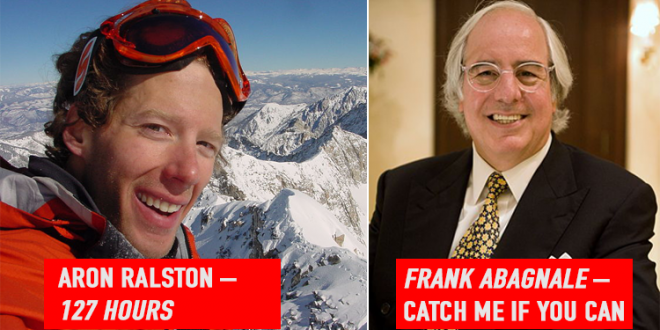
6. Aron Ralston – 127 hours (2010)

At 27, Aron Ralston set out on a solo hike in Utah, with no one knowing his whereabouts. During this adventure, he became trapped under an 800-pound boulder for five and a half days, and was freed after amputating his arm.
On April 26, 2003, Aron Ralston set out on a hike in a remote area of southeastern Utah, unaware of the fate that awaited him there. On Saturday afternoon, at 2:41 PM, Ralston was hiking through Blue John Canyon when, while descending the narrow canyon, he dislodged a hanging boulder, which fell with him. The 800-pound boulder pinned his right arm against the canyon wall, trapping him for over five days with only a liter of water, two burritos, a smattering of other food, and no jacket. On the fifth day, he reportedly drank his own urine to survive.
He had no way to call for help, and when his attempts to move or lift the boulder to free his arm failed, he decided the only way to survive was to amputate it at mid-forearm level. The only tool he had was a dull two-inch knife. He tried using tourniquets several times, but on the fourth day, he realized he couldn't cut the bones. Giving up, he carved his name, birth date, and estimated date of death into the rock and recorded a farewell video message to his family. Waking at dawn, he realized he could free his arm, whose blood supply had already been cut off, by using another tourniquet. He succeeded in amputating the arm, but the struggle wasn't over.
Exhausted by pain and fearing he would bleed to death, Ralston rappelled down the 65-foot wall and then climbed out on foot, where he met a family who helped him. The boulder that trapped Ralston was later moved by 13 men, a hydraulic jack, and a winch. Ralston was played by James Franco in Danny Boyle's film. «127 Hours» , released in 2010. (source)
7. Tony Mendez – Argo (2012)
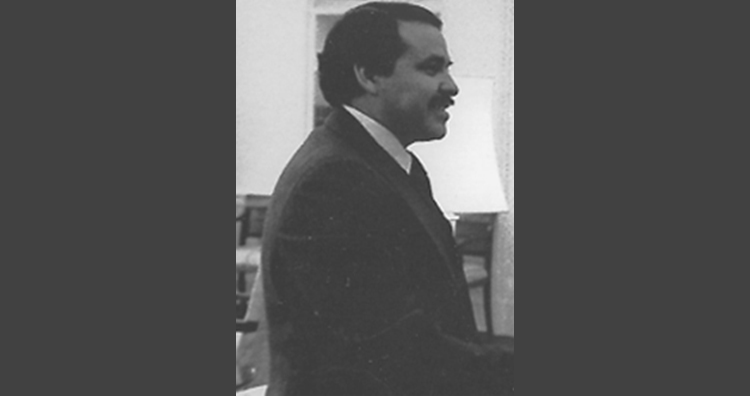
CIA agent Tony Mendez rescued six American diplomats stranded in Iran after the storming of the US embassy in 1979. He used the cover of a group scouting locations for a Hollywood science fiction film, and he succeeded.
Tony Mendez, known for his mastery of disguise, was a CIA agent tasked with rescuing six American diplomats who had escaped during the storming of the US embassy without the Iranian government's knowledge. He had no compelling reason to be in Tehran, so they concocted a bad one. The six Americans and Mendez were to pose as a Canadian location scouting team for a Hollywood sci-fi film. They created a fictitious film production company. Studio 6, and in two days the script for a film called "« "Argo". After this, a lot of media hype was created to make the film look like reality.
After weeks of persuasion from his superiors, Mendez went to Iran without a backup plan, under immense pressure to succeed. On January 25, 1980, he met with the American diplomats, who had been in hiding for 86 days, told them of the plan, and informed them of the film and their new identities. On January 28, they went to the airport with fake passports for a 7 a.m. flight to Zurich. Mendez hoped to arrive at dawn and find tired and sleepy immigration officials who would assist them. And it worked. He returned the Americans safely. Ben Affleck played Tony Mendez in the film. «"Argo" 2012. (source)
8. Jordan Belfort – The Wolf of Wall Street (2014)
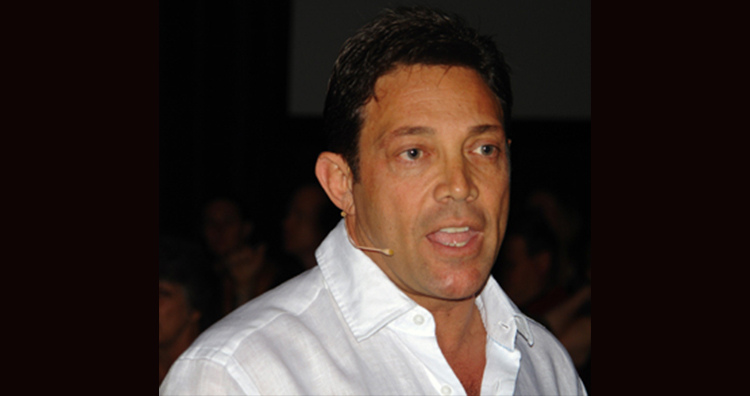
Jordan Belfort was a multimillionaire stockbroker who, while high on drugs, landed a helicopter on his front lawn. His firm embezzled $200 million from investors, landing him and all his colleagues in prison.
Known for his wild lifestyle, Jordan Belfort once sailed his yacht into the Mediterranean during a storm, despite the captain's warnings, and sank it. A former meat peddler turned stockbroker, he hosted dwarf-throwing competitions to entertain his employees. When he wasn't using drugs, he defrauded countless people by trading stocks, for which he was eventually arrested.
He was inspired by Edward Lewis's characters in the film «"Gorgeous"» and Gordon Gekko in "Wall Street" and aspired to similar luxury. He used his first bonus to buy a white Ferrari because he saw Don Johnson driving one. He once made $12 million in just three minutes. He was arrested for penny stock fraud and spent 22 months in prison. His firm, Stratton Oakmont, sold investors penny stocks, which he owned in large quantities, artificially inflating the prices of these shares. He then sold the shares at inflated prices, making a profit for himself, which caused the market price to fall and large financial losses for the investors. Leonardo DiCaprio played Jordan Belfort in in the film "The Wolf of Wall Street"« , released in 2014. (source)
9. Alan Turing – The Imitation Game (2014)

Alan Turing, a mathematical and computer science genius in an era when computer science was still a new concept, cracked the complex, thought-to-be-unbreakable codes created by the German Enigma encryption machine during World War II.
Alan Turing was a brilliant cryptographer who used his knowledge of mathematics and science to break "unbreakable" codes for the British. The Turing machine, a mathematical model of computation using logic, was one of the earliest computer models. He worked at the German Code and Cipher School, which provided top-level intelligence, where he invented several methods to speed up the process of breaking German codes, heading a division of the organization called "Hut 8.".
Turing's contributions to codebreaking are credited with helping the Allies win several battles, such as the Battle of the Atlantic, and ultimately the war. His work is believed to have shortened the war by two years and saved an estimated 14 million lives. He was homosexual at a time when it was illegal in England and was arrested on charges of "gross indecency." Instead of imprisonment, he chose chemical castration. He was posthumously pardoned. Actor Benedict Cumberbatch plays Alan Turing in a film based on his life, titled «The Imitation Game. (source)
10. Captain Chesley Sullenberger – Sally (2016)
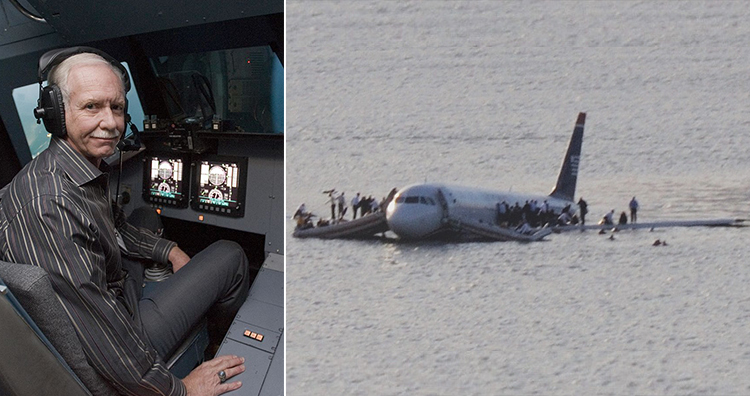
As the commercial jet took off from New York City, a flock of geese struck it, causing engine failure. Miraculously, Captain Sullenberger managed to land the plane in the Hudson River, saving the lives of all 155 people on board.
Captain Chelsea Sullenberger, also known as "Sully," saved the lives of 155 people through his presence of mind and experience. He was captain of US Airways Flight 1549, which took off from LaGuardia Airport in New York City on January 15, 2009. Shortly thereafter, the plane collided with a large flock of birds, causing both engines to fail. Knowing he wouldn't be able to reach the airport in time, he decided to land the plane in the Hudson River.
With zero engine power, he landed the plane safely in the Hudson River, and they were rescued by nearby boats. His composure during the emergency earned him the nickname "Captain Cool," but he suffered from post-traumatic stress disorder after the incident. An investigation into the incident found that Sully's actions were the best option in the situation, and if he had turned around to reach the airport, they would not have taken off. He later wrote a memoir about the incident, titled "« Highest Duty: My Search for What Truly Matters.".
Tom Hanks played Captain Sully in the film «"Sally"» , based on the book. (source)